Can the creator economy survive the AI content flood?
MrBeast’s diversification and ByteDance’s Seedance 2.0 signal a turning point for AI video, creator monetization, and brand strategy.

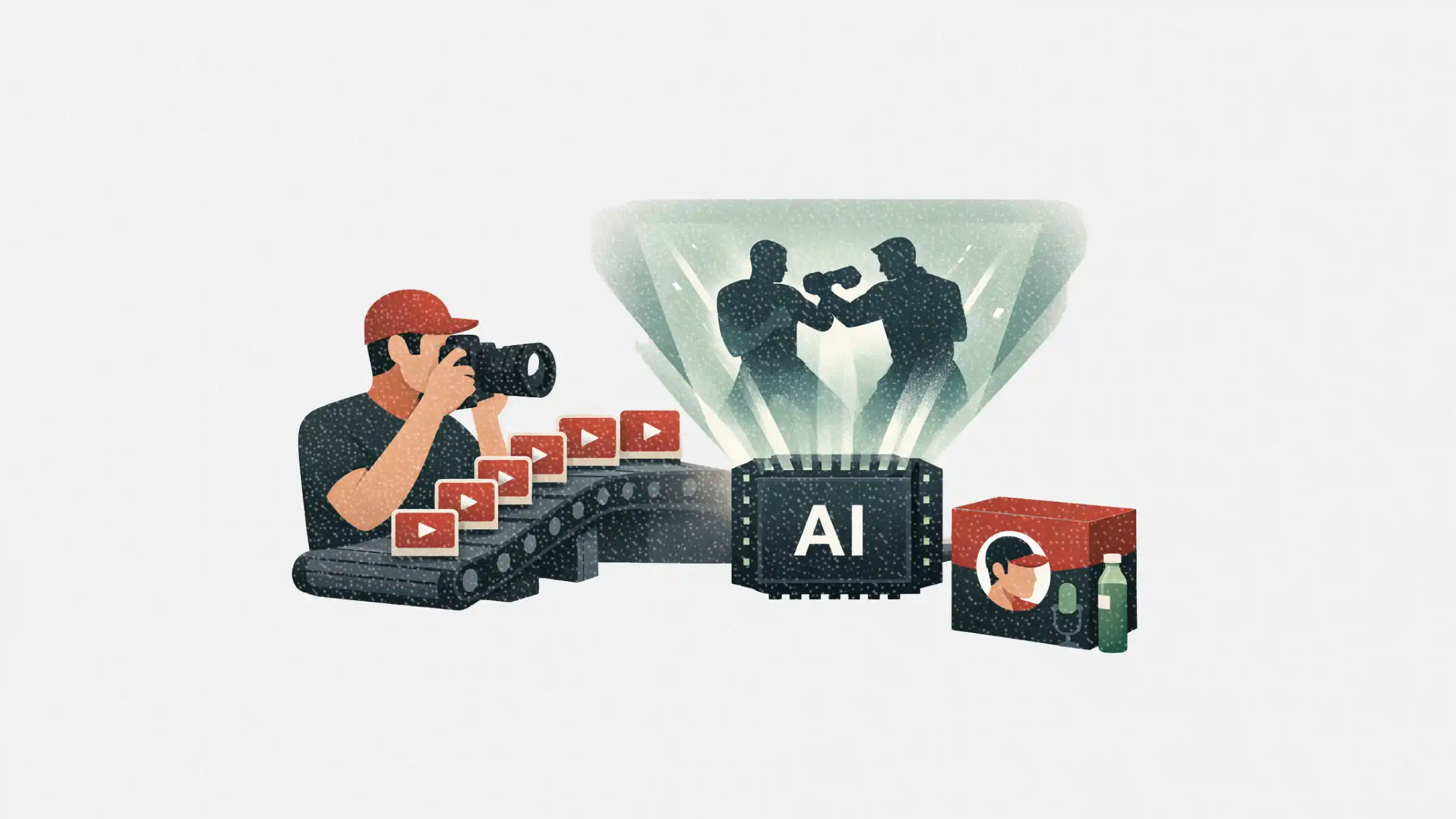
MrBeast buying a fintech startup. Hollywood studios firing off cease-and-desist letters to ByteDance over its new AI video model, Seedance 2.0. And a viral AI-generated clip of Brad Pitt fighting Tom Cruise circulating online.
These are not random headlines. Together, they signal a deeper shift in the creator economy and the AI marketing landscape. As generative AI video tools accelerate and creator business models evolve beyond ad revenue, the big question is no longer whether AI will reshape content. It is whether human creators can still stand out when the internet is flooded with synthetic media.
This article explores a recent discussion on TechCrunch’s Equity podcast, what these developments mean for creators, platforms, and the marketers who depend on both.
Short on time?
Here’s a table of contents for quick access:
- Why MrBeast is diversifying beyond ad revenue
- What Seedance 2.0 reveals about AI video and IP risk
- The coming saturation point for creators
- What marketers should know about AI slop and authenticity
 Patrecia Meliana
Why MrBeast is diversifying beyond ad revenue
Mega-creator MrBeast recently announced that his company is acquiring fintech startup Step. On its own, that sounds like a savvy entrepreneur expanding into financial services.
But the more revealing detail is this: his consumer products business, including a chocolate line, reportedly generated hundreds of millions of dollars in 2024 and was profitable. His media business was not.
If one of the biggest YouTubers in the world cannot rely solely on media economics, that says something about the current state of creator monetization.
Ad revenue saturation is real. CPM volatility, algorithm shifts, and platform dependency make pure content businesses fragile. The new playbook looks more like this:
- Build an audience
- Launch products
- Use content as the distribution engine
In other words, creators are increasingly behaving like vertically integrated brands. For marketers, this blurs the line between influencer, founder, and media company.
What Seedance 2.0 reveals about AI video and IP risk
At the same time, ByteDance launched Seedance 2.0, a new video generation model. AI-generated clips quickly began circulating online, including a viral fight scene featuring Brad Pitt and Tom Cruise.
Hollywood studios responded with cease-and-desist letters, arguing that the model enabled users to generate videos using protected intellectual property and recognizable actors.
ByteDance eventually acknowledged that the model had launched without sufficient guardrails and promised improvements.
This episode highlights two immediate tensions:
- AI video tools are improving fast and lowering the barrier to content production.
- Intellectual property enforcement is struggling to keep pace.
For brands, this raises urgent questions about brand safety, deepfakes, and reputational risk. The ability to generate realistic but synthetic media is no longer theoretical. It is operational.
The coming saturation point for creators
If ad revenue is saturated and AI can generate near-infinite video content, what is the next bottleneck?
One likely outcome is increased competition and fragmentation. As more creators enter the market and AI tools make production easier, standing out becomes harder.
There are a few possible paths forward:
- Productization: creators spin off physical or digital products.
- AI augmentation: creators use digital twins or AI clones to scale output.
- Medium shifts: new platforms or formats create fresh discovery surfaces.
But not every creator can launch a consumer brand. And not every AI-generated experiment will build loyalty.
The more content the internet produces, the more attention becomes the scarce resource. This makes differentiation and trust more valuable than ever.
What marketers should know about AI slop and authenticity
The phrase “AI slop” is already entering mainstream conversation. It refers to the flood of low-effort, mass-produced content generated by AI tools.
For marketers, this creates both opportunity and risk.
Here is how to think about it:
- Authenticity becomes a competitive advantage
As synthetic media increases, real human presence may become a premium signal. Audiences could gravitate toward creators who emphasize transparency and personal connection.
- AI tools can democratize production
Small businesses can now create video ads, product demos, and branded content without large budgets. Used strategically, AI video tools can expand creative testing and lower production costs.
- Brand safety must evolve
Deepfakes and IP misuse can expose brands to legal and reputational risk. Marketers should audit how AI tools are used internally and set clear policies for generative content.
- Discovery will get harder
With more content in the feed, breaking through organically becomes tougher. Diversified distribution, community building, and owned channels will matter more than chasing algorithms.
If you are exploring AI-driven content workflows, you may also want to read our coverage of AI-native marketing platforms and creative automation trends on ContentGrip, including:
- AI marketing tools shaping the next wave of content automation
- How AI video generators are changing creative production
- Platform risk and why marketers must diversify beyond social algorithms
The creator economy is not collapsing. It is recalibrating.
Top creators are evolving into product-driven businesses because media revenue alone is unstable. Meanwhile, AI video tools are expanding access to content production while simultaneously flooding the ecosystem with synthetic media.
For marketers, the takeaway is clear: AI will increase volume, but differentiation will come from strategy, brand clarity, and authentic human connection.
The flood is coming. The brands that survive will not be the loudest, but the most trusted.