Disney Imagineering is using Adobe Firefly Foundry to speed up theme park design
Disney Imagineering will use Adobe Firefly Foundry with custom models to speed concept art and 3D prototyping while keeping IP fidelity.

If you have ever watched Disney fans dissect concept art like it is a trailer drop, you already know the early design phase is part of the magic. People do not just show up for a ride. They show up for a world that feels emotionally “right” in color, character, and details.
That is why Disney is leaning into a very specific kind of generative AI: the kind that is trained on its own visual language, not the open internet. Disney shared details of its collaboration with Adobe in an official announcement, focused on using Adobe Firefly Foundry to accelerate how Walt Disney Imagineering develops and visualizes ideas for Disney Parks and Experiences.
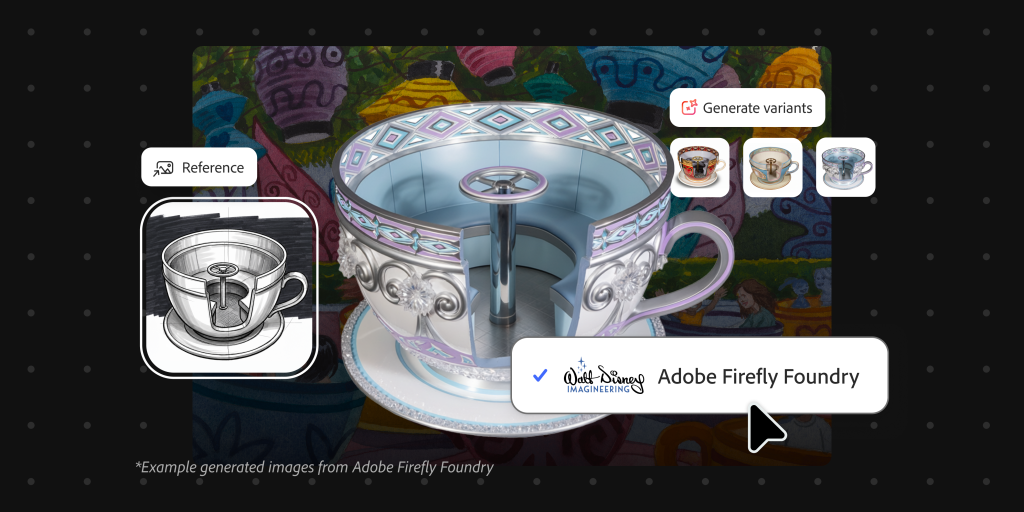
Table of contents
Jump to each section:
- What Adobe Firefly Foundry is doing for Disney Imagineering
- Why Disney is prioritizing brand-safe, franchise-accurate AI
- How the workflow changes: sketch-to-image, custom models, and 3D
- What this means for marketers watching generative AI in entertainment
What Adobe Firefly Foundry is doing for Disney Imagineering
Adobe and Walt Disney Imagineering Research & Development are collaborating to speed up design and pre-production visualization for Disney Parks and Experiences using Adobe Firefly Foundry.
Firefly Foundry is positioned as a way for businesses to create tailored generative AI models that align with their brand assets and guidelines. In Disney’s case, the models are described as being customized on existing Imagineering assets, and built on top of Adobe Firefly models that are framed as “commercially responsible.”
The practical aim is straightforward: shorten the path from early ideas to usable visualizations, while keeping the output consistent with Disney’s established look and feel across franchises and park experiences.
 ContentGrip
Why Disney is prioritizing brand-safe, franchise-accurate AI
For Disney, “good enough” visuals are not neutral. A slightly-off character style, a wrong color palette, or a vibe that does not match a franchise can break trust fast, especially when audiences are used to high craft and continuity.
That is the core argument behind using custom models trained on Imagineering’s own design catalog and licensed or proprietary assets, rather than models trained on scraped internet data. The collaboration positions provenance, IP fidelity, and brand consistency as the point, not a nice-to-have.
This matters beyond theme parks. It reflects a wider shift in how big brands want to use generative AI: not as a general-purpose toy, but as controlled infrastructure that can produce outputs that look like the brand, on purpose, repeatedly.
How the workflow changes: sketch-to-image, custom models, and 3D
The collaboration outlines a few early workflows that show where generative AI can compress time in the visualization pipeline:
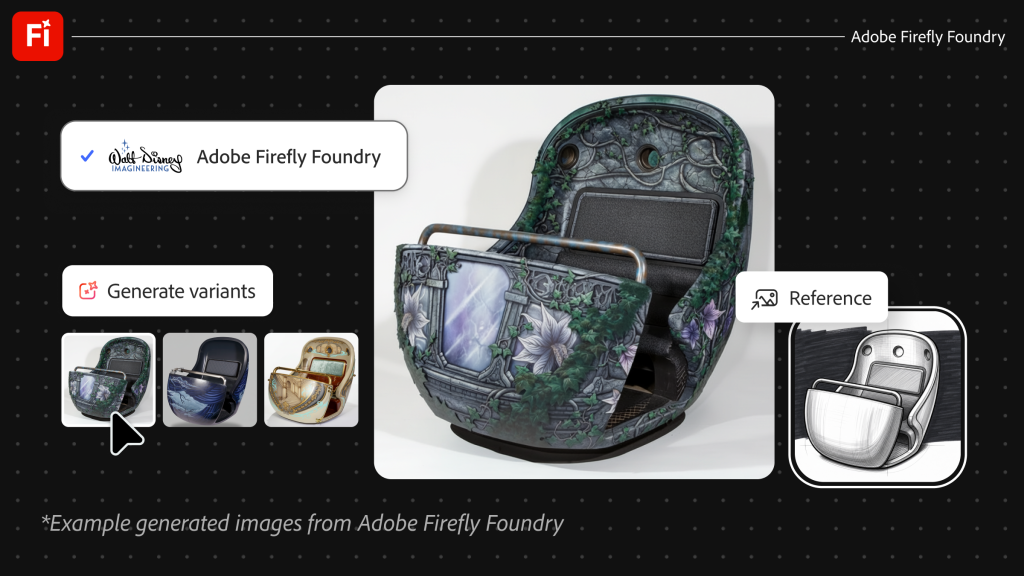
- Sketch-to-image for faster iteration. A model can transform rough, hand-drawn concepts into fully rendered 2D concept art, letting designers explore dozens of directions quickly and refine from there.
- A custom image model tuned to specific franchises. The collaboration describes generating on-brand, franchise-accurate creative assets across properties such as Mickey & Friends, Frozen, Moana, Lilo & Stitch, and Cars, with the goal of speeding up concept and design phases.
- Turning 2D concepts into 3D prototypes. A 3D modeling capability is described as translating 2D renderings into detailed 3D prototypes so teams can plan builds, estimate materials, and coordinate with engineering earlier, before physical construction begins.
Taken together, this is less about replacing designers and more about giving them more “drafts” to react to, faster, while keeping outputs anchored to a controlled design system.
What this means for marketers watching generative AI in entertainment
This is a Tier 2 signal because it shows how a major entertainment brand is operationalizing generative AI around IP safety, consistency, and production speed, not just novelty.
- “Brand voice” is becoming a model-training problem.
Disney is treating brand consistency like something you can encode into custom models. For marketers, this points toward a future where brand governance includes model governance. - Licensed assets and provenance are moving to the center of AI strategy.
The emphasis on licensed and proprietary inputs highlights a practical reality: large brands will push for defensible, auditable creative pipelines before scaling genAI use. - Generative AI’s biggest impact may be pre-production, not final assets.
The described value is in iteration and visualization: sketch-to-image, concepting variations, and early 3D prototyping. Marketing teams should watch pre-production workflows as the first place AI becomes “normal.” - Consistency at scale is the real promise, not speed alone.
Speed matters, but the collaboration frames “franchise-accurate” and “on-brand” as equally important. That is a useful filter for evaluating AI vendors: can they maintain standards across volume? - Creative teams will judge AI by how well it fits existing tools.
The collaboration highlights working “directly within the Adobe tools and workflows” teams already use. Adoption is less about new dashboards and more about whether AI shows up where work already happens.
Zooming out, this is a clear example of genAI maturing from internet spectacle into enterprise craft infrastructure. The more a brand’s value is tied to trust, IP, and emotional consistency, the more “custom and controlled” becomes the default stance.
It also hints at the next competitive layer in marketing and entertainment tooling: not who can generate the most images, but who can generate the right images, with the right permissions, in the right style, every time.