
Domino’s bets on dark comedy and portability to sell its new “Domino” pizza
Domino’s is marketing its one-person “Domino” pizza with dark comedy ads and a promo that swaps competitor receipts for free pizza, up to $1M.


Domino’s is trying to make pizza feel less like a group decision and more like a grab-and-go fast-food staple, with its new single-serve Detroit-style item called the Domino. The company framed the product as an answer to a very real modern-meal problem: nobody wants to negotiate toppings anymore.
The details were outlined in the company’s official announcement, alongside a promotion that dares customers to judge whether this pizza can sit next to iconic items like the Big Mac and Whopper.
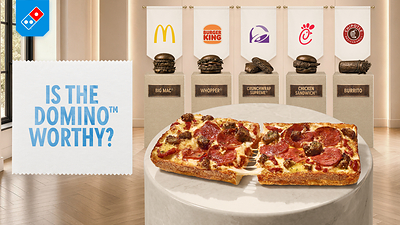
Table of contents
Jump to each section:
- What Domino’s is launching and how it’s being positioned
- Why the campaign’s “pizza can’t” idea is meant to break through
- How “Is the Domino Worthy?” uses receipts to manufacture a comparison set
- What this means for marketers
What Domino’s is launching and how it’s being positioned
The Domino is a rectangular, Detroit-style personal pizza designed “for one,” with customization built into the pitch. Domino’s is explicitly positioning it as a way to expand pizza into more dayparts and more situations where traditional pizza can feel awkward, messy, or too share-oriented.
In the company’s product description, the Domino is made with a “premium, buttery-flavored pan dough” with Parmesan cheese baked into the crust, topped with two layers of cheese, a choice of sauce and up to three toppings, finished with a garlic seasoning drizzle, and cut into two slices.
This is not a subtle positioning move. Domino’s is effectively saying: this is a pizza you can treat like a signature fast-food order, rather than a compromise meal for a group.
Why the campaign’s “pizza can’t” idea is meant to break through
Domino’s launched the “Pizza Can’t. The Domino Can” campaign with a 60-second hero spot built around exaggerated, darkly comedic failures of “regular pizza” in specific moments: eating in the car, rock climbing, gaming, and family topping negotiation spiraling into chaos. The point is less about literal use cases and more about making “traditional pizza” feel limited, then letting the Domino arrive as the fix.
The media plan signals Domino’s wants broad, mainstream attention, not just performance reach. The ad is set to run during the 2026 NFL international season opener on Netflix on Sept. 10 and during the Emmys on Sept. 14, with additional cutdowns (three 30-second versions tied to specific scenarios and a 15-second product-focused ad) running across linear, Netflix live spots, online video, connected TV, and paid digital and social.
There is also a physical-world component in New York, including high-impact out-of-home placements at the Nasdaq market site and other locations, plus limited-edition tote bags meant to carry the Domino during New York Fashion Week.
How “Is the Domino Worthy?” uses receipts to manufacture a comparison set
Domino’s “Is the Domino Worthy?” promotion turns competitor receipts into a marketing mechanic. Customers can buy an iconic fast-food item (including a Big Mac, Whopper, Crunchwrap Supreme, Chick-fil-A chicken sandwich, or a Chipotle burrito) and upload their receipt to a microsite to receive an offer code for a free Domino, while supplies last.
Domino’s said it plans to give away up to $1 million worth of the product through the effort. The promotion is structured as a direct attempt to place the Domino in the same mental category as “beloved, known and iconic” fast-food items that are “craveable, portable and memorable,” while pushing customers to perform the comparison themselves.
This also functions as a behavior nudge: if someone is already in the habit of buying a single-item “main character” order at a fast-food chain, Domino’s is trying to make a one-person pizza feel equally normal.
What this means for marketers
Domino’s is using product design, media placement, and a receipt-driven promo to ask consumers to rethink what counts as a fast-food “icon.” A few lessons stand out.
- Positioning can be a category rewrite, not just a product message
Instead of competing with other pizzas on flavor or price, Domino’s is competing with the entire idea of a portable, single-serve signature order. - Polarization is being treated as a feature of reach advertising
The campaign leans into dark comedy and extreme scenarios to earn attention in fragmented media environments, rather than trying to stay universally agreeable. - Promotions can create the comparison you want consumers to make
Requiring (or encouraging) competitor purchase behavior to trigger the free Domino code is a way to manufacture a direct “head-to-head” moment in the customer’s mind. - Big-stage programming is still being used to legitimize a product bet
Running spots during Netflix’s NFL game and the Emmys signals that Domino’s is aiming for mass awareness and cultural conversation, not just targeted conversion.
The larger signal here is that “convenience” marketing is drifting away from pure speed and price, and toward the feeling that a product fits modern life without negotiation. Domino’s is effectively saying personalization is not a premium feature anymore; it is the baseline expectation.
If this lands, it gives Domino’s a new way to talk about pizza in moments where burgers and burritos traditionally win by default. And if it does not, it still shows how aggressively restaurant brands are willing to reframe categories when their core growth story starts to slow.