Faye acquires CRM Science, award-winning Salesforce partner
Faye acquires CRM Science, strengthening its Salesforce and AI automation services amid a competitive US CRM consulting market.

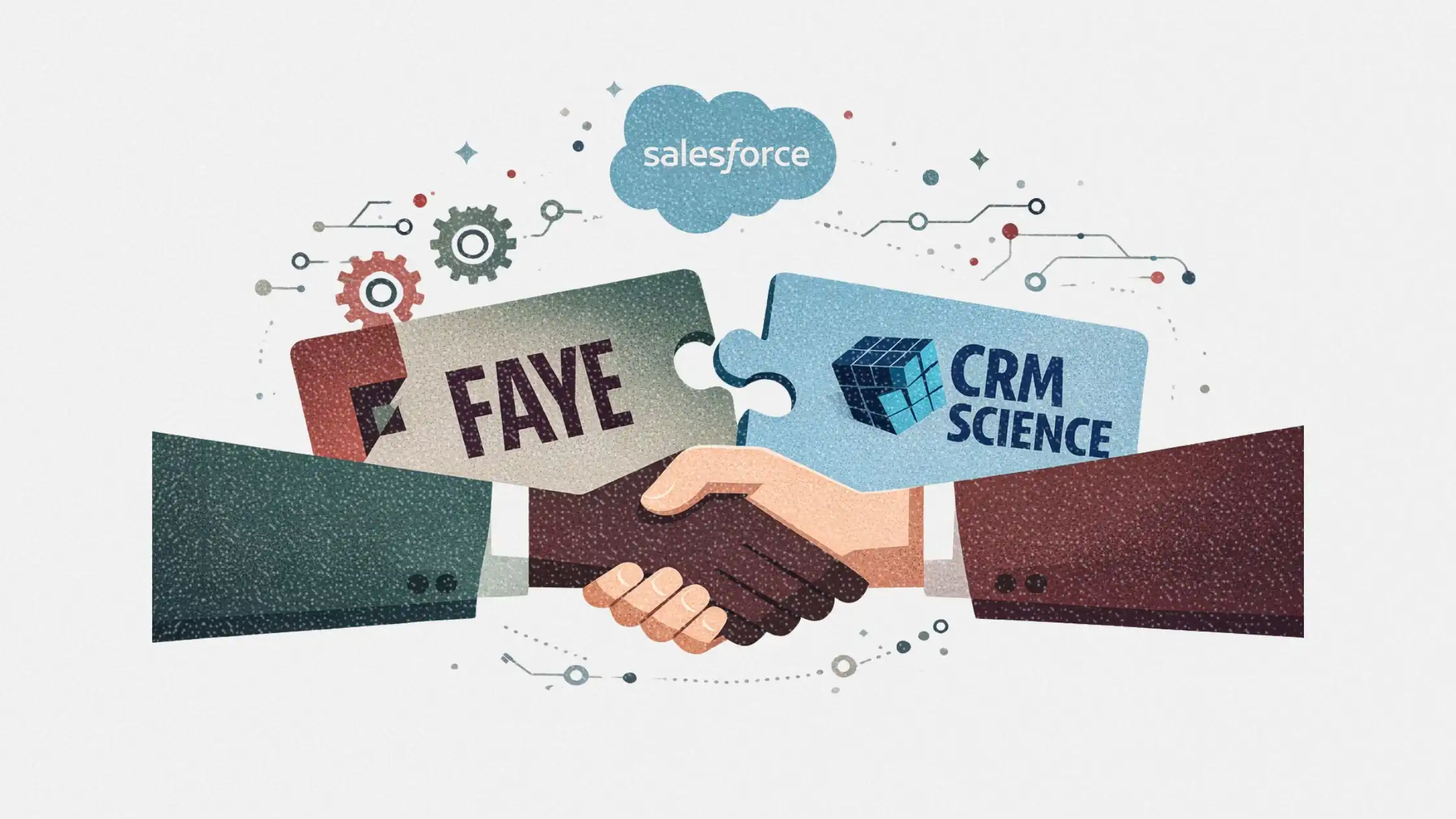
Faye has acquired CRM Science, a Salesforce and Agentforce partner, in a move aimed at expanding its Salesforce delivery capacity and AI automation services for mid-market and enterprise clients.
The deal is Faye’s 12th acquisition in 10 years, and it brings CRM Science’s team and customer base into Faye’s services organization, with an emphasis on Salesforce implementations, integrations, and Agentforce-focused work.
Short on time?
Here’s a quick look at what’s inside:
- What the acquisition adds to Faye’s Salesforce and AI services
- How this fits into a crowded Salesforce consulting market
- What marketers and revenue teams should watch next
What the acquisition adds to Faye’s Salesforce and AI services
Faye says the acquisition strengthens its Salesforce practice and expands its ability to deliver AI and automation, including Agentforce implementations. The stated goal is to help customers operate across “increasingly complex, multi-platform software environments,” where Salesforce needs to connect cleanly with adjacent systems.
From an operating model standpoint, Faye is positioning the combined team as an integrator across multiple customer-facing stacks, citing experience with platforms such as SugarCRM, Zendesk, Intercom, and HubSpot alongside Salesforce. For marketing and sales ops teams, this kind of services footprint typically matters most when workflows span CRM, CX, marketing automation, and reporting, and when automation initiatives break because data and permissions are inconsistent across tools.
CRM Science also brings specialist depth. In services markets, acquisitions like this often aim to reduce delivery bottlenecks in high-demand workstreams (implementation, integration, automation design, and change management) rather than simply adding a new product line.
 Valery Moniaga
How this fits into a crowded Salesforce consulting market
The Salesforce consulting market in the US is mature and competitive, with many partners offering similar core services: implementation, integration, managed services, and optimization. That puts pressure on firms to differentiate on either vertical expertise, speed-to-value, packaged accelerators, or AI-forward delivery.
Faye’s approach here appears to be scale plus breadth: expanding a Salesforce-focused team while also highlighting cross-platform integration. CRM Science’s positioning adds a Salesforce and Agentforce-specific angle, which can be useful if buyers are looking for tighter alignment to Salesforce’s current AI roadmap.
The category includes competitors such as TechForce Services, Eustace Consulting, Six Consulting, and Polar Strategy, which signals a landscape where differentiation often comes down to proof of delivery, referenceable outcomes, and how well a partner can standardize repeatable playbooks. Faye will likely need to demonstrate that the combined organization can deliver consistent results across complex environments, not just add more billable capacity.
This acquisition also fits broader trends like AI-powered CRM and the ongoing convergence of marketing and sales operations. As teams try to automate lead routing, pipeline management, service-to-sales handoffs, and lifecycle engagement, they increasingly need services partners who can coordinate data models and governance across CRM and CX systems without creating brittle automations.
What marketers and revenue teams should watch next
For marketers, the immediate implication is not the acquisition itself, but what it enables in execution. If your org relies on Salesforce, the practical questions to ask a combined Faye and CRM Science team are operational:
- Agentforce scope and governance: Which processes are suitable for agentic automation today, and what guardrails (approvals, data access, audit trails) are implemented from day one?
- Integration realism: How will data move between Salesforce and the rest of your stack (support, marketing automation, ERP), and what breaks when objects and permissions change?
- Measurement: What gets measured post-launch: productivity reclaimed, SLA improvements, pipeline impact, churn reduction, or cost-to-serve changes?
- Change management: Who owns adoption across marketing, sales, and service, and how will training and rollout be handled across teams?
Given the pace of AI feature rollouts in CRM platforms, services partners are increasingly being evaluated on whether they can turn new capabilities into governed, durable workflows, not just proofs of concept.