
Smallpdf survey finds freelancers still lose 204 hours a year to admin
Smallpdf survey: AI cuts creative time, but freelancers still lose 204 hours yearly to admin. Payment waits and formatting remain major drags.

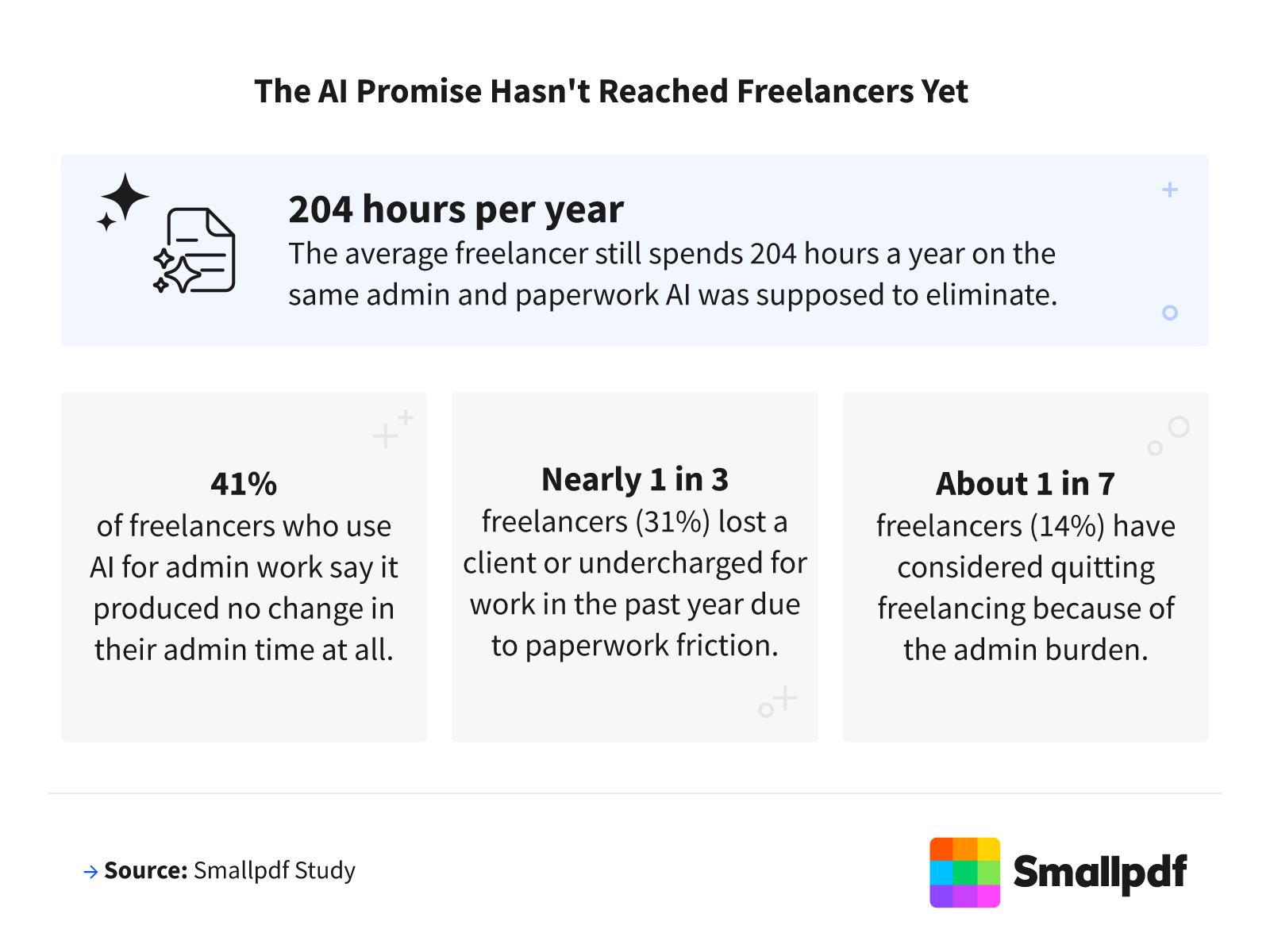
Freelancers are adopting AI to move faster on creative and client work, but much of the time drain still sits in the document and payment workflow that surrounds billable output. In a 2026 survey of 397 freelancers, Smallpdf found respondents still lose an average of 204 hours a year to admin and paperwork even with AI in their toolkit.
The company outlined the findings in its Freelancer Freedom Index post, highlighting a gap between faster “making” and slower “getting paid,” with formatting, approvals, and invoicing friction continuing to create revenue risk.
Table of contents
Jump to each section:
- Why AI speedups are not fixing freelancer admin time
- Where document workflows break down from proposal to payment
- What “paperwork friction” is costing freelancers
- What marketers should know about freelancer admin drag
Why AI speedups are not fixing freelancer admin time
The survey data points to a common pattern: freelancers use AI frequently, but they do not experience proportional time savings on admin. While 70% say they use AI for admin tasks and 65% use it for the work clients pay them for, 48% agree AI has done little to reduce their admin workload.
One reason is that “admin time” is often a chain of dependencies, not a single task. Drafting a proposal faster does not remove the time spent converting formats, managing versions, routing for signature, or following up when a client delays.
The findings also suggest that freelancer type and life context shape the pain. More than half of solopreneurs (58%) say AI has done little to reduce their admin workload, versus 46% of full-time freelancers. And 79% of millennial freelancers report doing admin outside normal business hours, compared with 57% of Gen X.
 ContentGrip
Where document workflows break down from proposal to payment
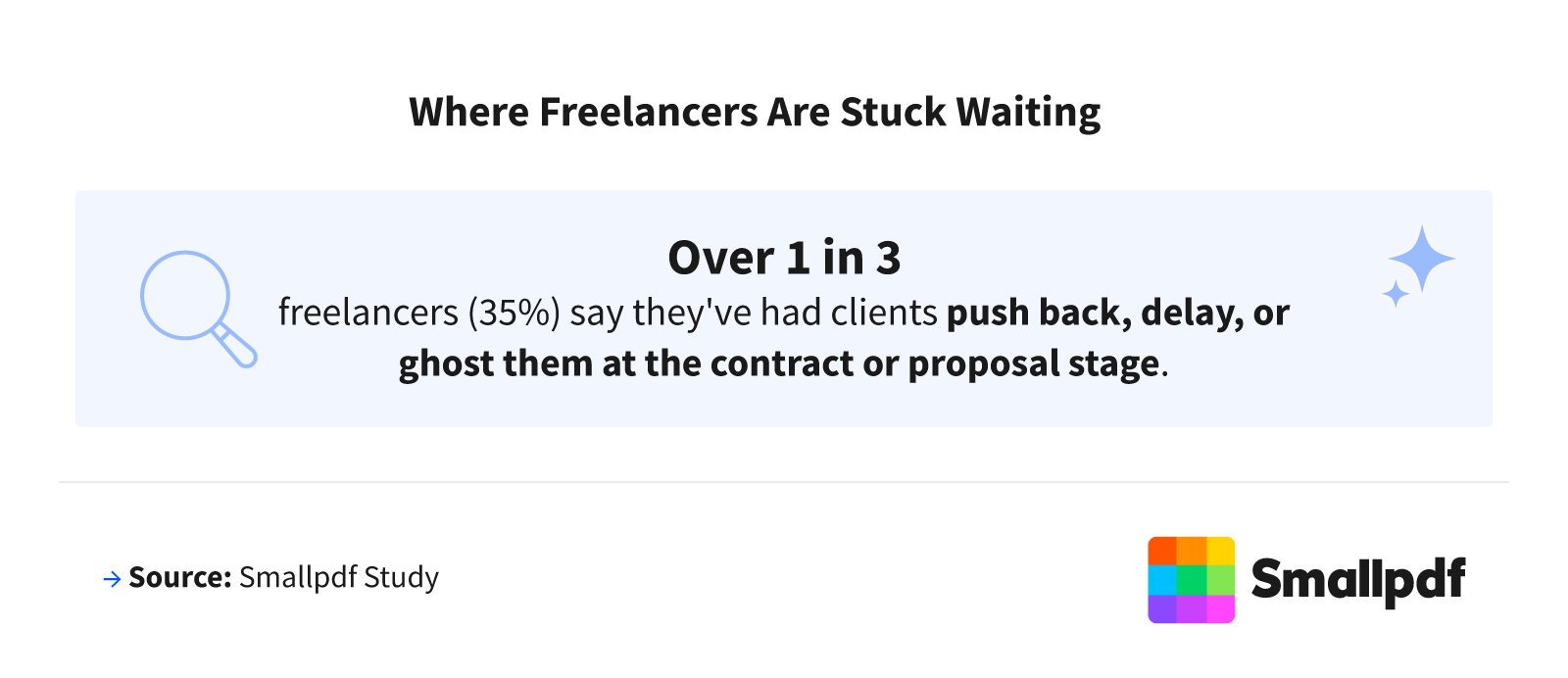
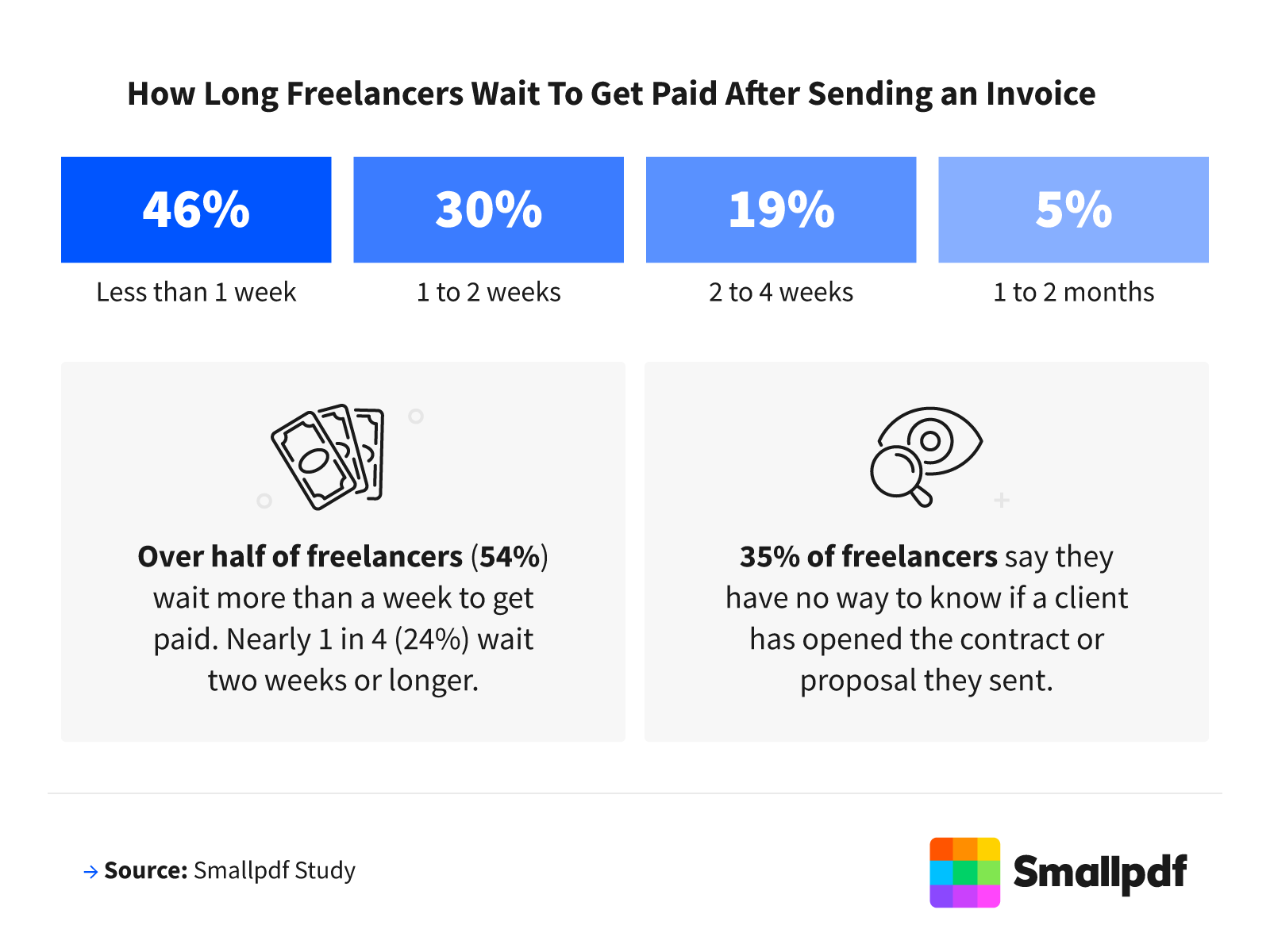
The survey highlights bottlenecks at both ends of the revenue process: early-stage approvals and late-stage payment. More than 1 in 3 freelancers (35%) say clients pushed back, delayed, or ghosted them at the contract or proposal stage. Separately, 35% say they have no way to know whether a client actually opened the contract or proposal they sent.
On the payment side, delays are widespread. More than half (54%) wait more than a week to get paid after sending an invoice, and 24% wait two weeks or longer. For Gen X, 31% wait two weeks or more, the longest wait of any generation in the survey.
The most time-consuming admin task cited is formatting documents, with 38% naming it as the task that eats the most time each week. That matters because formatting is often the “hidden tax” that sits between fast AI drafting and a sendable, signable artifact.
What “paperwork friction” is costing freelancers
Smallpdf’s survey frames admin drag as both a time problem and a revenue problem.
- More than half of freelancers say admin work costs them potential income, averaging nearly $6,800 per year.
- Nearly 1 in 3 (31%) lost a client or undercharged for work in the past year due to paperwork friction.
- 15% say 5% or more of the money they invoiced went unpaid or had to be written off.
- 14% consider quitting freelancing because of the admin burden.
These numbers indicate that “getting paid” risk is not limited to late invoices. It also includes pricing mistakes, missed scope changes, and stalled approvals that can quietly reduce effective hourly rate even when demand exists.
The coping strategies freelancers report are notably process-led rather than tool-led: reusable templates, e-signature adoption, centralizing documents in one place, selective outsourcing, and using AI for narrowly defined tasks like drafting and template generation.
What marketers should know about freelancer admin drag
Freelancers are a meaningful part of many marketing operating models, from creative and production to strategy and specialized channel execution. The survey’s message is that AI can speed up outputs, but the commercial workflow around those outputs still determines whether teams see real throughput gains.
- AI helps the “make” phase, but the “approve and pay” phase is still the constraint
If briefs, contracts, approvals, and invoicing live across fragmented tools, time savings from AI drafting can be absorbed by handoffs and follow-ups. The operational system, not the model, sets the pace. - Formatting and packaging are not trivial, they are the last mile of delivery
With 38% citing formatting as the biggest weekly admin drain, brand teams that standardize templates and deliverables can reduce rework and speed up review cycles, especially when multiple stakeholders touch the same file. - Lack of visibility creates avoidable follow-up work
When 35% of freelancers cannot tell if a client opened a contract or proposal, they default to chasing. Marketing teams can reduce friction by adopting clear status signaling in their document workflow, so “waiting” becomes measurable. - Payment timing is part of talent retention, not just finance hygiene
With 24% waiting two weeks or longer and 15% reporting meaningful write-offs, slow pay can push freelancers to deprioritize or decline future work. For marketing leaders, payment operations can affect access to specialist capacity. - Process changes beat broad AI usage for admin reduction
The practical moves freelancers reported are workflow fundamentals: templates, e-sign, centralization, selective outsourcing, and narrow AI use. For brand teams, that translates into designing a repeatable engagement system rather than expecting AI to compensate for fragmented operations.
Over time, marketing organizations that rely on flexible talent will likely differentiate on how easy they are to work with: clear scopes, standardized documentation, fast approvals, and predictable payment cycles.
AI may continue compressing the time it takes to generate first drafts, concepts, and variations. But unless the business process around creative production is tightened, teams should expect a persistent gap between faster creation and faster commercialization.