
Go-to-market strategy examples: what marketers can learn from real launch plays
Eight documented go-to-market strategy examples from B2B companies. For each, the focus is on the specific audience, channel, and message decisions that made the launch work.

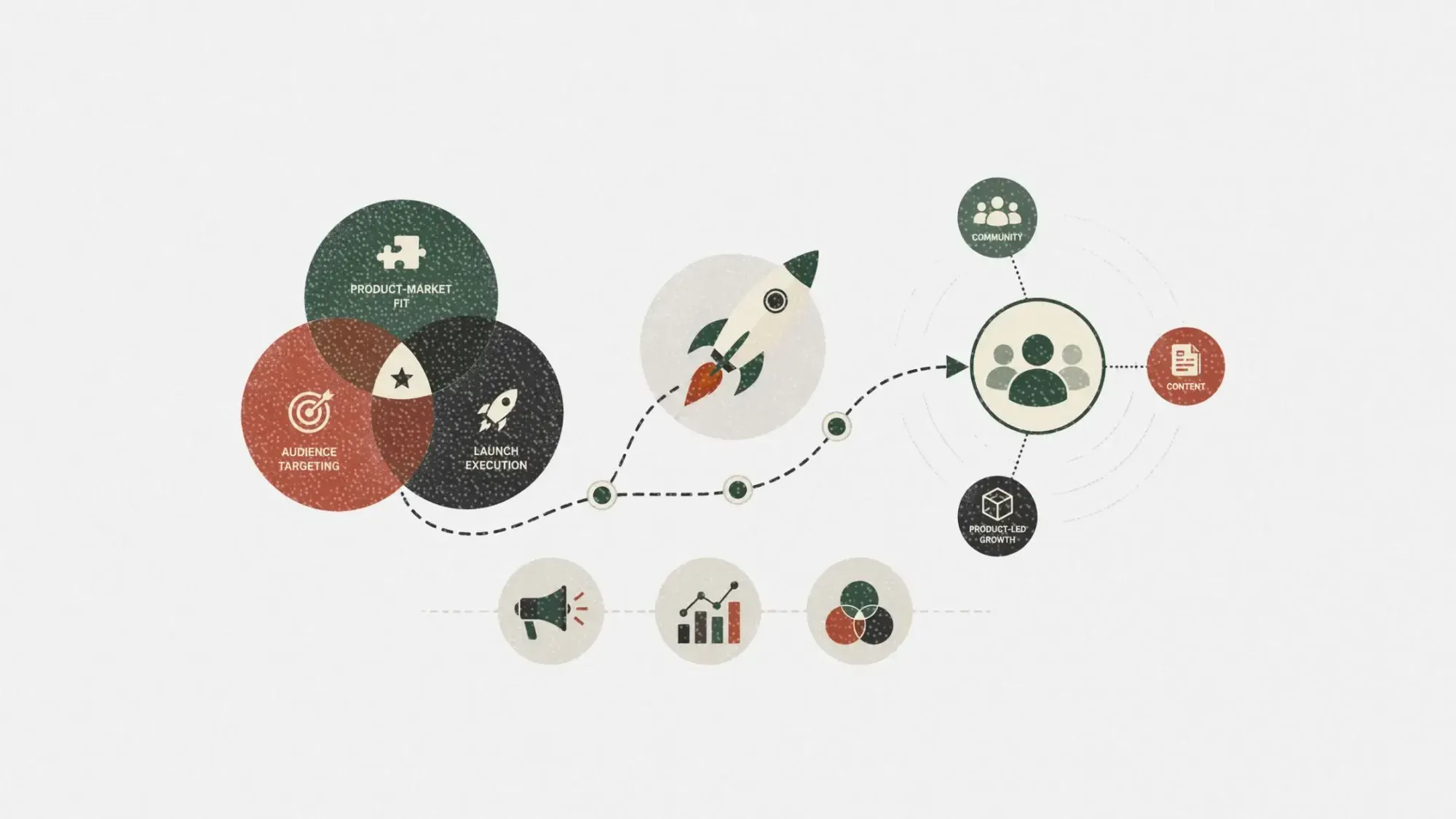
Go-to-market strategy and product-market fit are not two phases you move through in sequence. They run in parallel, and they feed each other. Early GTM decisions (which audience you target first, what you say to them, which channel you use) generate feedback that shapes the product. A message that falls flat tells you something is wrong with the value proposition or the audience segment.
A channel that converts at three times the expected rate tells you where the strongest fit actually lives. Companies do not finish finding product-market fit and then start marketing. They use early GTM experiments to triangulate what the fit actually is, and for whom.
The eight companies in this guide were doing both simultaneously. Figma was still refining collaborative editing when the team's first marketer Claire Butler was building community trust with designers. HubSpot was publishing about inbound marketing before they had fully validated that the methodology would drive their own growth. Slack's bottom-up freemium GTM generated the product usage data that showed them which team types had the strongest retention.
The GTM motion and the PMF search were the same process. What changed over time was the balance: early on, GTM experiments are mostly about discovery; once strong signal emerges, GTM shifts to scaling what those experiments proved.
What this guide isolates is the distribution layer: the specific audience, channel, and message decisions these teams made, and what made each approach work. The same product can also require a different GTM in a different market, because the audience's trust networks, buying habits, and channel preferences are different even when the product problem is identical. Understanding these decisions as learnable and adaptable, rather than as byproducts of a great product, is the point.
Table of contents
Jump to each section:
- What is a go-to-market strategy?
- GTM strategy vs marketing plan vs product launch plan
- 8 go-to-market strategy examples worth studying
- What strong GTM examples have in common
- A simple GTM framework for lean marketing teams
- GTM mistakes that weaken a launch
What is a go-to-market strategy?
A go-to-market (GTM) strategy is a coordinated plan for bringing a specific product or service to a defined audience at a defined moment. It answers five questions: who you are targeting, what problem you are solving for them, how you will reach them, what you will say, and how you will measure success.
GTM strategy is not the same as a general marketing strategy. A marketing strategy governs how a brand grows over time. A GTM strategy is time-bound and tied to a specific launch event, whether that is a new product, a new market entry, or a significant repositioning.
The critical word is coordinated. A GTM strategy only works when sales, marketing, product, and customer success are operating from the same playbook, with the same definitions of the target customer, the same messaging, and the same understanding of what success looks like in week one versus month six. In the earliest stages, this coordination also runs in the opposite direction: who responds, who activates, and who refers others generates product-market fit signal that feeds back into the roadmap.
 Patrecia Meliana
GTM strategy vs marketing plan vs product launch plan
These three terms are often used interchangeably, but they describe different scopes.
A marketing plan is the ongoing annual or quarterly roadmap for how a brand generates awareness, demand, and retention across all its products and markets. It is strategic and broad.
A product launch plan is the operational checklist for a specific release: what gets published, when, by whom, and in what sequence. It is tactical and narrow.
A GTM strategy sits between them. It is strategic enough to define positioning and channel logic, and specific enough to connect to a defined audience and timeline. You can have a product launch plan without a GTM strategy. You cannot have an effective GTM strategy without a launch plan embedded within it.
For B2B companies in particular, the GTM strategy needs to account for buying committees, longer sales cycles, and the fact that the person who uses the product is often not the person who approves the budget. That misalignment between user and buyer shapes every channel and message decision a GTM team makes.
8 go-to-market strategy examples worth studying
1. Figma: community-led growth in a crowded market
When Figma launched publicly in 2015, Adobe dominated professional design with tools that had been the default for two decades. Figma's GTM team, led by the aforementioned Claire Butler as one of the first ten employees, chose not to compete on feature lists. They built community trust first.
The channel logic was precise: designers were the users, but developers and product managers were the people they collaborated with daily. If designers adopted Figma and shared files with colleagues, the product would spread horizontally through organizations without needing enterprise sales.
Figma stayed free through 2017 and offered a generous freemium tier afterward. According to First Round Review's documented interview with Butler, 87% of first-time Figma users were invited by a colleague, confirming that the viral loop worked exactly as intended. Within five years, Figma had reached 60% market penetration among professional design teams.
The repeatable lesson: when your product is collaborative by nature, your GTM strategy should engineer sharing into the first use. The acquisition channel is the product itself.
2. HubSpot: category creation as a GTM bet
HubSpot launched in 2006 into a market where the dominant frame was outbound: cold calls, trade show booths, bought lists. Co-founders Brian Halligan and Dharmesh Shah did not try to compete in that frame. They named a different category and built their entire GTM strategy around it.
By publishing the concept of "inbound marketing" through their blog, speaking at conferences, and releasing free tools under that methodology, HubSpot made the buying decision less about "HubSpot vs. Marketo" and more about "inbound vs. outbound." Every piece of content they created demonstrated the methodology while selling the software that implemented it.
The self-referential nature of the GTM was its most powerful quality. HubSpot's own organic traffic growth was the proof of concept for what they were selling. By 2022, the company had surpassed US$2 billion in ARR with more than 100% net revenue retention.
The repeatable lesson: if your approach to the market is fundamentally different from existing solutions, naming the new category can be more valuable than competing in an existing one. The content that explains the category becomes the top-of-funnel for the product.
3. Slack: viral enterprise GTM through freemium
Slack launched in August 2013 and registered 8,000 sign-ups on its first day. The product targeted a specific frustration: knowledge workers who were drowning in email and fragmented across tools that were never designed to work together.
The GTM was deliberately bottom-up. Rather than selling to IT departments or procurement teams, Slack let individual contributors bring the product into their teams. The freemium tier made it trivial for a single manager to start a Slack workspace without budget approval. Once a team was active, the value of Slack increased with each new person who joined, creating a natural expansion motion.
The pricing structure was designed to convert at the team or department level rather than the individual. Once enough people within a company were using Slack's free tier, the case for an enterprise license became internal rather than sales-driven. Salesforce acquired Slack for US$27.7 billion in 2021, confirming the unit economics of that compounding adoption model.
The repeatable lesson: in enterprise software, the end user and the budget holder are rarely the same person. A GTM strategy that wins end users first creates pull that is far more durable than top-down sales pressure.
 Celi Anindia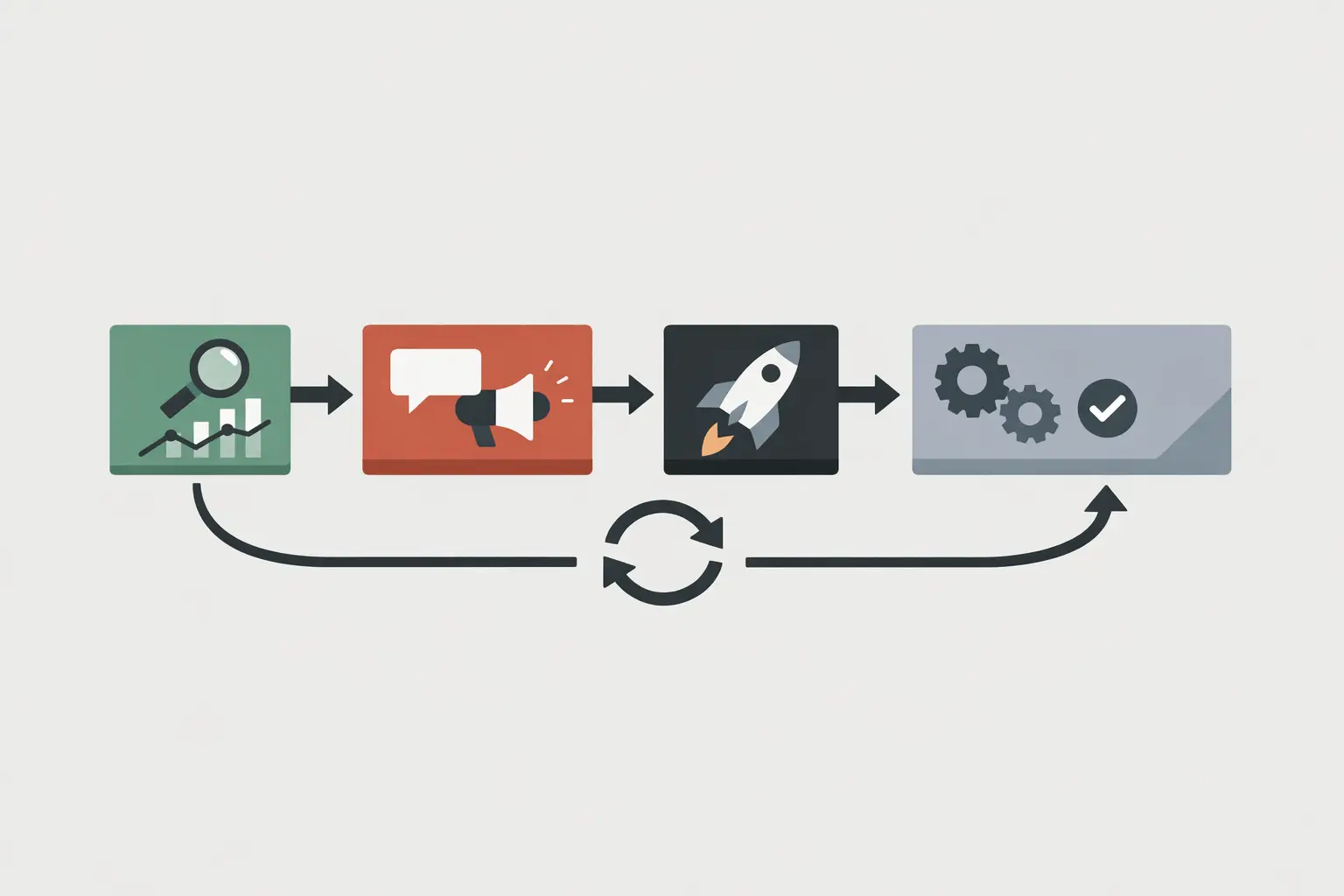
4. Gong: data-led thought leadership for category creation
When Gong entered the market around 2016, it was trying to sell into a new category it called "Revenue Intelligence." The problem was that no one was searching for that phrase. Sales leaders were not aware they needed it.
Gong's GTM response was to publish what their product knew. They launched Gong Labs, a research function that mined anonymized call data from billions of sales conversations to produce counterintuitive findings about sales effectiveness: optimal talk-to-listen ratios, the best time to discuss pricing, phrases that kill deals. As ContentGrip documented in its PR strategy examples guide, every Gong Labs piece was built to be useful without requiring a purchase, which made it shareable by exactly the sales leaders they were trying to reach.
The channel logic was LinkedIn and email, where sales professionals were concentrated. The content traveled through professional networks and created ambient brand authority. By the time a sales leader had seen ten Gong Labs findings in their feed, the product had already solved a credibility problem that a sales demo alone could not.
The repeatable lesson: if your category is new, the fastest way to create demand is to publish evidence that the problem exists and is measurable. Original data earns media placement, social sharing, and search traffic that generic thought leadership cannot match.
5. Atlassian: no enterprise sales team, channel plus self-serve
Atlassian scaled to a US$5.8 billion IPO valuation in 2015 without building a traditional enterprise sales force. The GTM strategy was structured around two motions that compounded each other: a self-serve model that let developers and project teams adopt Jira and Confluence independently, and a solutions partner channel that handled enterprise deployment and customization.
The pricing was transparent and published online, removing the friction of a sales discovery call for most buyers. Atlassian competed in a category (project tracking and documentation) where the people who evaluated the product were also the people who used it daily, making developer-to-developer recommendation the most trusted channel.
The channel partner ecosystem handled the complexity that a direct sales team would otherwise manage: large-scale deployments, integrations with enterprise systems, and compliance requirements in regulated industries. Atlassian provided the product; partners provided the implementation expertise.
The repeatable lesson: for technical products sold to practitioners rather than procurement teams, removing price opacity and enabling self-serve evaluation can be a more powerful GTM motion than a direct sales team, especially in the early stages.
6. Notion: bottom-up virality through product sharing
Notion grew from approximately US$3 million in ARR in 2019 to over US$31 million by 2021, almost entirely through a product-led viral loop. The mechanism was simple: any page created in Notion could be shared publicly as a link, which exposed non-users to the product in its native state rather than in a marketing context.
Templates were a key acquisition channel. Notion users shared workspace templates on Twitter, Reddit, and community forums. Each template share was effectively a product demonstration that carried implicit credibility because it came from a peer rather than a brand.
Notion's GTM strategy had no formal sales function for most of its early growth. Marketing was largely community cultivation: responding to user-built templates publicly, featuring community creators, and making it easy for power users to build and share their own Notion setups. The product was the distribution.
The repeatable lesson: if your product produces outputs that are naturally shareable, structuring your GTM around those sharing moments can generate acquisition at near-zero marginal cost. Design for sharing before designing for conversion.
7. Superhuman: controlled distribution as GTM and product feedback in parallel
Superhuman built a US$30-per-month email client for professionals and chose not to open it to general sign-ups. The company ran an invite-only model for the first two years, where every new user was personally onboarded by a Superhuman team member in a 30-minute setup call.
The GTM decisions here served two purposes simultaneously, which is what makes this example instructive. First, the distribution tactic: invite-only access created scarcity that generated organic press coverage and word-of-mouth within the professional communities Superhuman was targeting, without paid acquisition. The waitlist ensured everyone who entered the funnel had actively sought access rather than drifting in through an ad. At US$30 per month for an email client, the pricing signal reinforced that this was a professional tool worth paying a premium for, and the access scarcity reinforced that positioning.
Second, and running in parallel: controlled distribution gave the team clean product feedback. An invite-only audience is a self-selected sample of motivated, high-intent users. Their usage patterns, churn signals, and referral behaviour were far less noisy than what an open sign-up funnel would have produced. As Rahul Vohra documented in a 2019 analysis via First Round Review, that signal directly informed product iteration. The GTM tactic and the product learning process were the same mechanism.
The repeatable lesson: for premium B2B products, controlling who enters the funnel in the early stages improves both the quality of the acquisition signal and the quality of the product feedback. These are not separate goals. Restricting access is a distribution decision that simultaneously shapes what you learn about the product.
 Celi Anindia
8. Drift: using your own product as the GTM proof of concept
Drift entered the market in 2015 with a live chat and bot product for B2B websites. Rather than launching with a conventional marketing strategy, co-founder and CEO David Cancel deployed Drift on Drift's own website as the primary conversion mechanism and then documented the results publicly.
The GTM strategy was to demonstrate conversational marketing by practicing it. Every potential customer who visited the Drift site encountered the product before they could fill in a form or call a sales rep. Drift then turned those customer outcomes into case studies, original research, and eventually a book titled "Conversational Marketing," which named and claimed the category.
Drift reached a US$1 billion valuation in 2021 before being acquired by Salesloft in 2023. The category it created is now standard terminology in B2B demand generation.
The repeatable lesson: if your product claims to solve a marketing problem, using it publicly as your own GTM channel provides proof that competitors who describe the same benefit in their messaging cannot match.
What strong GTM examples have in common
Looking across these eight cases, a pattern emerges that is distinct from the generic frameworks found in most GTM guides.
Each company made one primary bet and built its entire launch motion around that bet rather than spreading effort across multiple channels and audiences simultaneously. Figma bet on community. HubSpot bet on content. Slack bet on bottom-up virality. Gong bet on original data. The focus was not a resource constraint. It was a strategic discipline.
Each company also knew exactly who would see value first, and targeted that person rather than the eventual budget holder. The first user was always someone whose specific daily workflow would improve immediately from using the product. Conversion to a paid or enterprise contract came later, through expansion within accounts where the product had already demonstrated value.
A final thread across all eight: each strategy generated evidence that could be shared. Figma files, HubSpot blog posts, Gong Labs reports, Notion templates, Drift case studies. The GTM was not purely a media or advertising play. It was a content and product motion that compounded over time.
A simple GTM framework for lean marketing teams
For teams without dedicated GTM specialists, the following five-step framework captures the decisions that matter most before launch.
- Define the beachhead audience. Who is the smallest specific group of people who will get the most immediate value from this product? Not the total addressable market. The narrowest possible first customer segment where you can achieve density and generate word-of-mouth within a defined community.
- Map the decision journey for that audience. Where does this audience currently learn about new tools and approaches in their category? Which communities, publications, newsletters, podcasts, or professional networks do they trust? The answer to this question determines channel selection, not the other way around.
- Choose one primary acquisition motion. Based on your product's natural sharing behavior and your audience's trust networks, choose a primary GTM motion: product-led (the product drives its own adoption), content-led (original information builds authority and generates inbound demand), community-led (concentration in a specific professional community creates social proof), or sales-led (direct outreach targets high-value accounts). Most successful launches use one primary motion in year one and add secondary motions as evidence accumulates.
- Build documented evidence before scaling spend. Before increasing acquisition budget, collect the marketing evidence that makes scaling efficient: activation rates within the beachhead segment, conversion data from the first cohort, early customer quotes, and at least one case study with specific outcomes. Scaled acquisition without this evidence means paying to reach audiences with unproven messaging. With it, every new channel has a tested foundation to build from.
- Define the expansion motion. How does initial adoption in a small group convert to broader organizational purchase? For PLG companies, this typically involves feature gating or seat limits that create internal demand for an upgrade. For sales-led companies, it involves account-based motion that follows product usage signals. The expansion motion should be designed before launch, not discovered after.
 Celi Anindia
GTM mistakes that weaken a launch
Understanding what works is only half the picture. These are the GTM execution errors that consistently surface in failed or underperforming launches.
- Targeting everyone at launch. A product marketed to a broad audience before it has demonstrated clear value with a specific segment generates mediocre response rates everywhere. The data from those early campaigns becomes misleading because it mixes highly relevant users with weakly matched ones.
- Choosing channels before understanding the audience. Many teams default to the channels they are most comfortable with, often paid social or SEO, without first establishing where their target audience actually concentrates attention and makes professional decisions. Channel selection should follow audience research, not precede it.
- Treating the launch as a single event. Figma's Claire Butler noted in her First Round Review interview that she would treat every feature update as a launch opportunity rather than reserving announcement energy for major releases. Sustained presence in the category builds authority that a single launch announcement cannot.
- Skipping the attribution setup. GTM strategy cannot improve without feedback. UTM parameters, CRM tagging, and attribution windows should be defined before the launch date, not investigated afterward when the data is already fragmented.
- Measuring vanity metrics in the first 90 days. Impressions, open rates, and website visits are lagging indicators for B2B GTM performance. The leading indicators are activation rate within the beachhead segment, time from first touch to first meaningful product engagement, referral rate from early users, and qualified pipeline generated from the launch motion. For context on building the attribution infrastructure to track these properly, ContentGrip's coverage of RevSure's full-funnel GTM data platform covers how B2B revenue teams are connecting marketing activity to pipeline outcomes.
A well-structured GTM strategy does not guarantee a successful launch. Markets are unpredictable, timing is difficult, and category creation carries genuine risk. What it does guarantee is that the team learns from the launch and can build on that evidence for the next one.