Google phases out DSA as AI Max exits beta for Search campaigns
What marketers need to know about the forced upgrade to AI-driven search automation

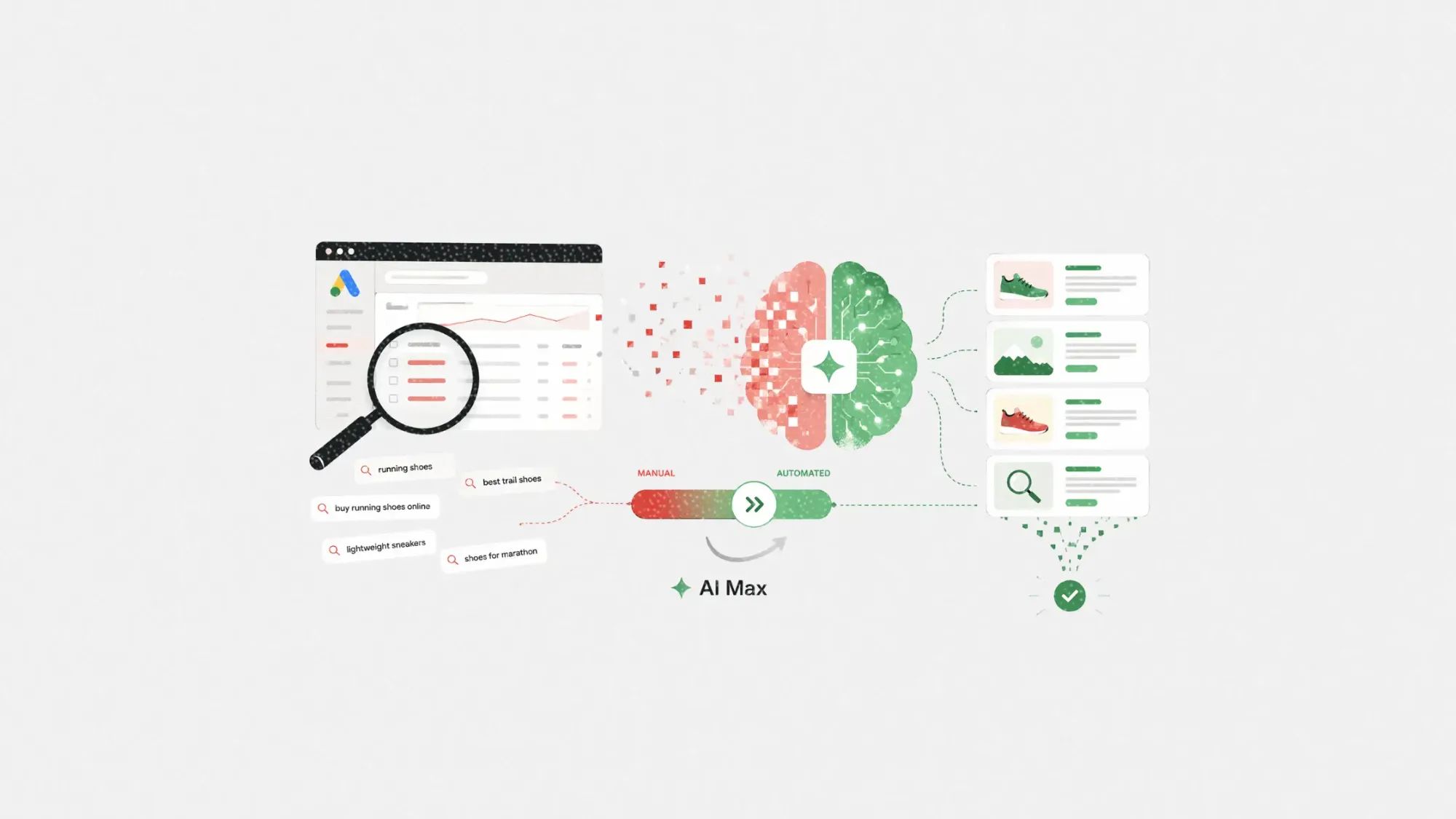
Google is pushing Search advertising further into automation, with AI Max officially moving out of beta and replacing legacy setups like Dynamic Search Ads.
For performance marketers who have relied on DSA as a flexible catch-all, this is not just a feature update. It is a structural shift in how targeting, creatives, and optimization work inside Google Ads. The question is no longer whether to adopt AI-driven campaigns, but how much control you want to retain before Google makes that decision for you.
This article explores what the transition means, how the upgrade will roll out, and what marketers should do before automation takes over by default.
Short on time?
Here’s a table of contents for quick access:
- What is AI Max for Search campaigns and what’s changing?
- How AI Max compares to Dynamic Search Ads
- Timeline for the DSA to AI Max upgrade
- What marketers should know before switching to AI Max
 Patrecia Meliana
What is AI Max for Search campaigns and what's changing?
AI Max is Google’s next-generation Search campaign framework that combines automation across targeting, creative generation, and optimization into a single system.
Unlike traditional keyword-driven campaigns or even DSA, AI Max uses a broader mix of inputs. This includes advertiser assets, website content, and real-time intent signals to dynamically match queries and generate relevant ads.
The key update here is availability and scale. AI Max is moving out of beta, with hundreds of thousands of advertisers already using it. Google reports that campaigns using the full AI Max feature set see an average 7% increase in conversions or conversion value at similar CPA or ROAS compared to using only search term matching.
More importantly, this is not optional in the long term. Google is setting the stage for AI Max to become the default way Search campaigns operate.
How AI Max compares to Dynamic Search Ads
Dynamic Search Ads were originally designed to fill gaps in keyword coverage by scanning website content and generating ads dynamically. That approach still exists in AI Max, but the scope is much broader.
Here is how the two approaches differ in practice:
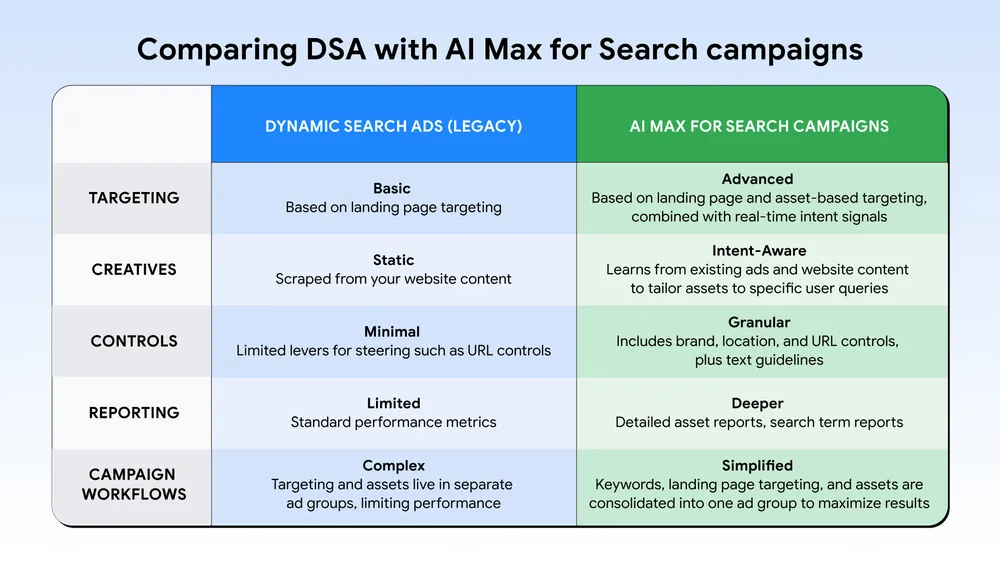
- Targeting
DSA relies on landing page targeting. AI Max expands this with asset-based targeting and real-time intent signals, making it more adaptive to unpredictable queries.
- Creative generation
DSA pulls static content from your website. AI Max learns from existing ads and site content to generate intent-aware assets tailored to each query.
- Controls
DSA offers limited levers like URL controls. AI Max introduces more granular controls including brand, location, and text guidelines.
- Reporting
DSA provides standard performance metrics. AI Max goes deeper with asset-level and search term reporting.
- Workflow
DSA separates targeting and creatives across ad groups. AI Max consolidates keywords, assets, and landing pages into a simplified structure designed to maximize performance.
In short, AI Max is not just an upgrade. It is a shift from reactive automation to predictive, AI-led campaign orchestration.
Timeline for the DSA to AI Max upgrade
Google is rolling out the transition in two phases, with a clear deadline.
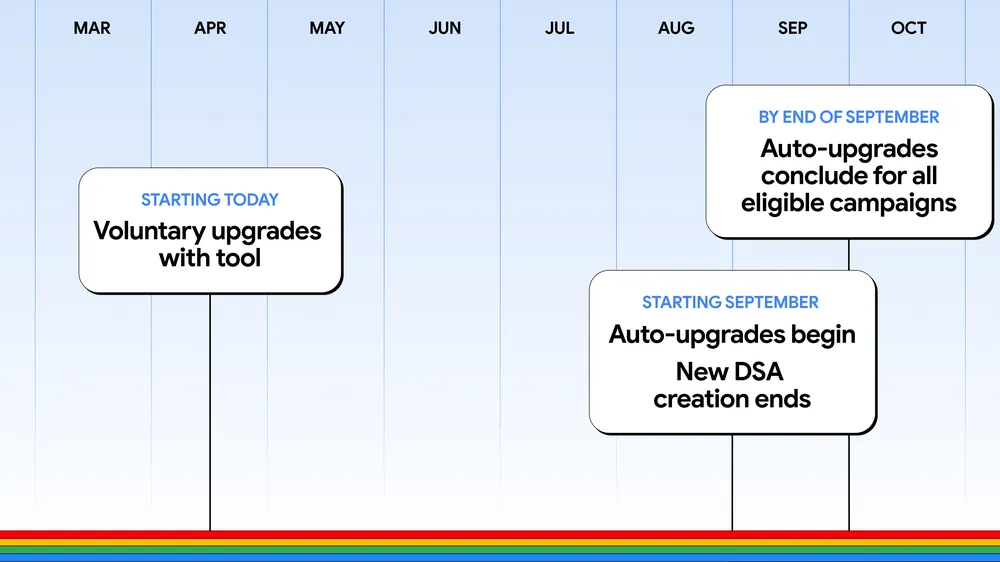
Phase 1: Voluntary upgrades (starting now)
Advertisers can begin upgrading campaigns manually using Google’s migration tools.
- DSA users can port existing settings and historical data into AI Max-compatible ad groups
- ACA and broad match users will see upgrade prompts directly in the Google Ads interface
Phase 2: Automatic upgrades (starting September)
From September onwards, Google will begin enforcing the transition:
- All eligible campaigns using DSA, ACA, or campaign-level broad match will automatically upgrade to AI Max
- Creation of new DSA campaigns will no longer be possible across Google Ads, Editor, or API
- All upgrades are expected to complete by the end of September
To minimize disruption, Google will mirror existing campaign settings during the transition. For example, DSA campaigns will retain URL controls and enable all AI Max features by default.
The message is clear: manual control is temporary, automation is inevitable.
What marketers should know before switching to AI Max
This transition is less about adopting a new feature and more about adapting your strategy to an AI-first system. Here are the key considerations:
1. Control shifts from setup to guidance
You are no longer defining exact targeting rules. Instead, you guide the system using inputs like assets, brand constraints, and creative guidelines.
2. Creative quality becomes a performance lever
Since AI Max generates variations dynamically, the quality and diversity of your inputs directly impact performance. Weak assets will scale poor results faster.
3. Measurement needs to go deeper
With more automation, surface-level metrics are not enough. You need to analyze asset performance, search term insights, and incremental lift.
4. Testing becomes critical
Google recommends using one-click experiments to evaluate AI Max performance. Treat this as a controlled rollout rather than a blind switch.
5. Early adopters gain a learning advantage
Switching now allows you to shape campaign structure and inputs before automation locks in defaults. Waiting means inheriting Google’s assumptions.
Patrecia Meliana
Google’s move to phase out Dynamic Search Ads in favor of AI Max reflects a broader trend across ad platforms. Automation is no longer a supporting feature, it is the foundation.
For marketers, the opportunity is clear but so is the risk. AI Max can unlock incremental performance, but only if you actively guide it with the right inputs, structure, and testing strategy.
The brands that adapt early will not just see better results. They will also build a deeper understanding of how to operate in an AI-driven advertising ecosystem.