Firmable research highlights habits behind high-growth B2B sales teams
Firmable surveyed 222 B2B sales pros. The standout pattern: cleaner CRM data, structured prospecting, and routines that make AI useful.


Firmable surveyed 222 B2B sales professionals to compare “hyper-growth” teams (30%+ business growth over the past year) with everyone else, and the results point to something refreshingly unglamorous: data quality, targeting discipline, and repeatable routines.
The company outlined the findings in its official research write-up, including how top-performing teams define success, where AI is actually used today, and which operating habits show up most often among faster-growing teams.
A useful reframing here is that AI is not the center of the story. The center is operational clarity. When execution is inconsistent, “more tools” mostly creates more noise. And the more interesting question is not whether AI can replace parts of sales work, but where it can amplify already-solid fundamentals.
Table of contents
Jump to each section:
- What the research actually measured
- Why “perfect data” beats “best AI” in real sales orgs
- How hyper-growth teams define winning
- The repeatable habits that show up in faster-growing teams
- What this means for marketers
What the research actually measured
Firmable’s research defined hyper-growth teams as those reporting at least 30% business growth over the past year, then compared their behaviors with teams below that threshold. The sample included 222 B2B sales professionals across levels, from frontline reps to senior leaders.
Because the research is comparative, its value is less about any single metric and more about pattern recognition: which behaviors correlate with higher growth, and which “obvious” AI use cases are still rare in practice.
One tension runs through the dataset. Plenty of teams are experimenting with AI, but the differentiator is whether they have the inputs and routines that let AI create leverage.
 ContentGrip
Why “perfect data” beats “best AI” in real sales orgs
The loudest signal in the findings is not a new AI workflow. It is the preference for clean prospect data. Firmable reports that 75% of B2B sales professionals would choose perfect prospect data over the best AI sales assistant.
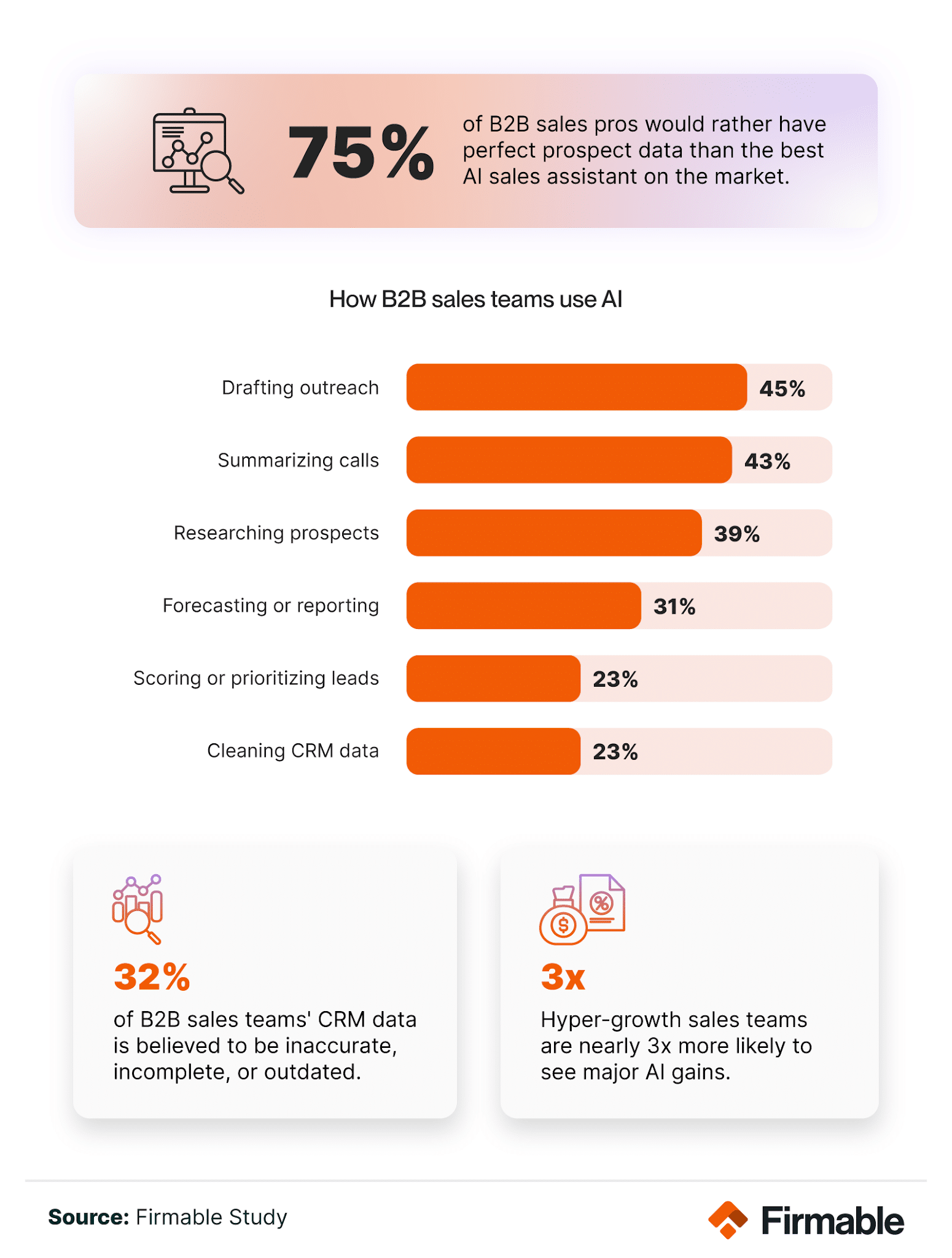
That preference is easier to understand next to another stat from the same research: sales pros estimate 32% of their CRM contact and account data is inaccurate, incomplete, or outdated. If roughly a third of the system of record is unreliable, even strong AI assistance becomes a confidence problem. People do not act on suggestions they do not trust.
It also clarifies why the most common AI use case is relatively low-risk. Firmable found 45% use AI to draft outreach emails or messages, while only 23% use AI to score or prioritize leads. Drafting a message changes wording; lead scoring changes who gets attention, follow-up, and urgency. The second requires higher confidence in both data and governance.
Strategic observation: Teams adopt AI fastest where mistakes are cheap, not where impact is highest.
How hyper-growth teams define winning
Firmable’s research suggests the fastest-growing teams may be more direct in how they evaluate performance. Quota attainment is the top measure among hyper-growth teams, cited by 40% versus 31% for teams below 30% growth. Meanwhile, customer retention shows up less as a primary measure for hyper-growth teams (10% versus 23%).
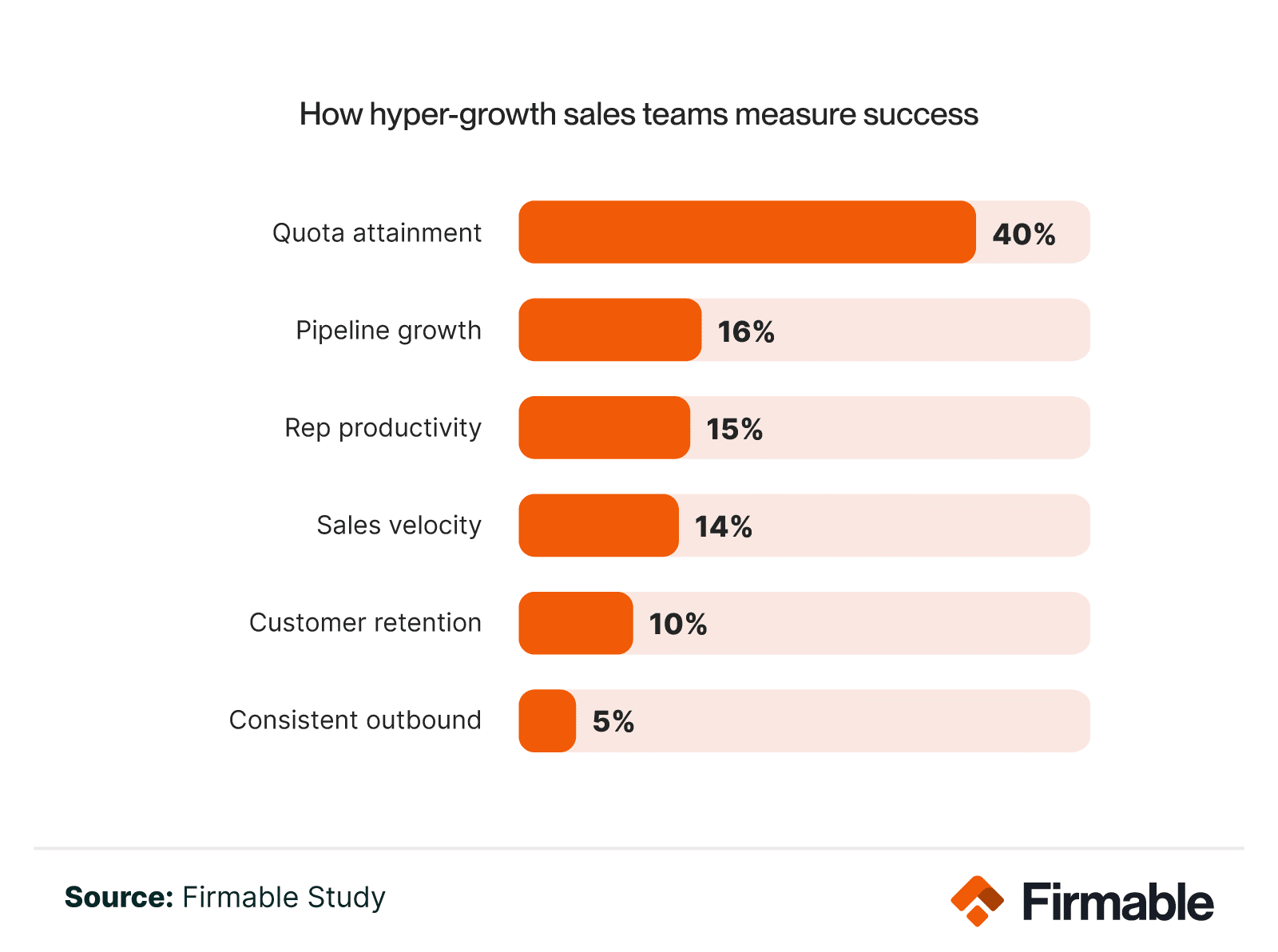
The temptation is to read this as “hyper-growth teams care less about retention.” A more cautious interpretation is that these teams may be optimizing for the next constraint in their growth curve. When pipeline creation is the bottleneck, quota becomes the most legible scoreboard.
That distinction matters because metrics shape behavior. If quota is the loudest signal, teams will bias toward actions that increase pipeline movement, including prospect selection, follow-up persistence, and time allocation.
The repeatable habits that show up in faster-growing teams
Firmable’s data puts “habits” on the critical path to growth. 95% of sales pros say top reps are differentiated by something other than raw talent, with better habits and consistency (31%) and better relationships (28%) leading. 83% agree they could grow faster by improving habits, not just working harder.
This is where the research becomes concrete:
- Structured prospect research: Hyper-growth teams are more likely to do structured research before outreach (41% vs 32%).
- More follow-up attempts: They make a median of 4 follow-up attempts before giving up, vs 3 for others.
- More selling time: They spend a median of 65% of their week selling vs 53% for others.
- Process consistency matters: 67% say inconsistent processes hold their team back more than a lack of effort.
- Targeting errors are costly: 21% say spending time on the wrong prospects is the biggest drag on growth.
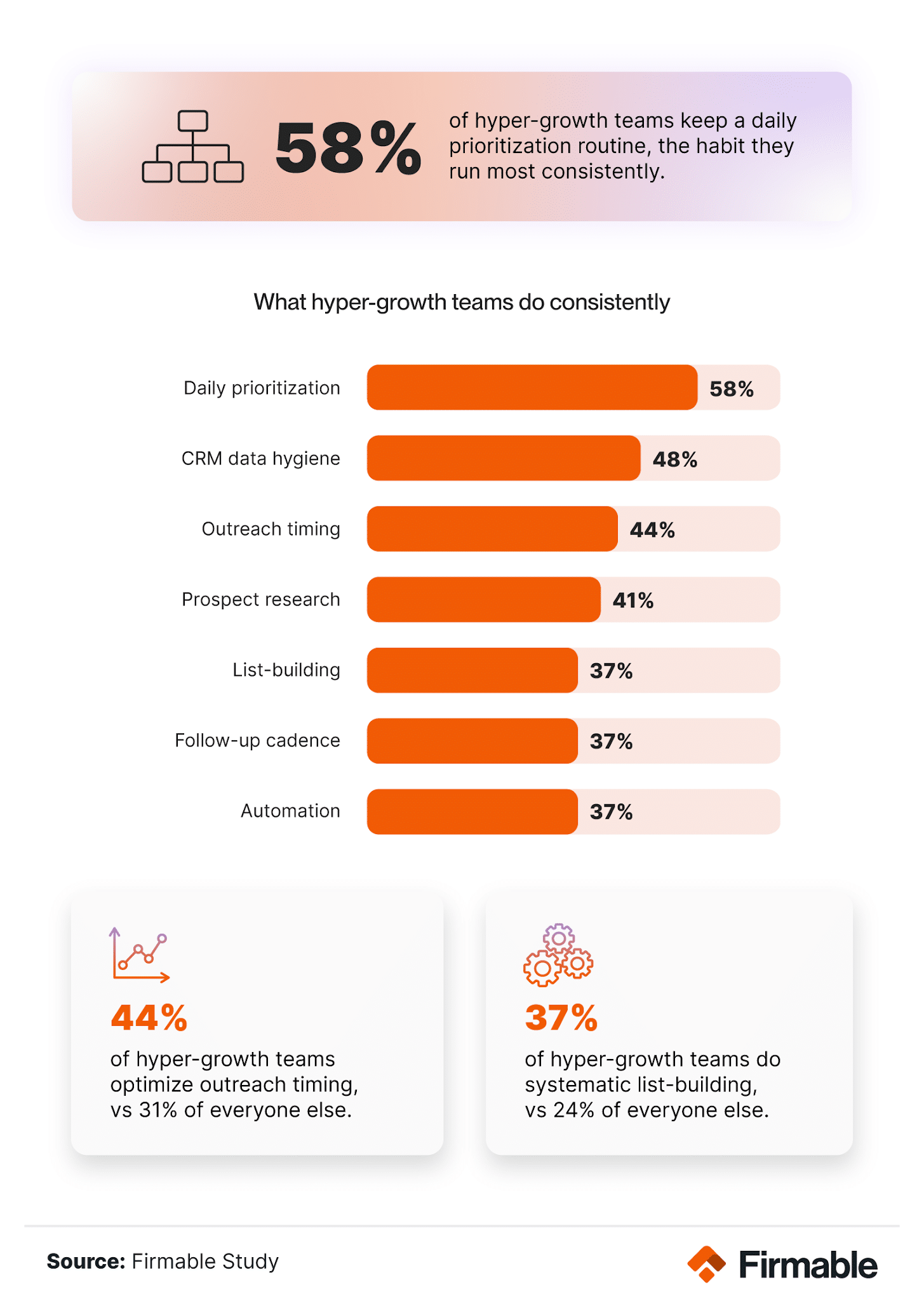
The pattern is less “do more” and more “waste less.” Better research reduces dead-end outreach. More consistent follow-up reduces leakage. More selling time reduces the hidden tax of admin and data entry. In that context, AI becomes most valuable when it protects focus, not when it generates more activity.
Strategic observation: Growth often looks like speed, but it is usually the removal of friction.
What this means for marketers
Sales habits might seem like a sales ops topic, but the implications for marketing are immediate: pipeline quality, segmentation, and handoff friction are shared systems. A short framing: if sales teams are telling you they would trade “the best AI” for “perfect data,” then data reliability is now a front-line revenue lever, not a back-office clean-up project.
- Treat data quality as a positioning problem, not just an ops problem
Firmable’s finding that 32% of CRM data is flawed implies downstream harm to targeting, personalization, and measurement. Marketers should frame data improvement as “better decisions” and “less wasted spend,” not as database hygiene. - Optimize AI for decision-making moments, not content volume
With 45% using AI for drafting messages and only 23% for lead scoring, the adoption gap likely sits at trust and accountability. The payoff for marketing is bigger when AI influences prioritization (who to pursue, which segment to nurture) rather than just generating more copy. - Align around a shared definition of a “good lead”
The research points to sharper targeting and structured prospect research in higher-growth teams. Marketing can support that by tightening ICP definitions, clarifying disqualifiers, and reducing “gray area” segments that create high activity but low conversion. - Design follow-up systems as part of the brand experience
Hyper-growth teams follow up more (median 4 vs 3). Marketing leaders often focus on top-of-funnel experience, but follow-up cadence and consistency are where trust is won or lost. A coordinated sequence across sales and lifecycle messaging can turn persistence into professionalism. - Make “time spent selling” a shared KPI with sales leadership
If hyper-growth teams spend 65% of time selling (vs 53%), marketers can help reduce non-selling time by improving enrichment, intent signals, and pre-call context. The aim is not more leads. It is fewer interruptions between insight and outreach.
The deeper shift is that revenue teams are moving from “more activity” to “more precision.” AI fits into that shift only when the system around it is stable: clean data, consistent routines, and a clear idea of what winning looks like.
Over time, brands that win B2B will look less like they have a better AI tool and more like they have a better operating model. That is uncomfortable, because operating models are slower to change than software subscriptions.
But it is also the opportunity: if you can make targeting and handoffs more consistent, you do not just improve conversion. You improve how your brand feels at every touchpoint.