Influencer marketing ROI: a data-driven framework for B2B marketers
The US$5.78 benchmark was built for e-commerce. Here is how B2B marketers should actually measure what creator programs return.

There is a number that has done a lot of damage to B2B influencer marketing budgets: US$5.78. That is the average return per US$1 spent on influencer marketing, widely cited across the industry and sourced from the Influencer Marketing Hub 2026 Benchmark Report.
CMOs quote it in QBRs. Agency decks lead with it. And it is almost entirely useless for the B2B marketer trying to justify an influencer program to their CFO.
The problem is not the number itself. It is that the methodology behind it aggregates e-commerce brands with 48-hour attribution windows, affiliate link click-throughs, and TikTok Shop conversions. None of that maps to a SaaS company with a 90-day sales cycle, a six-person buying committee, and a deal that closes in a CRM, not a checkout cart.
According to Shopify's research, 50% of marketers still cannot prove influencer ROI. That statistic is not a technology failure. It is a framing failure. B2B marketers are trying to prove ROI using a B2C measurement model, and the model keeps breaking.
This guide rebuilds the framework from the ground up for B2B realities. It covers how to define return in a way your CFO will accept, which attribution windows actually reflect how B2B buyers buy, which KPIs move the needle and which ones just look good in a slide, and how to connect creator content to pipeline in your existing CRM.
Table of contents
Jump to each section:
- Why the US$5.78 benchmark misleads B2B marketers
- Redefining return for B2B influencer programs
- The B2B influencer ROI framework
- Attribution windows for B2B sales cycles
- The KPIs that matter and the ones to ignore
- Connecting creator activity to your CRM
- What good looks like at each stage of program maturity
- ROI is a conversation, not a calculation
Why the US$5.78 benchmark misleads B2B marketers
The US$5.78 figure represents a blended average across thousands of influencer campaigns globally, the majority of which are B2C, DTC, or e-commerce in nature. When an Instagram creator posts a discount code and 300 people use it within 72 hours, the attribution is clean and immediate. The ROI calculation is straightforward.
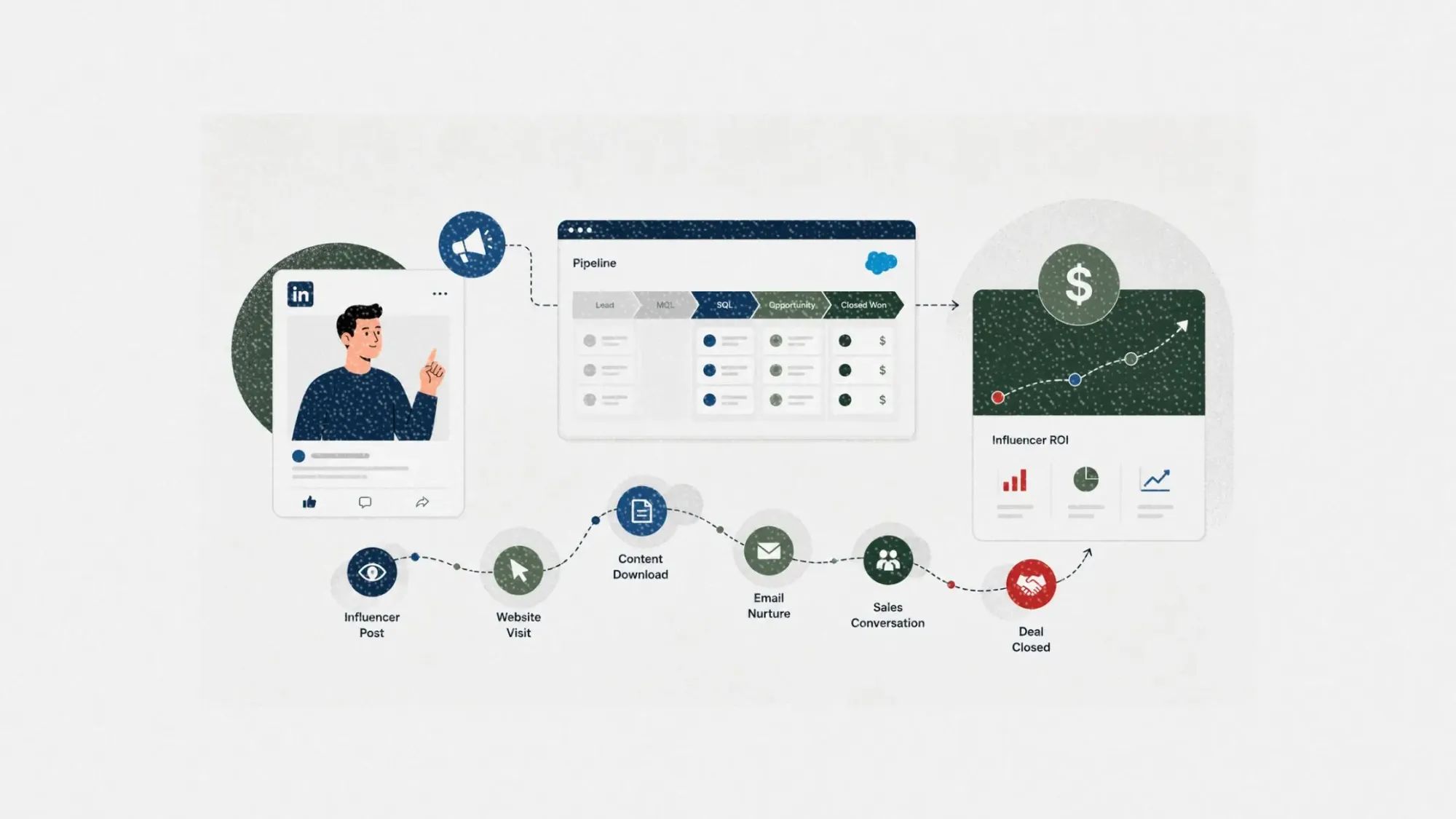
B2B buying does not work this way. Forrester research shows that B2B buyers now engage with 27 or more touchpoints across an extended sales cycle before making a purchase decision. A creator's LinkedIn post might be touchpoint three. The demo request might be touchpoint 14. The closed deal might be touchpoint 27, appearing in the CRM 90 to 180 days after the creator content was first seen.
Last-touch attribution, which credits the final interaction before conversion, would give that creator zero credit for the deal. Yet the creator may have been the first touchpoint that introduced a prospect to your brand, the moment that seeded awareness in a decision-maker's mind months before they ever clicked on a paid ad.
The State of B2B Marketing Attribution 2025 report by Revsure.ai found that only 18.2% of B2B marketers currently use integrated attribution across channels, with the rest still measuring success in silos. And 67% of B2B marketing teams continue to rely on last-touch attribution despite its well-documented limitations for complex buying journeys.
This is the real reason most B2B marketers cannot prove influencer ROI. It is not that influencer marketing does not work. It is that the measurement architecture was designed for a different type of sale.
Redefining return for B2B influencer programs
Before building a measurement framework, B2B teams need to agree on what "return" means in their specific context. This is not a philosophical exercise. It is a budget-defense requirement.
In B2C, return typically means revenue directly attributed to a creator's content, tracked via promo codes, affiliate links, or UTM-tagged landing pages. In B2B, return is multidimensional and time-delayed. The clearest way to define it is across three layers.
The first layer is pipeline influence. Did your creator program contribute to qualified opportunities entering your sales pipeline? This does not require direct attribution. It requires evidence that prospects who engaged with creator content moved further, faster through your funnel than those who did not.
The second layer is deal acceleration. Did accounts that were exposed to creator content close faster or at a higher conversion rate than your baseline? According to research cited by Stormy AI and corroborated by multiple B2B CRM studies, prospects who engage with a B2B creator's content before a discovery call close 20 to 30% faster than cold leads. That acceleration has a dollar value: shorter sales cycles free up capacity and reduce cost per close.
The third layer is brand search and category authority. Creator content drives branded search volume, which correlates with inbound lead quality. If your brand's share of voice grows alongside a creator program, and inbound lead quality improves, that is a measurable return even without direct attribution.
"We push clients to stop asking whether influencer ROI exists and start asking which layer of return matters most for their current business stage," says Dinda Anandita, Account Director at content-led comms agency Content Collision. "An early-stage SaaS brand needs category awareness and branded search. A Series B company needs pipeline velocity and cost-per-MQL. The measurement framework should match the stage, not just the channel."
The B2B influencer ROI framework
This framework has four sequential steps. Teams should complete each step before moving to the next, because each one depends on the clarity of the previous.
Step 1: Define your B2B conversion events. A B2B conversion is not a purchase. It is a meaningful action that signals buying intent and moves a prospect toward a sales conversation. Common B2B conversion events include demo or discovery call bookings, gated content downloads (pricing pages, ROI calculators, case studies), webinar registrations, free trial signups, and newsletter subscriptions from target accounts. Choose two to three conversion events that your sales team agrees are legitimate demand signals. Everything else is a proxy metric.
Step 2: Build creator-specific tracking infrastructure before launch. This is non-negotiable and is where most B2B influencer programs fail before they start. Every creator should have a unique UTM-tagged landing page or link. The UTM parameters should capture source (the platform), medium (influencer), and campaign (the specific creator or campaign name). These links feed directly into Google Analytics 4 and, via integration, into your CRM. Without this infrastructure in place before the creator posts, attribution becomes guesswork after the fact.
Step 3: Establish your attribution window. B2B sales cycles do not close in 72 hours. Set your attribution window to match your average sales cycle. For most B2B SaaS companies, a 90-day attribution window is the minimum. Enterprise deals with six-plus-month cycles may need 180 days. This window defines how long after a creator touchpoint you will continue tracking influenced conversions. It is the single most important structural decision in your ROI framework.
Step 4: Define your baseline before campaign launch. ROI measurement requires a before and after comparison. Before your creator program begins, document your baseline metrics: average inbound leads per month, average time from first touch to demo booking, average close rate for inbound leads, and branded search volume. You cannot prove lift without a baseline.
Attribution windows for B2B sales cycles
The attribution window question deserves its own section because it is where B2B influencer measurement most commonly breaks down.
Most marketing platforms default to 7-day or 30-day attribution windows. These are reasonable for e-commerce. For B2B, they cut off the majority of the conversion journey. A prospect who sees a creator's LinkedIn post in week one, downloads a whitepaper in week three, attends a webinar in week six, and books a demo in week ten will appear as an unattributed organic conversion in a 30-day window.
The practical solution is to run two parallel attribution models. Use a 30-day window for reporting to stakeholders who need monthly updates, and flag it explicitly as a partial view. Use a 90-day or full-cycle window as your primary ROI model for program optimization decisions.
In your CRM, tag every contact whose first known touchpoint was creator-sourced, regardless of when they eventually convert. This allows you to build cohort data over time. After two to three campaign cycles, you will have enough cohort data to demonstrate that creator-first prospects convert at a different rate, velocity, or average contract value than non-creator prospects. That cohort comparison is more persuasive to a CFO than any single-campaign ROI calculation.
The KPIs that matter and the ones to ignore
Most B2B influencer measurement reports include metrics that CMOs accept as proof and metrics that are vanity dressed as data. The following is a working distinction between the two.
KPIs that move the needle in B2B contexts include creator-attributed UTM traffic to high-intent pages such as pricing, demo, or case study pages; demo or trial bookings from creator-tagged sources; pipeline influence rate, meaning the percentage of open opportunities that had at least one creator content touchpoint; deal velocity comparison between creator-influenced and non-influenced prospects; and branded search volume changes measured via Google Search Console during and after campaign periods.
KPIs that look good in a slide but mean little in B2B contexts include total impressions and reach (awareness metrics with no proven connection to pipeline), engagement rate in isolation without context about the quality of engagement, follower count of the creator, and estimated media value, which is a methodologically inconsistent metric that most CFOs rightly question.
There is one nuanced exception: comment quality. In B2B, the quality of engagement under a creator's post can be a leading indicator of audience relevance. A LinkedIn post with 300 comments from CFOs and heads of procurement in your target vertical is more valuable than a post with 3,000 emoji reactions from a generalist audience. Qualitative audit of creator comments once per quarter is worth doing, even if it cannot be automated.
According to Sprout Social's Q1 2025 Pulse Survey, 67% of B2B brands cite brand awareness as their primary influencer marketing goal, with 55% aiming for revenue growth and 54% focused on credibility and trust. Teams that conflate all three into one ROI model end up with a framework that measures nothing clearly. Separate your awareness KPIs, your credibility KPIs, and your pipeline KPIs into distinct tracks with distinct reporting cadences.
Connecting creator activity to your CRM
The gap between creator content and CRM data is where B2B influencer ROI arguments fall apart. Closing it requires technical setup that most influencer marketing guides skip because it is less glamorous than creator strategy. Here is the minimum viable setup for connecting creator activity to pipeline in Salesforce or HubSpot.
In HubSpot, create a custom contact property called "Creator first touch" and populate it automatically when a contact arrives via a creator-specific UTM. Set up a workflow that tags these contacts with a campaign label and adds them to a creator-influenced list. Build a custom report that tracks conversion rate and deal velocity for this list versus your general inbound list.
In Salesforce, use campaign membership to capture creator-influenced contacts. Create a campaign for each creator or creator cohort. When a contact converts via a creator UTM, add them to the relevant campaign in Salesforce and track campaign-influenced pipeline using the standard campaign influence reporting. This allows you to report on creator-influenced pipeline value without requiring direct attribution, which is the right goal for B2B.
For teams not yet on enterprise CRM plans, Google Analytics 4's assisted conversion report is a reasonable proxy. It shows which traffic sources contributed to a conversion path even when they were not the final touchpoint. UTM-tagged creator content will appear in assisted conversions for any prospect that came through a creator link before eventually converting on your site.
Tools like Dreamdata and HockeyStack offer more sophisticated B2B-specific attribution that connects marketing touchpoints to CRM deal stages without requiring manual setup. For teams spending US$50,000 or more annually on influencer programs, the investment in a dedicated B2B attribution platform is justified.
What good looks like at each stage of program maturity
B2B influencer programs rarely produce clean ROI data in month one. Expectations should be calibrated to program maturity.
In months one to three, you are building infrastructure and baseline data. Meaningful success at this stage looks like creator UTM tracking fully operational, at least one conversion event producing data, and a baseline for branded search volume and inbound lead rate established. ROI claims at this stage are premature and will not survive CFO scrutiny.
In months four to six, you should be seeing early cohort data. Creator-tagged contacts should be appearing in your CRM. You may not have enough volume to demonstrate statistical significance, but you can show directional indicators: creator-sourced contacts converting at a similar or better rate than other inbound channels, deal velocity data starting to accumulate.
From month seven onwards, with consistent program execution and a 90-day attribution window, you should have enough cohort data to make a credible ROI argument. At this point, compare creator-influenced pipeline value against program cost, including creator fees, platform costs, and internal time. If creator-influenced pipeline value is two to three times program cost, the program is likely generating positive ROI even before accounting for the brand authority and SEO compounding effects.
TopRank Marketing's 2025 B2B Influencer Marketing research found that teams using an always-on influencer approach, meaning continuous creator relationships rather than one-off campaigns, rated their programs as effective 99% of the time, and were 17 times less likely to report program ineffectiveness compared to campaign-based teams. The implication for ROI measurement is that always-on programs produce more consistent data and more defensible attribution, because the measurement infrastructure compounds over time rather than resetting with each campaign.
For a detailed breakdown of creator costs across tiers and platforms, which feeds directly into your ROI cost-side calculation, see our influencer marketing cost guide.
ROI is a conversation, not a calculation
The most sophisticated ROI framework in the world will not protect your influencer budget if your CFO does not understand what they are looking at. The final step in any B2B influencer ROI program is translating measurement data into a language that resonates with financial decision-makers.
Three principles make that translation work.
Speak in pipeline, not impressions. The moment you present an influencer report with reach or engagement as the headline metric, you have lost the CFO. Lead with pipeline influenced, cost per influenced opportunity, and deal velocity comparison. Put the engagement data in the appendix.
Show the trend, not the snapshot. A single campaign's ROI data is too noisy to be persuasive. Two or three campaign cycles of data showing consistent pipeline influence is a trend. Trends justify budget continuation and growth. Snapshots justify skepticism.
Acknowledge what you cannot measure. Dark social, direct shares, private Slack recommendations, and word-of-mouth from creator content cannot be tracked. Acknowledging this proactively rather than claiming perfect attribution actually increases credibility with financially literate audiences. Say something like: "These numbers represent the measurable portion of creator impact. Word-of-mouth and dark social influence are real but not captured in this model." That honesty typically lands better than an overconfident ROI claim.
The B2B marketers who protect and grow their influencer budgets are not the ones with the best analytics setups. They are the ones who have done the patient work of connecting creator activity to the metrics their CFO already cares about, and who have built enough historical data to show that the connection is real.