Why human-sounding emails are outperforming AI personalization
New data shows human-sounding emails outperform AI personalization

AI has made it easier than ever to scale email marketing. But while teams are producing more content, they are not necessarily getting better results. In fact, new data suggests the opposite may be happening.
A recent Adobe Express survey of 1,007 US consumers shows that the biggest driver of email engagement is not personalization, automation, or even relevance. It is something far less technical and much harder to scale: whether the email sounds like it was written by a real person.
This article explores why tone is emerging as a performance lever, where AI falls short, and how marketers can adapt before efficiency starts hurting engagement.
Short on time?
Here’s a table of contents for quick access:
- Why tone is becoming the most important email performance lever
- Why personalization is losing to human-sounding content
- Why Gen Z is forcing marketers to rethink AI email tone
- What marketers should know about fixing tone in AI-generated emails
 Patrecia Meliana
Why tone is becoming the most important email performance lever
For years, email marketing has been driven by data. More personalization, better segmentation, and tighter targeting were seen as the path to higher engagement.
But this report challenges that assumption.
When asked what makes a marketing email appealing, 60% of consumers said that emails that “sound like a real person wrote them” matter most. Relevance followed closely at 59%, while basic personalization like including a recipient’s name lagged far behind at just 26%.
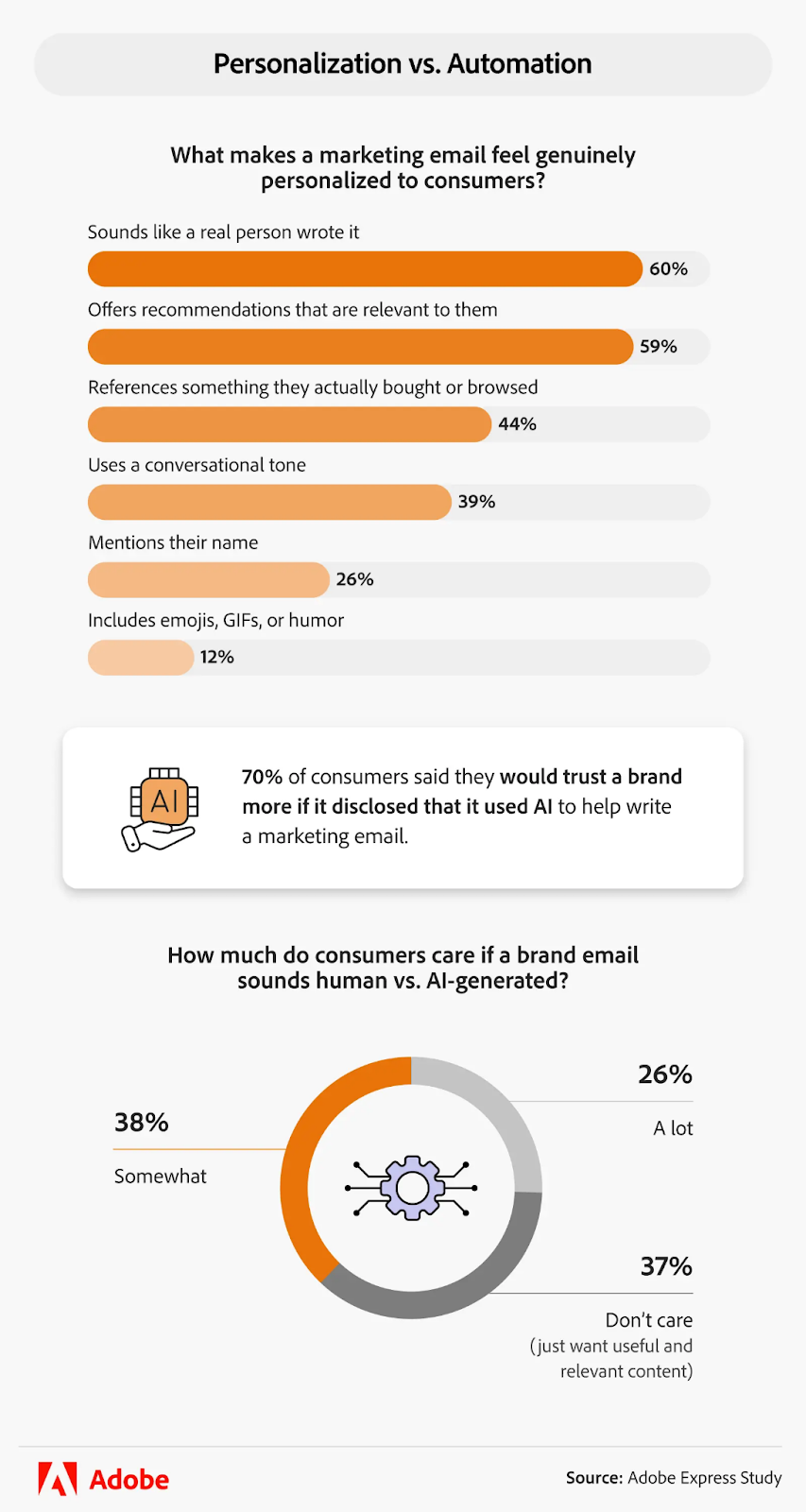
At the same time, 68% of respondents said tone directly affects whether they stay subscribed to a brand’s emails.
This signals a shift in how email performance should be understood. Tone is no longer a creative detail. It is a core performance variable that influences both engagement and retention.
Why personalization is losing to human-sounding content
The data points to a growing mismatch between what marketers optimize for and what consumers actually respond to.
Traditional personalization strategies focus on:
- Names
- Behavioral triggers
- Segmented offers
But these signals are increasingly seen as table stakes. They do not guarantee that an email feels thoughtful or intentional.
Meanwhile, AI-generated emails often excel at structure and relevance but struggle with nuance. The result is content that is technically correct but emotionally flat. This becomes a problem when tone signals intent.
Consumers associate certain patterns with low-effort communication:
- Overly polished language
- Generic phrasing
- Excessive sales pressure
In fact, 78% of respondents said emails that feel too salesy or pushy are the biggest turn-off, followed by wordy emails at 46% and generic messaging at 37%.
This explains why less polished, more human-sounding emails often perform better. According to the study, 37% of consumers trust brands more when emails feel human, even if they are less refined.
Why Gen Z is forcing marketers to rethink AI email tone
Not all audiences respond to AI-generated emails the same way, and this is where things get more complex.
Gen Z stands out as the most tone-sensitive group in the study:
- 72% say tone affects whether they stay subscribed
- Only 20% say they do not care if an email sounds AI-generated
They are also the most confident in identifying AI-written content. This combination makes Gen Z a critical audience segment for marketers relying on automation. They are more likely to notice when something feels off and more likely to disengage because of it.
But this is not just a generational quirk. It is an early signal of a broader shift.
Gen Z has grown up in an environment saturated with digital content, making them more attuned to patterns, repetition, and inauthentic tone. What they reject today may become a wider expectation across other segments over time.
In that sense, Gen Z is not just another audience. They are a leading indicator of where content expectations are heading.
 Patrecia Meliana
What marketers should know about fixing tone in AI-generated emails
The challenge is not to reduce AI usage, but to improve how its output is shaped and delivered.
Here are practical ways to approach tone more effectively:
1. Prioritize tone in your workflow, not just at the end
Tone should not be a final edit. It should be built into prompts, templates, and review processes from the start.
2. Avoid over-optimization
Highly polished content can feel artificial. Leaving room for natural phrasing and variation can make emails feel more genuine.
3. Train AI on real brand voice, not generic examples
Generic training inputs lead to generic outputs. Use past high-performing emails to guide tone.
4. Add a human editing layer where it matters most
AI can handle scale, but humans are still better at nuance. A quick human pass can significantly improve perceived authenticity.
5. Test tone as a variable, not a constant
A/B testing should go beyond subject lines and offers. Test different tonal approaches to understand what resonates with your audience.
AI has solved many of the operational challenges in email marketing, but it has also exposed a new limitation. Efficiency alone does not drive engagement. Tone does. The Adobe Express data makes it clear that consumers are not just evaluating what emails say, but how they say it.
For marketers, the next phase of email optimization will not be about adding more data or automation. It will be about mastering tone at scale without losing the human feel that audiences still expect.