Liquid Death uses AI to shorten its marketing decision cycle
Liquid Death's AI workflow connects intelligence to action. The evidence supports a change in operating cadence, not a proven financial return.


Liquid Death is using AI to bring campaign analysis and action closer together. At Advertising Week New York on October 5, chief media and digital commerce officer Benoit Vatere described a move toward daily retail-media optimization, supported by agency partner Power Digital.
The partnership uses Iris, Omega and Creative Affinity, an ecosystem Power Digital detailed in its official announcement. The strategic question is whether connecting intelligence to execution can help a small team make better decisions without adding another layer of reporting.
Table of contents
Jump to each section:
- Why daily decisions change the AI business case
- What the agency operating system adds
- Why a lean team still needs human judgment
- What marketers should know about AI-native operations
Why daily decisions change the AI business case
“We optimize our campaign on a daily basis, especially on the retail media side,” Vatere said. Previously, reviews happened weekly or twice weekly.
That change is useful evidence of an altered workflow. It is not proof that more frequent intervention improves returns. A team can react faster and still make poor decisions if it mistakes short-term variation for a meaningful signal.
The practical value of AI here lies in reducing the effort required to understand what deserves attention. When gathering and interpreting information takes less work, marketers can reserve more time for deciding whether a campaign needs an adjustment, further investigation, or no action at all.
Decision speed matters only when the team knows which decisions to accelerate.
For marketing leaders, this changes how an AI investment should be assessed. Counting prompts or generated reports says little about whether an operational bottleneck has been removed. A more useful question is whether the system helps a responsible person reach a defensible decision sooner.
What the agency operating system adds
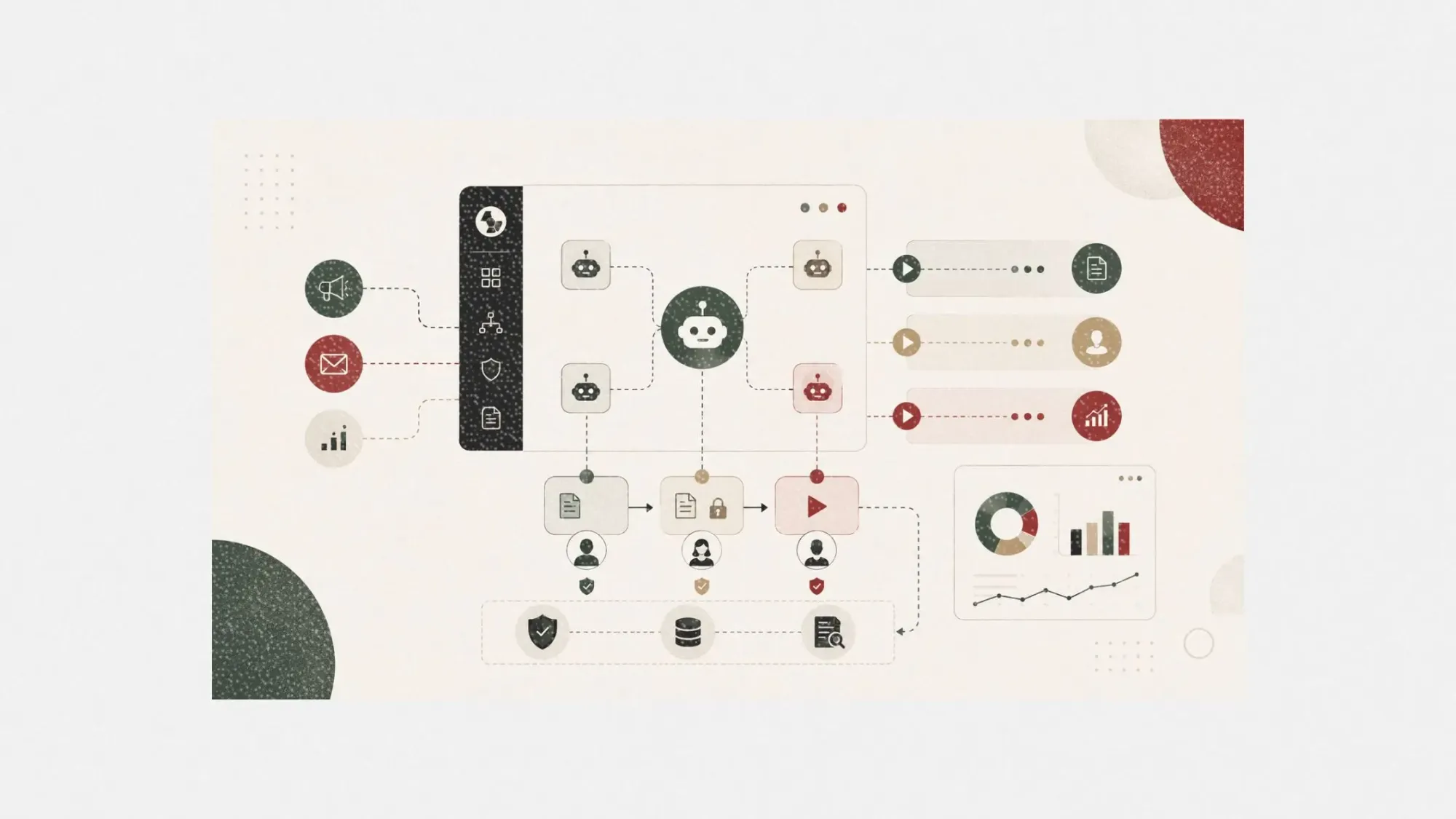
Power Digital describes Iris as the intelligence layer, Omega as the environment for campaign execution, and Creative Affinity as the creative-analysis layer. Its announcement says strategists approve agent actions and that recommendations are logged against KPIs.
That architecture separates generating an answer from carrying out work. A general-purpose assistant may help someone interpret a question. An operating environment must also connect the answer to permissions, campaign context and an accountable action.
| Layer | Role described by Power Digital |
|---|---|
| Iris | Interprets business signals and recommends growth decisions. |
| Omega | Connects recommendations to approved campaign actions. |
| Creative Affinity | Analyzes creative assets to inform creative effectiveness. |
The table describes the agency's product design, not independently verified performance. For buyers, that distinction creates a straightforward evaluation standard: ask how a recommendation moves through approval, execution and measurement, rather than accepting the existence of an intelligence layer as the outcome.
The interface is only as useful as the decision process behind it.
Shared access can also make the agency relationship more inspectable. A client should be able to understand why an action was proposed and who approved it. Otherwise, faster execution simply makes an opaque process harder to question.
Why a lean team still needs human judgment
17 iterations in three weeks. Liquid Death refined its Omega application repeatedly during that period, according to the company's panel discussion.
Repeated iteration suggests that the application is being adapted to the work. It does not establish product maturity or commercial success. Marketing teams evaluating a similar approach should distinguish useful refinement from changes made because the system cannot yet support a stable workflow.
Two internal people. Operating a sizeable budget with that internal staffing level is a goal described by Benoit Vatere, not an achieved staffing benchmark.
A lean internal team can still depend on substantial agency expertise, engineering and review. Any assessment of efficiency needs to include that supporting work. Moving a task outside the brand's headcount does not make its cost disappear.
The tension is that AI promises less manual effort while introducing a new responsibility: deciding what the system should be allowed to do. Human approval should therefore be part of the operating design, with reviewers able to inspect the reasoning and underlying data.
Automation can reduce handling time. Accountability still needs an owner.
What marketers should know about AI-native operations
Liquid Death offers an operating-model example worth examining, with evidence concentrated in workflow changes rather than measured financial outcomes.
Measure the bottleneck. Identify where campaign decisions wait for information or coordination. That gives an AI project a clearer purpose than a broad instruction to increase adoption.
Keep approval meaningful. A reviewer needs enough context to challenge a recommendation. A fast confirmation button is not a substitute for informed judgment.
Count the whole delivery model. Evaluate internal work alongside agency services, engineering and maintenance. Lean staffing and lower total operating cost are different questions.
Protect the learning loop. Connect actions to outcomes so the team can test whether its decisions improved the business. Faster activity should remain open to correction.
The wider opportunity is to build marketing operations that can learn without accumulating unnecessary coordination work. That requires consistent business definitions and clear responsibility as much as capable software.
For brand leaders, the next AI conversation may be less about which model employees use and more about which decisions the organization can make, explain and revisit. That is a more demanding standard, but also a more useful one.