Live shopping gains traction as brands see stronger ROI on TikTok and creator-led streams
New Adobe Express data shows how platforms, creators, and real-time tactics are reshaping social commerce performance

Live shopping is steadily moving from experimental to essential. New data from Adobe Express shows that both content creators and brands are not just testing the format, they are generating measurable revenue and rethinking how sales and engagement happen in real time.
For B2B marketers and PR professionals, the takeaway is clear: live shopping is no longer a niche channel. It is becoming a serious part of the commerce mix, especially where content, community, and conversion overlap.
This article explores what the latest live shopping data reveals about platform performance, buyer behavior, and the tactics that actually drive conversions.
Short on time?
Here’s a table of contents for quick access:
- Why live shopping is becoming a core revenue channel
- Which platforms deliver the highest ROI for live shopping
- What drives conversions during and after live shopping events
- What marketers should know about scaling live shopping
 Patrecia Meliana
Why live shopping is becoming a core revenue channel
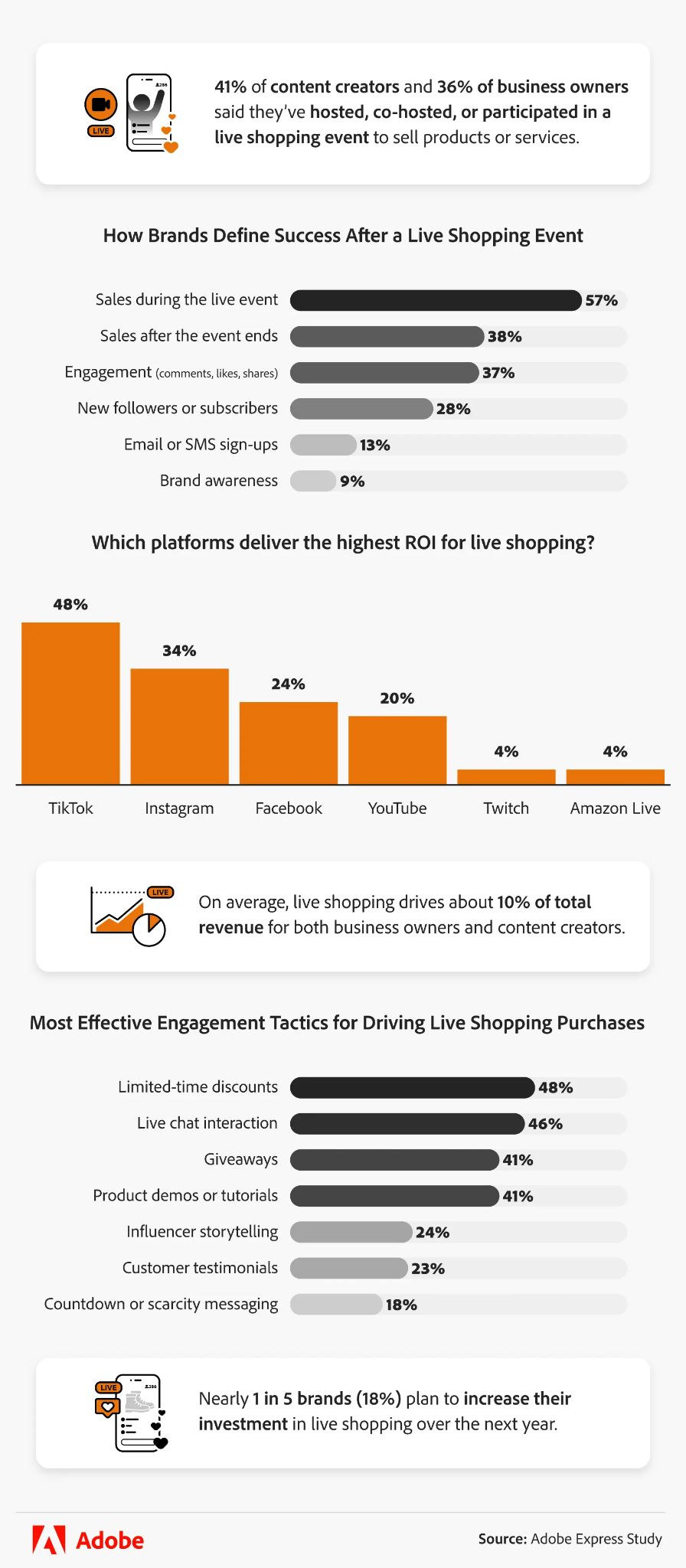
Adobe’s data shows that 41% of content creators and 36% of business owners have already hosted, co-hosted, or participated in live shopping events. More importantly, this is not just experimentation. On average, live shopping accounts for about 10% of total revenue for both groups.
Even more telling, 43% of brands said live shopping outperformed their other sales channels. That suggests a shift in how audiences prefer to discover and buy products, especially when real-time interaction is involved.
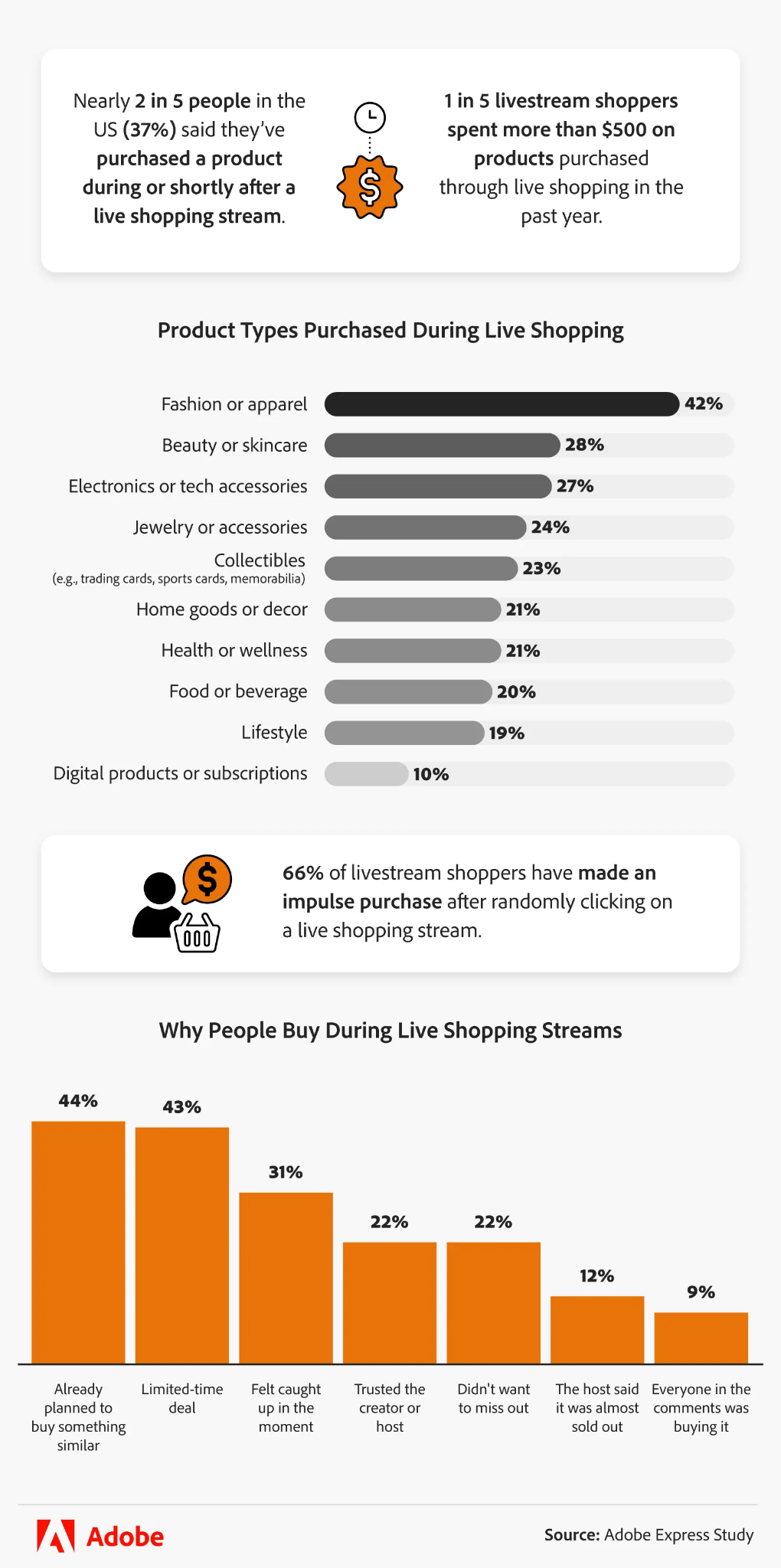
Consumer behavior supports this trend. Nearly 37% of US shoppers reported purchasing during or shortly after a live stream, and one in five spent more than US$500 on live shopping purchases in the past year. Discovery is also a major driver, with 80% of viewers finding new brands or products through live events.
This trend is even stronger among Gen Z, where 85% report discovering new products via live shopping, reinforcing its role as a key channel for younger audiences.
This positions live shopping as both a performance channel and a discovery engine, something traditional e-commerce struggles to balance.
 Brandon T. Suss
Which platforms deliver the highest ROI for live shopping
When it comes to ROI, platform choice matters. Brands overwhelmingly point to TikTok as the top performer, with 48% citing it as delivering the highest return.
Instagram follows at 34%, while Facebook (24%) and YouTube (20%) still play meaningful roles. Twitch and Amazon Live trail behind at just 4% each.
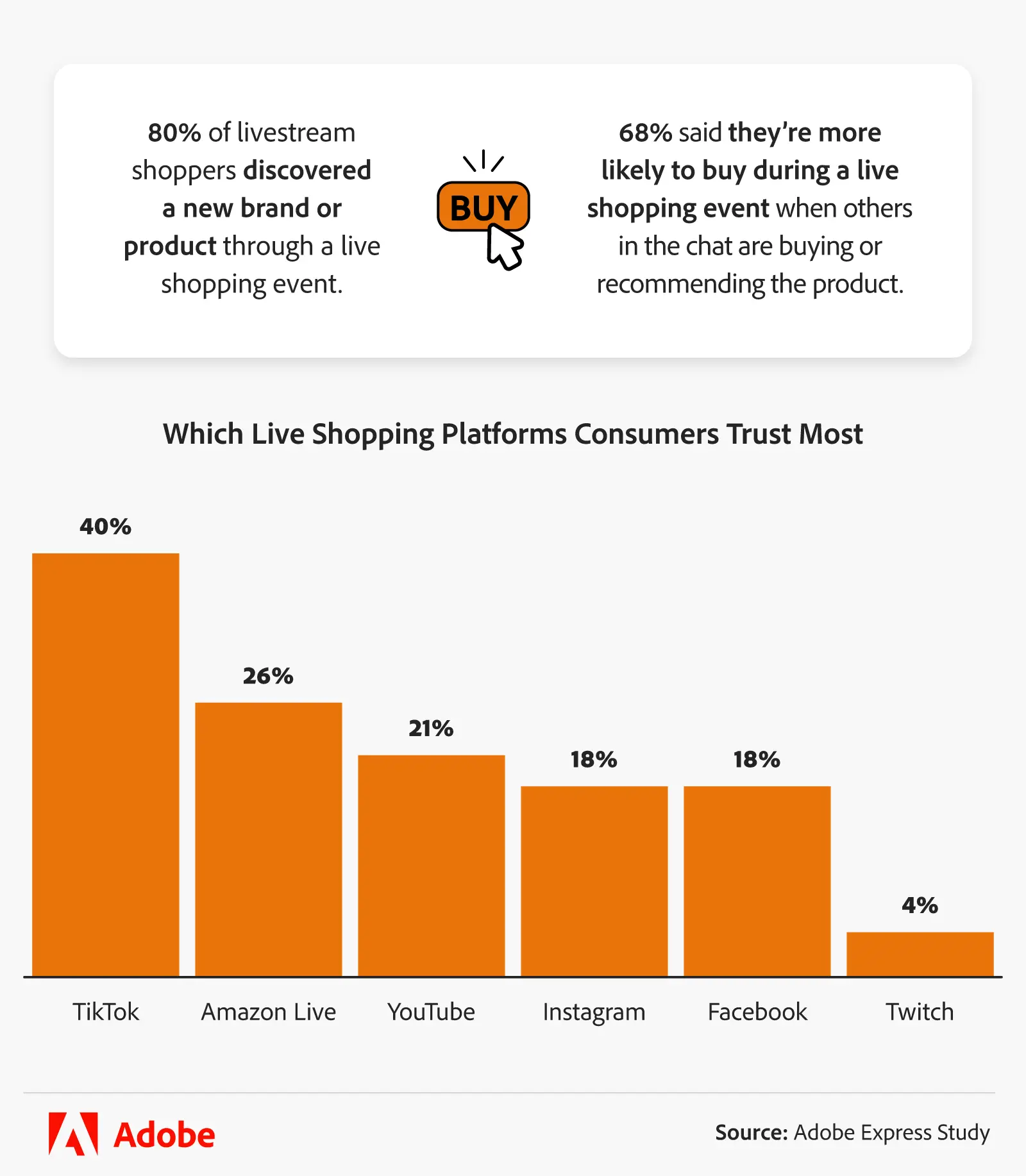
Trust levels tell a slightly different story but reinforce TikTok’s dominance. Consumers ranked TikTok highest in trust at 40%, followed by Amazon Live at 26% and YouTube at 21%.
The takeaway is not just about reach. TikTok’s format, which blends entertainment, algorithmic discovery, and native shopping behaviors, appears to create the right conditions for both trust and conversion. For marketers, this signals a platform hierarchy where TikTok leads for performance, while others serve more complementary roles depending on audience and content strategy.
What drives conversions during and after live shopping events
Live shopping success is not just about going live. It is about how the experience is structured.
During events, the most effective tactics include limited-time discounts (48%), live chat interaction (46%), giveaways (41%), and product demos (41%). These tactics create urgency and keep audiences engaged in real time.
Social proof also plays a significant role. About 68% of consumers said they are more likely to buy when others in the chat are purchasing or recommending products.
After the stream ends, sales continue. Around 24% of purchases happen post-event, driven by tactics like promo codes (47%), pinned or reposted product links (39%), and follow-up emails or texts (39%).
Impulse behavior is another factor. 66% of livestream shoppers reported making a purchase after randomly clicking into a stream, highlighting how discovery and spontaneity drive conversions.
 Patrecia Meliana
What marketers should know about scaling live shopping
For marketers looking to move beyond testing, the data points to a few clear priorities:
1. Focus on creator-led formats
Influencers or creators are the most effective hosts (34%), outperforming brand-only streams. Co-hosted formats also work well, blending credibility with brand messaging.
2. Treat live shopping as a full-funnel channel
It is not just about the live moment. Pre-event promotion and post-event follow-ups are critical for maximizing ROI.
3. Design for interaction, not just presentation
Live chat, real-time feedback, and social proof are key conversion drivers. Static product showcases are not enough.
4. Start small but stay consistent
Most brands run live shopping events a few times per year (55%), but those running monthly or more frequently are building stronger momentum and learning faster.
5. Reduce creative friction with tools
Adobe Express highlights tools like AI-powered video editing, clip generation, and design automation to streamline content production. This is especially relevant for teams that lack in-house production resources.
For teams hesitant to adopt, the barriers are familiar: lack of interest (42%), limited expertise (40%), and uncertainty about ROI (23%). The data suggests those concerns are increasingly outdated as performance benchmarks become clearer.
Live shopping is evolving into a hybrid of content, commerce, and community. It rewards brands that can combine storytelling with real-time engagement and follow through with post-event conversion strategies.
For marketers, the opportunity is not just to sell during a stream, but to build a continuous loop of discovery, engagement, and revenue. Those who treat live shopping as a structured, repeatable channel rather than a one-off campaign are more likely to see meaningful returns.
As platforms mature and tools improve, the gap will widen between brands that experiment occasionally and those that operationalize live commerce as part of their core strategy.