
McDonald’s Philippines uses an AI pop star to spotlight why fries are social
McDonald’s Philippines introduces Chip, an AI pop star, to frame fries as shared memories, backed by a music video and weekly Fryday activations.

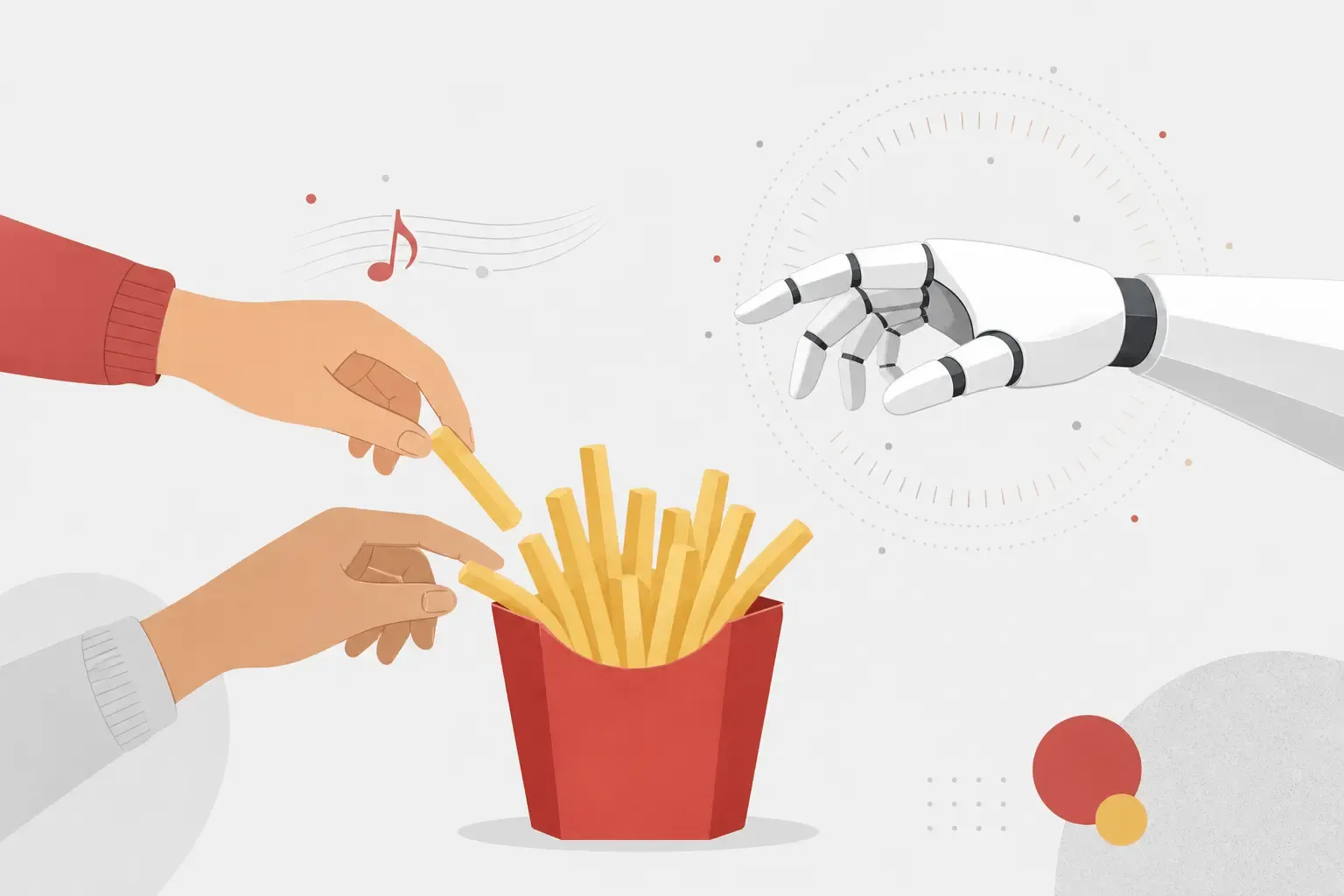
Sharing fries is one of those tiny rituals that feels bigger than it is. It is the grab from the carton, the unspoken “you want some?”, and the way a snack becomes a marker for hanging out after school, post-movie decompression, or late-night drives.
McDonald’s Philippines is leaning into that human truth with a campaign built around “Chip”, a fictional AI pop star who can study people’s cravings and habits, but cannot actually feel the memories attached to them. The company outlined the idea in an official campaign announcement.
Table of contents
Jump to each section:
- Why an “AI pop star” fits a very human fries ritual
- What McDonald’s Philippines is actually doing in “AI wanna taste it”
- The creative tension: using AI to argue AI has limits
- What this means for marketers
Why an “AI pop star” fits a very human fries ritual
The fun of Chip as a character is that he is built to be obsessed, in the way fandoms get obsessed. He is not just “AI in an ad”. He is a stand-in for the internet’s always-on attention, looking at humans like they are the interesting part of the story.
And for fries specifically, that framing makes sense because fries are rarely a solo experience in how people talk about them. The product is tied to moments that are easy to remember and easy to share: after-school snacks, movie nights, road trips, and the late-night “we should eat something” detours. The campaign uses that emotional shorthand rather than trying to convince people that fries are culturally relevant. It assumes they already are.
 ContentGrip
What McDonald’s Philippines is actually doing in “AI wanna taste it”
At the centre of the campaign is a music video that introduces Chip and follows his fascination with why people keep coming back to McDonald’s World Famous Fries, not only for taste, but for the memories that surround them.
McDonald’s Philippines said Chip will keep appearing across its social channels in the coming weeks, with the character trying to understand what fries represent beyond flavour.
The brand is also turning “Fryday” into a recurring moment: every Friday from 17 July to 28 August, it plans to encourage customers to gather over fries through a series of activations.
On the production side, the campaign blends live-action filmmaking with AI production. It was directed by Joel Limchoc of Film Pabrika, with music composed by Loudbox Studios, and developed with Leo Manila.
The creative tension: using AI to argue AI has limits
A lot of AI-themed advertising falls into a familiar pattern: either “look what the tech can do” or “don’t worry, humans still matter”. McDonald’s Philippines tries to hold both ideas at once, but with a clearer emotional target.
Chip can analyse behaviour, conversations, and patterns. That is the point of the character. But the campaign’s claim is that analysis is not the same as experience. Fries, in this framing, are not just a product with good metrics. They are a product with personal context.
That choice keeps the story from becoming a tech demo. AI is used as a narrative device to make the audience notice something they already feel: the human part of eating together is not reducible to data, even if the data proves the habit is real.
What this means for marketers
Using AI inside a story works best when the “AI” is not the point. Here, it is a mirror for human behaviour.
- Make the emotion legible before the tech appears
The campaign is rooted in recognisable moments (after school, movie nights, late-night cravings, road trips). That gives the AI character something to contrast against, instead of asking viewers to care about AI on its own. - Treat AI as a character, not a feature list
Chip is positioned like a pop-cultural figure who is curious and slightly outside the human experience. That is more shareable than generic “AI-powered” claims because it gives audiences a persona to follow across social content. - Build recurring rituals, not just a one-off video
The “Fryday” run (17 July to 28 August) turns the idea into a repeated moment people can participate in. That is how campaigns move from “I saw it” to “I did it”. - Let production choices support the idea, quietly
Blending live-action filmmaking with AI production fits the theme of human experience versus machine observation. Marketers do not need to overexplain the toolchain if the output matches the story. - If you are using AI creatively, be clear about what AI cannot do
The campaign’s core tension is a useful template: AI can study behaviour at scale, but it cannot replace the feeling that makes a ritual worth repeating. That distinction can help brands avoid AI messaging that feels cold or self-congratulatory.
The bigger cultural signal is that audiences are increasingly comfortable with “synthetic” characters, as long as the emotional centre stays human. People do not need a brand to prove it is cutting-edge. They need a reason to care, and ideally a reason to see themselves in the moment.
For marketing teams, this is a reminder that AI storytelling lands best when it is used to frame a human truth the audience already believes. When the product is tied to real-life rituals, AI can amplify the contrast, but it cannot be the substitute for the ritual itself.