
Priceline brings Penny AI chatbot to Snapchat ads
Priceline brings Penny into Snapchat chats. The key test is whether travel intent and trip details carry through to completed bookings.


Priceline is putting its AI travel assistant Penny inside Snapchat advertisements, allowing people to discuss trip ideas with the brand's chatbot before continuing the conversation on Priceline's booking platform. The November 10 campaign makes Priceline the first travel brand to use Snapchat's AI Sponsored Snaps. The arrangement extends an advertising format Snap introduced in April. Rather than asking audiences to leave a social platform immediately, the ad opens a brand-operated conversation in the app's Chat section. It is a practical test of whether a marketing interaction can carry enough useful context to make the next stage of shopping easier.
Table of contents
Jump to each section:
- Priceline takes Penny into Snapchat chats
- Why the handoff matters more than the message
- How conversational ads compare with a standard click
- What marketers should know about AI chat ads
Priceline takes Penny into Snapchat chats
Priceline's Sponsored Snap appears as a promoted message in Snapchat. People who choose to open it can ask Penny about destinations, draft itineraries and places to stay. If they move to Priceline to continue planning or book, details from the Snapchat conversation, including trip dates, can accompany them. The campaign is new, but Penny is not. Priceline expanded the assistant in June 2026, integrating Anthropic's Claude models into its own AI stack and connecting conversational requests with travel inventory, price comparisons and booking functions. That existing product infrastructure explains why the brand can bring an assistant into a new media placement instead of building an isolated advertising chatbot.

The following company demonstration shows Penny's earlier travel-planning experience. It predates the Snapchat campaign and is not footage of the new advertisement.
That distinction matters for marketers. The ad is a distribution experiment for a product that already has a service purpose. A chatbot without useful inventory, pricing or next-step functionality would offer a different customer experience.
Why the handoff matters more than the message
Conventional social advertising often treats the click as the critical transition: the person sees an ad and moves to a website or app, where the brand must learn what that person needs. Priceline is experimenting with a different sequence. Some preference gathering happens in the sponsored conversation, and the brand then tries to preserve it through the handoff. The real asset is not the chat transcript but the continuity of intent. A discussion about destination, dates and lodging matters commercially only if those inputs help the person complete a useful next step. That does not establish that Priceline's Snapchat campaign generates better results. The company has cited stronger conversion among people who use Penny on its own platform, but this reflects a different population and does not isolate the impact of the new ad format.
Approximately twice the conversion rate Priceline says users who engage with Penny convert at about twice the rate of non-Penny users on its platform, according to the disclosed campaign background. This is not a measured result of Priceline's Snapchat advertisement.
A difference between two groups is not proof that the assistant caused it. People who choose to use Penny may already be more motivated to book. Marketers evaluating conversational ads should therefore distinguish assisted bookings, incremental conversions and whether the same customer would have purchased without the chat.
How conversational ads compare with a standard click
AI Sponsored Snaps sits within a broader Snapchat messaging-ad offering. The important change is not simply that an advertiser appears in someone's inbox. It is that the message can become an interactive service operated by the advertiser.
| Experience | What a customer does | What a marketer needs to evaluate |
|---|---|---|
| Conventional ad or Sponsored Snap | Views promotional content and may follow its call to action | Response, downstream activity and attributable outcomes |
| AI Sponsored Snap | Opens a chat with the advertiser's AI agent and asks questions | Useful conversation, data handling and the next step after the chat |
| Priceline's Penny test | Discusses travel plans inside Snapchat, then continues on Priceline | Whether planning context survives and contributes to completed bookings |
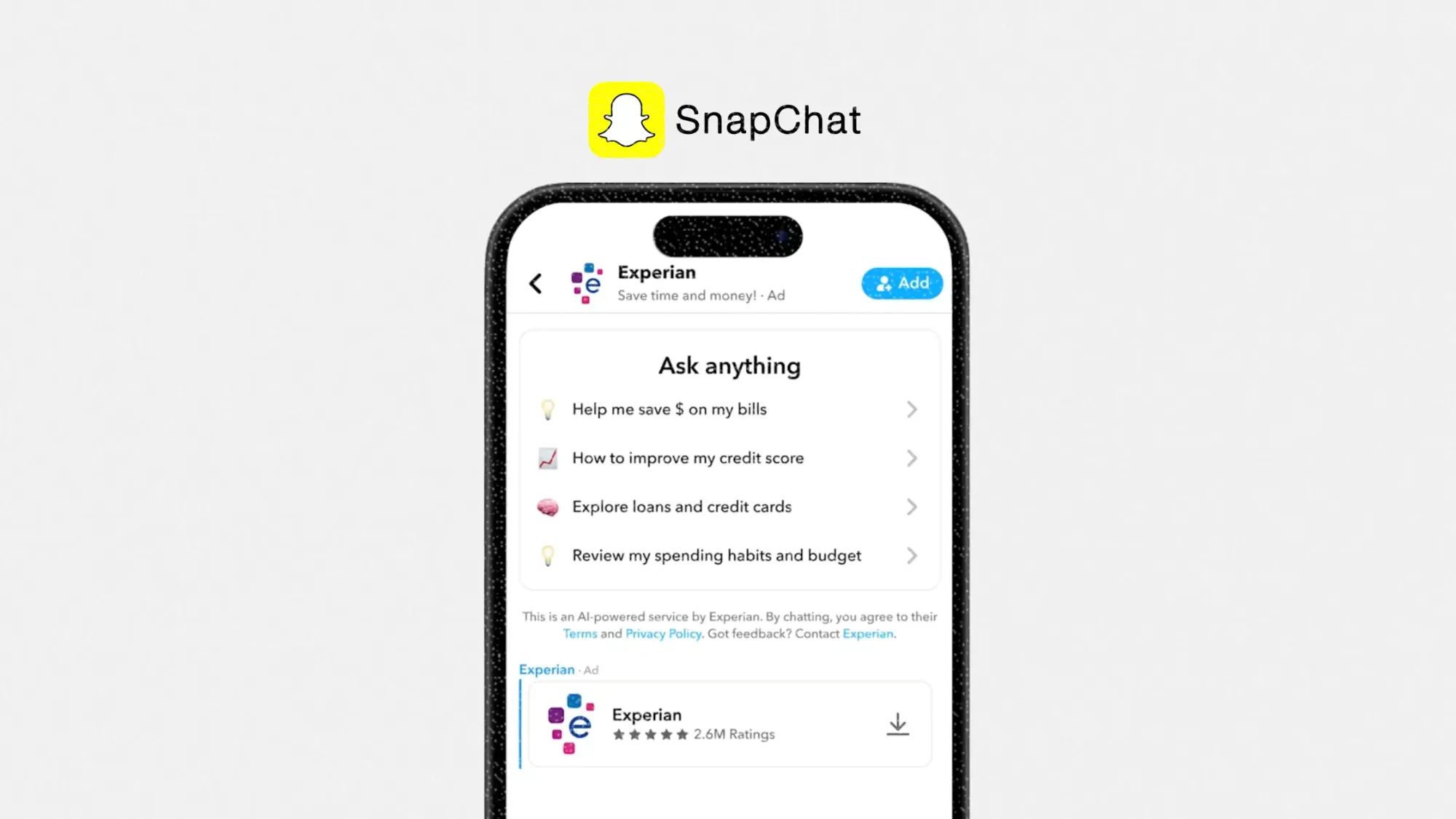
Snap had already identified financial-services company Experian as an early AI Sponsored Snaps partner, making Priceline a distinct travel-commerce application rather than the platform's first conversational brand experiment. Experian's original announcement described AI-led financial education within Snapchat rather than a shopping journey ending in a reservation or purchase. Snap has also publicized strong results for its broader Sponsored Snaps inventory. Those are relevant to Snapchat's sales pitch, but marketers should not transfer the benchmark to Priceline or assume that adding a chatbot produces the same performance.
22% more conversions and nearly 20% lower cost per action Snap says standard Sponsored Snaps achieve these differences against other inventory in its platform comparisons. The figures are not specific to AI Sponsored Snaps or to Priceline.
Ajit Mohan, Snap's chief business officer, put the platform's ambition in a sentence during its April launch: "Conversation is becoming the most valuable real estate in advertising." The unresolved question is not whether a conversation is engaging. It is whether engagement produces useful, measurable progress without adding friction to a customer's decisions.
What marketers should know about AI chat ads
Priceline's campaign offers a focused case for examining where agentic marketing begins and ends. The ad can answer questions, but a brand still has to decide what counts as success beyond a completed message exchange. Separate attention from intent. Conversations might indicate curiosity or an active purchase plan. An itinerary request is more actionable if subsequent booking behavior can be linked to it responsibly. Measure the handoff. The most revealing step in Priceline's design is the move from Snapchat to its own booking platform. Losing a traveler's dates or preferences at that point would weaken the purpose of the conversation, even if the ad drew responses. Treat disclosures as part of the experience. Snapchat's support guidance says the chat is run by the advertiser's bot, not Snapchat's My AI, and that messages are sent to the advertiser's AI service. The first interaction also includes links to the advertiser's terms and privacy policy. Customer expectations about who receives their information matter alongside conversion goals. Avoid borrowing another product's metrics. Penny's site-level conversion comparison and Snap's inventory-level advertising benchmarks describe different systems. Neither reveals the incremental performance of this specific campaign. If conversational advertising grows, the competitive difference may lie less in the sophistication of the model and more in the quality of the handoff between paid media and the customer's actual task. For travel, that task ends with workable choices and a booking, not a polished dialogue. Brands considering similar formats face a broader design question: are they building another advertising interaction, or connecting discovery to something their business can reliably deliver? The difference is where AI marketing becomes a customer-experience decision rather than a media-format experiment.
