Stop Managing Content Calendars. Start Building Proof Libraries
AI search rewards evidence more than publishing volume. Build proof libraries that help buyers, journalists, and AI systems verify your strongest claims.

AI has made generic content cheaper, faster, and less defensible. The content calendar was built for a market where publishing more often could still create an advantage. That market is fading.
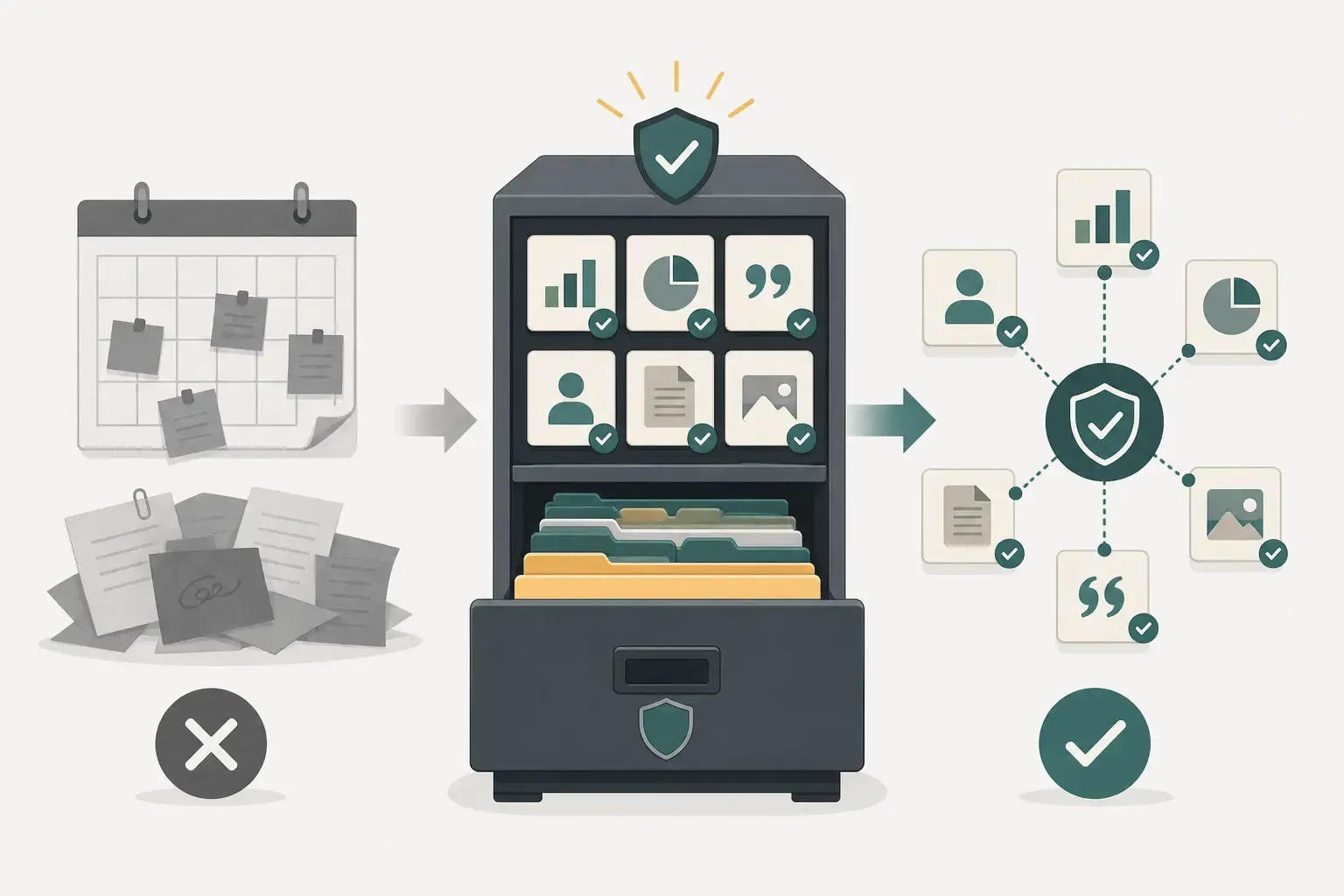
The better operating model is a proof library. Not a folder of case studies. Not a polished resource center. A proof library is the maintained evidence layer behind the brand's claims, examples, comparisons, expert points of view, customer outcomes, sourceable data, and third-party validation.
This matters because discovery is moving into environments where the brand no longer controls the order of persuasion. A buyer may see an AI answer first, a Reddit thread second, an analyst quote third, and the vendor's site only after the shortlist has already formed. In that path, the team with the clearest proof has more leverage than the team with the fullest calendar.
Key Takeaways
- AI search is making proof more valuable because buyers and machines both need evidence they can verify.
- A proof library gives content, PR, SEO, sales, and product marketing a shared evidence layer instead of scattered one-off assets.
- The strongest content strategy now starts with what the brand can prove, not how many pieces it can publish.
Table of contents
Jump to section:
- Why the content calendar is losing strategic value
- What a proof library changes
- Where proof should live outside the website
- How to measure proof without reducing it to traffic
- The teams that win will make verification easy
Why the content calendar is losing strategic value
The old calendar asked a simple question. What should we publish next?
That question still has operational value. Teams need deadlines, formats, channel owners, and launch dates. But as the primary strategic object, the calendar is weak. It pushes teams toward output before evidence, cadence before credibility, and distribution before proof.
The shift is already visible in search. AI systems can now answer informational queries without sending the user to the original publisher, which weakens the old bargain between content depth and organic traffic.
58% lower average clickthrough rate is what Ahrefs reported for top-ranking pages when AI Overviews appear, based on 300,000 keywords and Google Search Console data comparing December 2023 with December 2025.
That does not make content less important. It makes weak content less recoverable. A generic article can be summarized, compressed, or bypassed. A real example, proprietary benchmark, customer pattern, hard-earned comparison, or expert point of view gives both humans and AI systems something more useful to work with.
That is why ContentGrip's recent profile of Kickresume's least AI-written growth asset is more than a clever case study. Its strongest content is a page of real resumes from real people who got hired at recognizable companies. The asset works because it is not advice dressed up as expertise. It is evidence with context.
The content calendar rewards teams for filling slots. The proof library rewards teams for becoming harder to ignore.
What a proof library changes
A proof library changes the center of gravity from publishing management to claim management. Instead of asking which article, webinar, social post, or pitch should go live next, the team asks which claims deserve to be made more visible because the brand can support them better than competitors can.
That sounds subtle until the operating model changes. Content strategy becomes less about topic volume and more about evidence stewardship. PR becomes less about coverage volume and more about where third-party validation strengthens the brand's most important claims. Sales enablement becomes less about collateral freshness and more about helping buyers defend a decision internally.
| Operating unit | What it optimizes | What usually breaks |
|---|---|---|
| Content calendar | Publishing cadence, channel coverage, campaign support | Evidence gets scattered across assets, teams, and old campaigns |
| Proof library | Claim quality, verification paths, reusable evidence | It requires ownership across content, PR, product marketing, and sales |
For B2B teams, this is not theoretical. Buying groups already include people who rarely talk to sales but still shape the decision. Content has to travel inside those internal conversations without the marketer in the room.
64% of hidden decision-makers said thought leadership is more trustworthy than marketing materials and product sheets when assessing capabilities, according to the 2025 Edelman-LinkedIn B2B Thought Leadership Impact Report.
A proof library serves those hidden buyers because it gives them material they can reuse. It also serves journalists, analysts, creators, partners, and AI systems because it makes the brand's strongest evidence easier to find, cite, and compare.
The most useful proof assets do not merely say the brand is credible. They make credibility portable.
Where proof should live outside the website
The owned site is still the home base, but it is no longer the whole arena. AI answers, media coverage, newsletters, marketplace listings, podcasts, communities, review sites, social posts, and category pages can all become validation surfaces.
This is where the proof library differs from a resource hub. A resource hub assumes the user comes to the brand. A proof library assumes the brand's evidence must travel.
Muck Rack's 2026 research is useful because it shows how much AI sourcing already leans on earned and third-party material.
84% of AI citations came from earned media in Muck Rack's May 2026 analysis of more than 25 million links from ChatGPT, Claude, and Gemini responses across 17 industries.
For marketing and communications teams, the lesson is not to chase press for its own sake. The lesson is that third-party evidence is becoming machine-readable reputation infrastructure.
ContentGrip's recent B2B digital PR guide frames this well. Digital PR works when it gives journalists, buyers, and AI tools something useful to cite. That can be proprietary data, expert commentary, customer evidence, technical clarity, or a category story that explains a market better than existing sources do.
The same logic applies to paid AI search. Profound's Ads Studio gives marketers a way to think about conversational ad placement, but ContentGrip's coverage of paid AI search measurement also points to the harder question. Visibility without accountable proof can become another dashboard that produces confidence before it produces understanding.
Proof now has to be distributed like media and maintained like infrastructure.
How to measure proof without reducing it to traffic
Traffic is still useful, but it is increasingly incomplete. A buyer may use the brand's evidence without visiting the brand's site. An AI answer may summarize a third-party review. A journalist may cite a benchmark. A sales champion may forward an executive point of view in a private thread.
Those actions matter even when analytics treats them as background noise.
A proof library needs measurement that follows evidence, not only sessions. Teams should track whether priority claims are supported, where those claims appear, which third-party sources reinforce them, how often AI systems cite or mention them, and whether sales teams can use them to unblock buying-group doubt.
Google's own guidance reinforces the basic direction. Its AI features documentation says there are no special requirements for appearing in AI Overviews or AI Mode, and that fundamental SEO best practices still apply. That should push marketers away from loophole-chasing and toward assets that are useful, reliable, accessible, and well-structured.
The cleanest measurement question is not whether a proof asset generated a click. It is whether the market can verify the claim without relying on the brand's assertion alone.
The teams that win will make verification easy
The next content advantage will not come from producing the most polished version of a familiar answer. AI can do that. Agencies can do that. Competitors can do that, often within hours.
The advantage will come from evidence that is hard to copy because it came from real customers, real usage, real research, real executive judgment, real operational learning, or real third-party validation.
That makes the proof library a cross-functional asset. Product marketing owns the claims. Content turns them into useful formats. PR earns validation. SEO makes them findable. Sales tests whether buyers actually use them. Analytics watches whether the proof travels beyond the site.
The team that keeps treating content as a calendar will keep asking what to publish next. The team that treats content as proof will ask what the market needs to believe, what the brand can actually demonstrate, and where that evidence must appear before the buyer starts checking.
Verification is becoming the new distribution. Brands that make their claims easy to prove will be easier for buyers to trust and harder for AI systems to flatten into generic category noise.