Smalls' Melody Park on turning 'cat' into a brand you can't escape
Smalls' Melody Park explains how the new Is Cat campaign uses selective copy, concentrated OOH, and live feedback to build recognition.


Here's the problem with building an ad campaign around a blank space: anyone can fill it in with anything, and then it means nothing.
Smalls just built one anyway. The formula is "___ is cat," and the cat food brand is betting that being picky about what goes in that blank is exactly what will make the phrase stick.
The timing makes sense. The American Pet Products Association reported that 49 million US households owned a cat in 2025, up from 40 million just two years earlier. More cat people means more room for a cat brand to break through. It also means more room to sound exactly like every other pet ad out there.
That's the tightrope Melody Park walks. She's Smalls' Director of Brand Marketing, and her job is turning "cat" from a pet category into a whole point of view, one that survives getting stretched across billboards, TV spots, and a room full of strangers drinking cat-themed cocktails.
On September 1, Smalls launched "Is Cat," the brand's biggest campaign yet, running through September 27. It's everywhere at once: a New York City street takeover, a national TV run lasting three months, paid creators, and a one-night art exhibition.
ContentGrip talked to Melody about the lines that made the cut, the ones that got killed, and how you actually know if a cultural idea has landed, versus just been seen.
Table of contents
Jump to each section:
- The system beats the tagline
- The line they killed tells you more than the ones they kept
- Why the ads are only in three neighborhoods
- How do you know it actually worked
- The blank never fills itself
The system beats the tagline
Most brands would've picked one tagline and run with it. Smalls picked a formula instead.
"An investment in top of funnel at a scale we've never pursued before," is how Melody describes it. Not one big idea plastered everywhere, the same fill-in-the-blank device running through TV, city streets, social posts, and one very specific party.
That's the trick. A single tagline says the same thing wherever it shows up. A blank lets every billboard say something slightly different while still landing on the same punchline: Smalls is cat.
Cats are having a moment right now too, showing up in fashion and pop culture in ways they didn't a few years ago. Melody says Smalls saw a window to walk through it, not with another pet-aisle ad, but with something that actually sounds like it came from someone who gets it.
That's easier said than proven. Someone watching TV in Ohio and someone walking past a mural in SoHo are having two completely different experiences of this campaign. The whole bet is that both of them come away feeling like they saw the same brand.
 Zoe Park
The line they killed tells you more than the ones they kept
You learn more about a brand from what it says no to.
Smalls killed a line: "saying no is cat." On paper, it works. Cats are picky, cats have boundaries, cats don't do things they don't want to do. But Melody's team cut it anyway, because it landed too close to the joke everyone already makes about cats being difficult.
"We wanted a fresher perspective and to avoid reinforcing familiar assumptions about cat behavior," she says.
That's the actual filter: a line can be true and still be the wrong line, if it's a joke the whole category has already made a thousand times. Melody says the survivors had to be "unexpected, specific, and relatable while still leaving room for interpretation," basically, surprising enough to notice, specific enough to feel real, and open enough that you fill in the rest yourself.
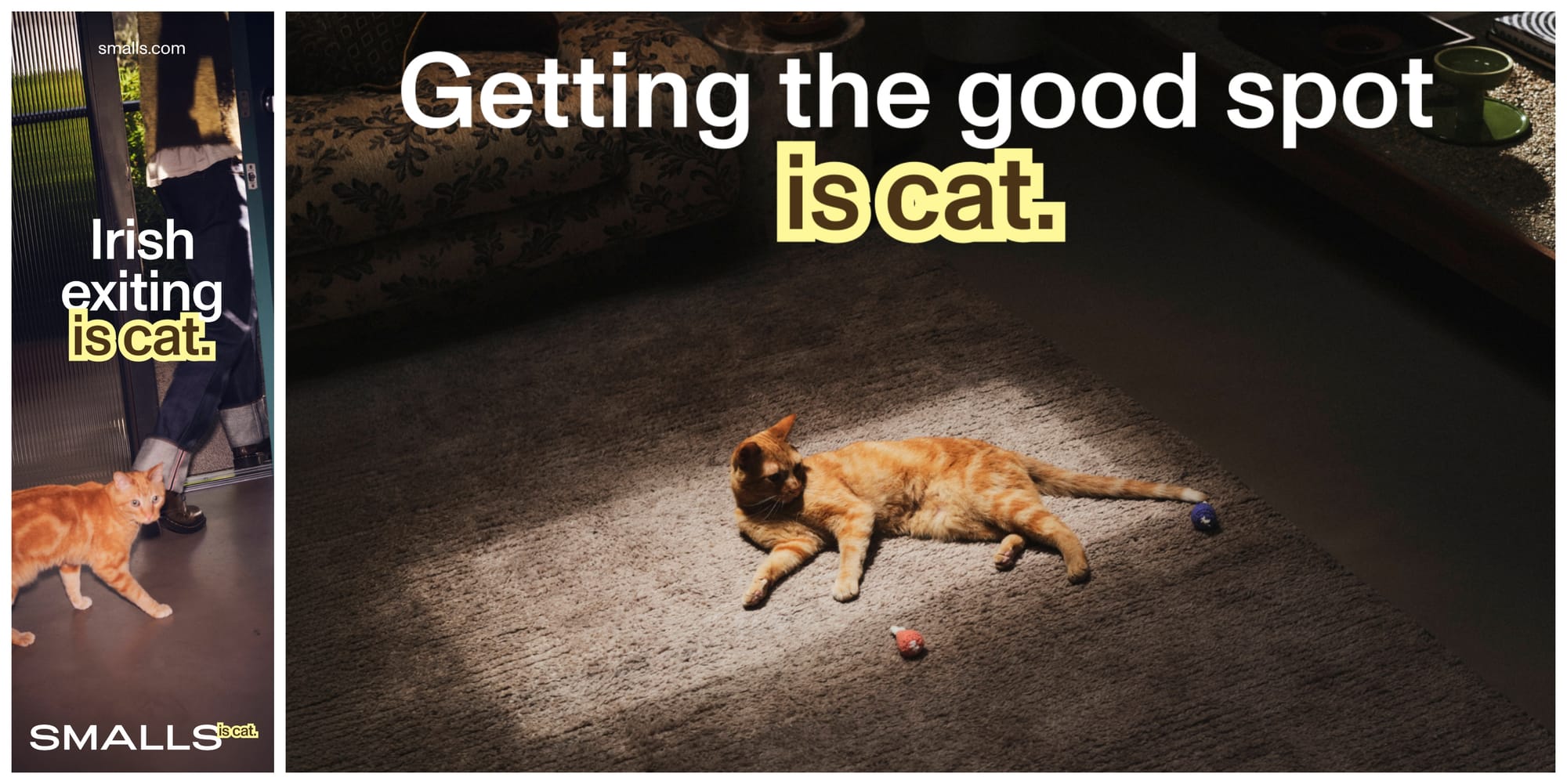
Take "Irish exiting is cat," one of the lines that made it out into the world. It's about ducking out of a party without saying goodbye, no explanation, no wink to the camera. You either get it or you don't, and that's the point.
Why the ads are only in three neighborhoods
New York City is a big place. Smalls picked three neighborhoods and stayed there: SoHo, NoHo, and Williamsburg.
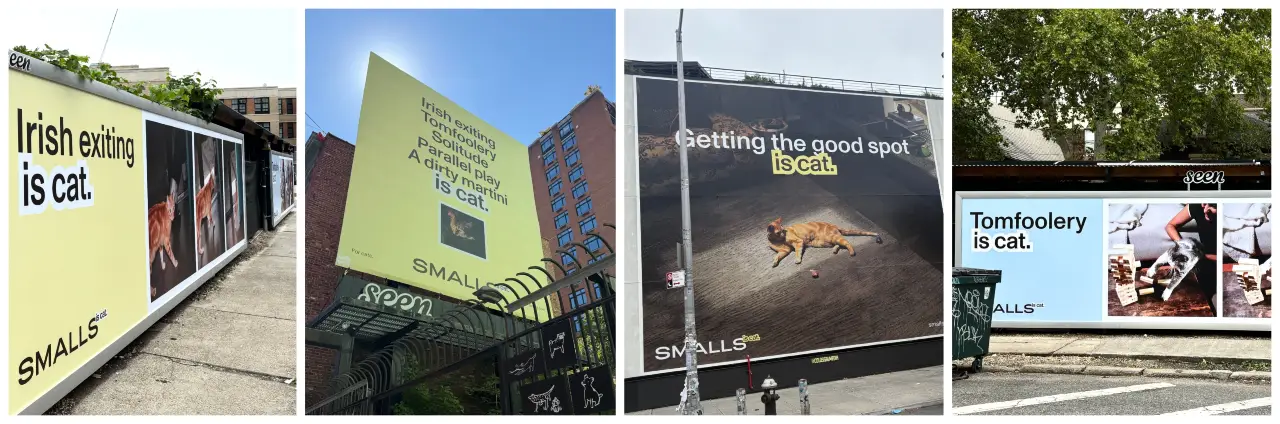
Not random ones, either. Melody says these are places where the brand's actual audience lives, works, and hangs out, high foot traffic, and enough cultural weight that showing up there means something.
Here's the actual logic: "A cat person who lives in Williamsburg, commutes through NoHo, and grabs drinks in SoHo could encounter Smalls multiple times throughout their day, making the campaign feel hard to miss."
Same person, same day, three run-ins with the same brand. That's not an accident, that's the whole point of picking three neighborhoods instead of thirty. Fewer places, more encounters, harder to forget.
And the placement isn't random either. "Irish exiting is cat" showing up in a neighborhood full of the exact bars people Irish-exit from, that's not a coincidence, that's the joke landing where it lives.
How do you know it actually worked
Anyone can buy a billboard. Knowing whether it actually changed how people think about your brand is a different, much harder problem.
Smalls' answer was a party. One night, roughly 100 people, mostly cat owners, none of them paid to show up or post about it. Melody calls it "a kind of real-world focus group for 'Is Cat,' where we could see firsthand whether the idea resonated beyond simply reaching people through paid media."
What she noticed wasn't just that people showed up. It's that they started making the idea their own, cat cocktails, the artwork, the copy on the walls, all of it turned into something personal for the people in the room. To Melody, that's the tell. Ads that just get seen don't usually get remixed by the people looking at them.
Worth being honest about the limits here: a hundred invited guests who already like cats is not the same as the broader public, and Melody didn't say what happens if the bigger rollout doesn't land the same way. One warm room proves the idea can connect. It doesn't prove the whole campaign will.
 Zoe Park
The blank never fills itself
"Is Cat" is designed to keep producing new lines forever. Whether that's a strength or a liability depends entirely on whether Smalls keeps saying no to the obvious ones.
That's really the whole campaign in miniature: TV for reach, three New York neighborhoods for repetition, one party for a gut check on whether any of it actually landed. Different jobs, same underlying idea holding it together.
Melody's own hobby says something similar, in miniature. She's kept a Hobonichi planner every single day for years, filling it with stickers, washi tape, and whatever's on her mind that day. "It gives me a little space every day to slow down and check in with myself," she says.
A campaign built around a blank needs the same kind of discipline. There's always room to write one more line. The real work is knowing which ones are actually worth the space.