
The UPS Store adds “Blu” to make small-business services feel simpler
The UPS Store debuts Blu in a multiyear campaign to broaden service awareness beyond shipping, supporting franchise consistency and recall.


The hardest part about selling “mundane” services is that customers only notice you when something goes wrong. Shipping stress. Deadline panic. That moment you realise you need a mailbox or a print run today, not next week.
That is the emotional gap The UPS Store is trying to close with Blu, a new brand character designed to make its service menu feel more human and more memorable. The company outlined the character and campaign details in an official announcement.
Blu is positioned as a friendly helper for small business owners, showing up when the day-to-day gets chaotic, and pointing people to services beyond shipping, including printing, shredding, and mailboxes.
In new ads, The UPS Store’s Blu character appears via a portal to help small business owners with tasks such as shipping, shredding and printing.
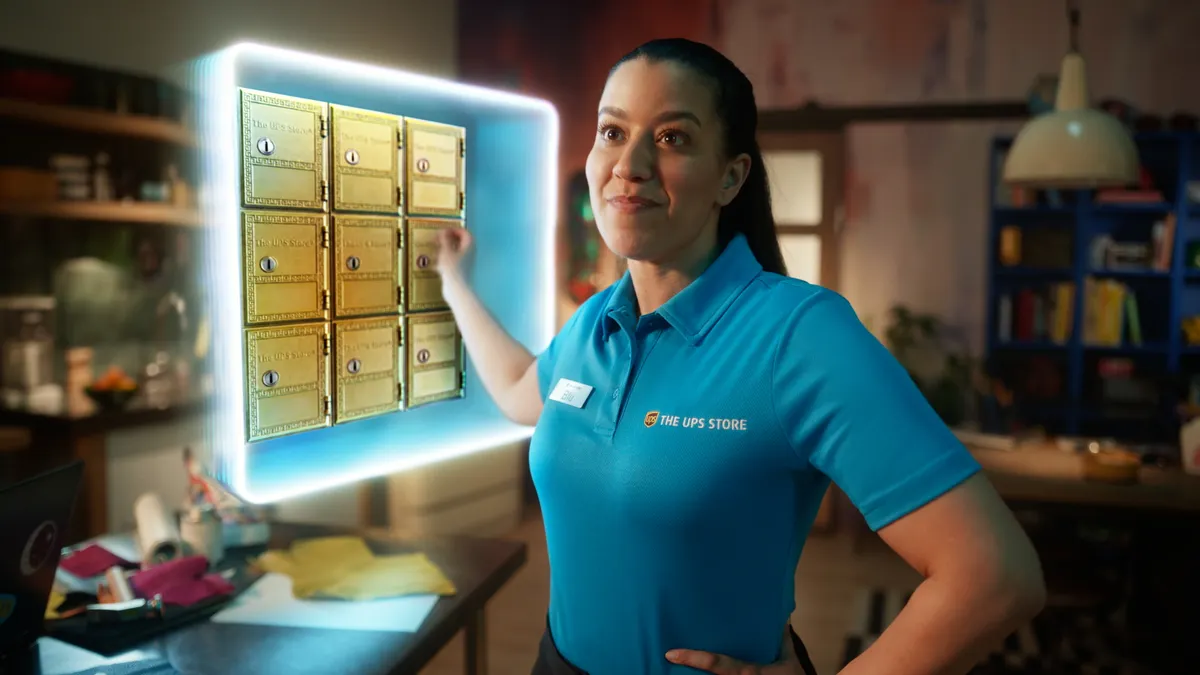
Table of contents
Jump to each section:
- Why The UPS Store is leaning into brand characters now
- What the Blu campaign is doing, and who it is built for
- How Blu supports franchisees through unified messaging
- What marketers should know about characters for service brands
Why The UPS Store is leaning into brand characters now
Brand characters are back because attention is expensive and category differentiation is hard. If you sell something that people think they already understand, like shipping, you are fighting autopilot behaviour. Customers default to whatever is closest, fastest, or habit-based.
Characters interrupt that autopilot. They give a brand a “face” that can show up across channels and make a routine errand feel like a small story. The UPS Store is not alone here: recent campaigns from Stanley (with “Stan” the toolbox) and Liberty Mutual (with “Liberty Biberty”) signal a broader push to make functional categories feel more entertaining and more distinctive.
For The UPS Store, the character strategy is also a way to broaden mental availability. If consumers only associate you with shipping, they will not think of you when they need printing, shredding, or a business mailbox.
What the Blu campaign is doing, and who it is built for
Blu is The UPS Store’s first brand character, presented as a friendly woman in a blue The UPS Store polo and black pants. She appears “through a portal” in campaign spots to help small business owners with specific tasks.
The campaign is described as a larger national, multiyear effort running across television, digital, social, and print. The creative includes spots pairing Blu with NFL player and small business owner Aidan Hutchinson, with ads running on Paramount streaming and CBS, plus additional digital and social content through early November.
One of the clearer creative choices here is that the scenarios are not abstract brand promises. They are recognisable “I need this handled” moments: a plumber needing printing and shredding, or a custom sneaker brand needing a business mailbox. That specificity matters because small business owners do not shop for “services.” They shop for solutions that save time and reduce stress today.
How Blu supports franchisees through unified messaging
The UPS Store’s footprint is largely owned and operated by independent franchisees, which makes consistency hard. Even when operators are strong, local decision-making can create a fragmented brand experience and uneven service awareness.
Blu is an attempt to solve that at the brand level by unifying messaging around a broader set of offerings. Instead of each location needing to “re-explain” what The UPS Store does beyond shipping, the national campaign gives franchisees a shared narrative and visual shorthand.
This is also happening alongside a wider shift at parent company UPS toward “premium volume,” with emphasis on small and medium business, health care, and B2B. In early 2025, UPS said it would reduce deliveries for Amazon by over 50%, citing low margins, and it restructured its network with job cuts that year and additional reductions planned for 2026. UPS reported consolidated revenue of $22.8 billion in Q2.
Even though Blu is a The UPS Store campaign, the timing suggests a consistent signal: the company wants higher-value relationships, and it needs clearer communication to earn them.
What marketers should know about characters for service brands
A brand character is not just a mascot. In service categories, it can be a navigation tool that helps customers remember what you do and when to use you.
- Characters work when they shorten the “what do you do again?” moment
The more services a brand offers, the more likely customers are to reduce it to one default association. Blu is built to reopen that mental menu. - Specific scenarios beat generic promises, especially for small businesses
“Support small business” is a common line. A plumber needing shredding and printing is a situation. Situations are easier to recall and share. - Franchise brands can use characters as consistency infrastructure
When the network is decentralised, brand characters can standardise tone and message without requiring every location to reinvent the story. - Multi-channel only works if the creative has a repeatable device
The portal concept is a reusable mechanism for endless “help me with this” vignettes across TV, social cuts, and short-form. - A character strategy should clarify the value, not distract from it
Comedy and personality can earn attention, but the end goal is still service comprehension. Blu’s job is to make the offering easier to understand, not to become the whole point.
The bigger takeaway is that service brands are increasingly being forced to market like entertainment brands, not because they want to be trendy, but because modern attention demands a narrative hook. When your product is reliability, the marketing challenge is making reliability memorable.
Blu is a bet that a human, repeatable character can do that job at scale, while giving franchisees a single story to stand behind. If it works, it is less about “likability” and more about recall: the next time a small business owner needs printing, shredding, or a mailbox, The UPS Store wants to be the brand they think of first.