USA Today is redesigning articles for AI buyers, not just readers
USA Today Co. is testing machine-friendly article formats as GEO and AI content licensing begin to converge.


USA Today Co. is treating article formatting as more than a reader-experience decision. The publisher is testing ways to restructure content so AI systems can access, understand and cite its reporting more easily, according to Digiday.
The commercial logic is notable. Publishers have spent the past two years debating whether AI platforms should crawl, cite or pay for journalism. USA Today Co. is now asking a more operational question: if AI companies are becoming customers and distribution partners, should the content itself be packaged differently for machines?
That turns generative engine optimization, or GEO, from a traffic tactic into something closer to licensing infrastructure. It also creates a new tension for publishers and brand content teams: the best article for a human reader may not always be the easiest asset for an AI system to ingest and reuse.
Key Takeaways
- USA Today Co. is testing content formats and templates designed to make reporting easier for AI systems to access, understand and cite.
- The experiment connects GEO with a commercial goal: making publisher content more useful in AI licensing and distribution deals.
- For marketers, machine readability is becoming a content-operations question alongside SEO, rights management and brand governance.
Table of contents
Jump to each section:
- The article itself is becoming AI infrastructure
- GEO is moving from traffic tactic to licensing strategy
- USA Today already has a reason to invest
- The risk is optimizing before the standards settle
- What marketers should take from the publisher playbook
The article itself is becoming AI infrastructure
USA Today Co. chairman and CEO Mike Reed summarized the shift on the company's August 6 earnings call: "We recognize that we have to create and format content for humans and for machines."
Kara Chiles, the company's SVP of product management, told Digiday that changing content formats and templates can make USA Today reporting easier for AI systems to access, understand and cite. She described the work as part of a broader GEO strategy aimed at improving discoverability in AI answer engines.
What is still unknown matters just as much. USA Today Co. has not publicly detailed the exact formatting changes it will standardize. There is no basis yet to say it is adopting a particular schema, feed format, API structure or markup convention.
That uncertainty makes the experiment more interesting, not less. The publisher is effectively testing what a machine-readable editorial product should look like before the market has settled on a common standard.
GEO is moving from traffic tactic to licensing strategy
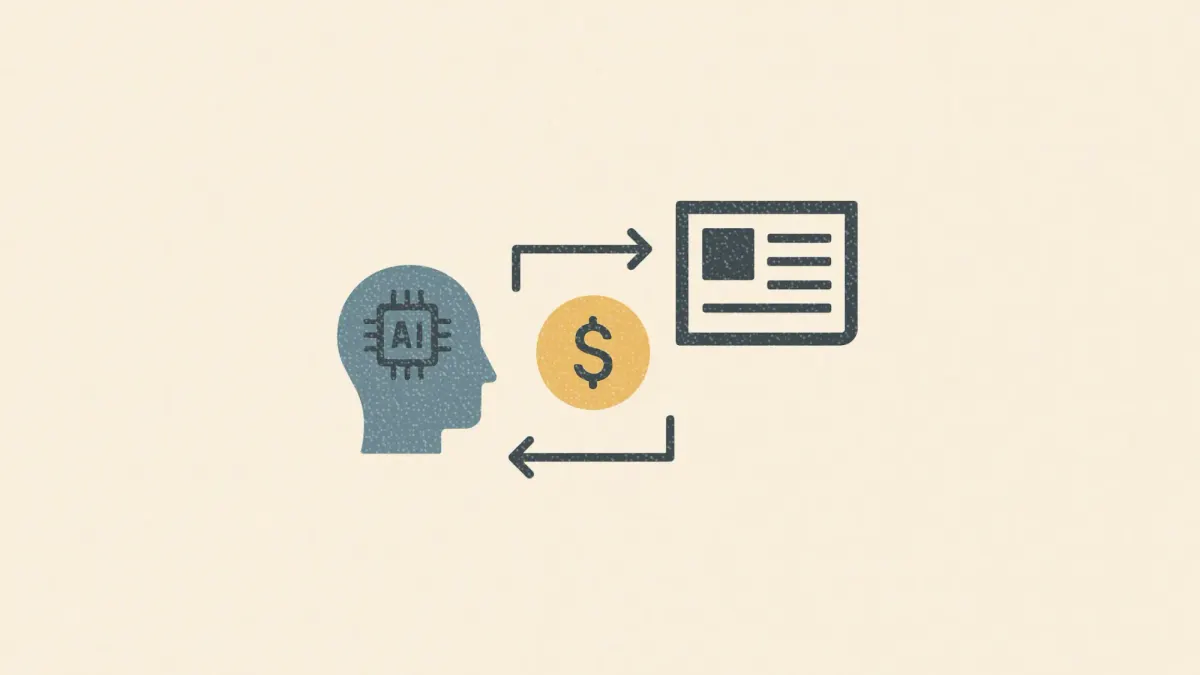
Most GEO conversations focus on visibility: how to get a brand or publisher cited inside ChatGPT, Google AI Overviews or other answer engines. USA Today Co.'s approach adds a second objective. Machine readability can also affect how easily content can be delivered, evaluated and potentially licensed to an AI partner.
That does not mean cleaner formatting automatically produces a licensing deal. Commercial agreements still depend on rights, pricing, coverage, freshness and the value of the underlying journalism. But lower ingestion friction could make a large archive easier for an AI company to use once a deal exists.
This is where the publisher strategy starts to resemble product design. A story is no longer only a webpage that attracts search traffic and advertising. It can also become a licensable data asset whose structure affects how efficiently a machine can retrieve facts, identify context and preserve attribution.
For publishers, that may create a new layer of optimization between the newsroom and the business-development team. Editors still decide what is worth publishing, while product teams increasingly decide how that work should be exposed to different machine audiences.
USA Today already has a reason to invest
USA Today Co. is not starting from zero. The company has already announced AI content licensing partnerships, including a multi-year agreement with Meta, and previously struck a deal with Perplexity covering USA Today and its local network.
The financial context gives the experimentation more weight. Digiday reported in May that USA Today Co.'s "other" digital revenue category, which includes digital content syndication, affiliate revenue, content and AI partnerships, and licensing, grew sharply in the first quarter.
USA Today Co.'s other digital revenue rose 125.6% year over year to US$33.75 million in Q1. The category includes AI partnerships and licensing but is broader than AI revenue alone, according to Digiday's coverage of the company's earnings.
That distinction is important. The figure does not reveal how much money came specifically from AI licensing. Still, management has a concrete reason to treat licensing as more than an experimental side project when the broader revenue bucket containing it is expanding.
The strategic sequence is becoming clearer: sign distribution and licensing deals, learn how AI systems consume the content, then adjust publishing infrastructure to make those relationships easier to scale.
The risk is optimizing before the standards settle
There is an obvious danger in designing too aggressively for machines. AI platforms change retrieval systems quickly, and publishers have limited visibility into which formatting choices genuinely affect citation, ingestion or commercial value.
A publisher could spend heavily restructuring templates only to find that model providers prefer direct feeds, APIs or licensed data pipelines instead of public-page optimization. It could also create editorial pressure to make articles more uniform because highly structured content is easier for machines to parse.
That is why USA Today Co.'s experiment is better understood as product discovery than as a proven GEO formula. The company is testing how content should serve two audiences at once while acknowledging that machine distribution is becoming commercially relevant.
The broader publisher market is testing several compensation models at the same time. As ContentGrip has previously reported, publishers are experimenting with crawl fees, usage royalties and licensing marketplaces rather than relying on one universal approach.
What marketers should take from the publisher playbook
Brands do not have the same licensing business as a national news publisher, but the operational lesson travels well. If AI systems are becoming an important discovery layer, content teams need to think beyond keywords and rankings.
The useful questions are increasingly structural. Can a machine identify the main claim quickly? Are sources, dates, authorship and ownership clear? Can important facts be separated from navigation and promotional clutter? Does the company have a rights policy for content reused by AI systems?
For enterprise marketing teams, this makes GEO partly a governance problem. Better machine readability is valuable only when the organization also knows which content it wants machines to quote, which assets can be reused, and what attribution or commercial terms should apply.
USA Today Co.'s experiment shows where the market may be heading. Publishers are no longer only asking how to stop AI from taking value from their content. Some are beginning to redesign the content supply chain so AI companies can become paying customers.