Adobe Express study finds under-30-second YouTube Shorts drive key metrics
Survey of 507 creators links under-30-second Shorts to views and click-throughs, with 30–60 seconds tying for subscriber growth.


Adobe Express published a survey-based study on YouTube Shorts length, based on responses from 507 creators with at least 1,000 subscribers, detailing how duration correlates with views, shares, click-throughs, saves, and subscriber growth. The details were outlined in the company’s official announcement.
The headline result is simple: creators most often associate under-30-second Shorts with better top-of-funnel performance, while slightly longer Shorts can be just as effective for subscriber growth. The strategic nuance is that “best length” depends on which metric you are trying to win, not what the platform allows.

Table of contents
Jump to each section:
- What the study suggests about Shorts length and performance
- The strategic tension: reach efficiency vs subscriber intent
- How niche and timing shape what “optimal” looks like
- What this means for marketers using Shorts as a growth channel
What the study suggests about Shorts length and performance
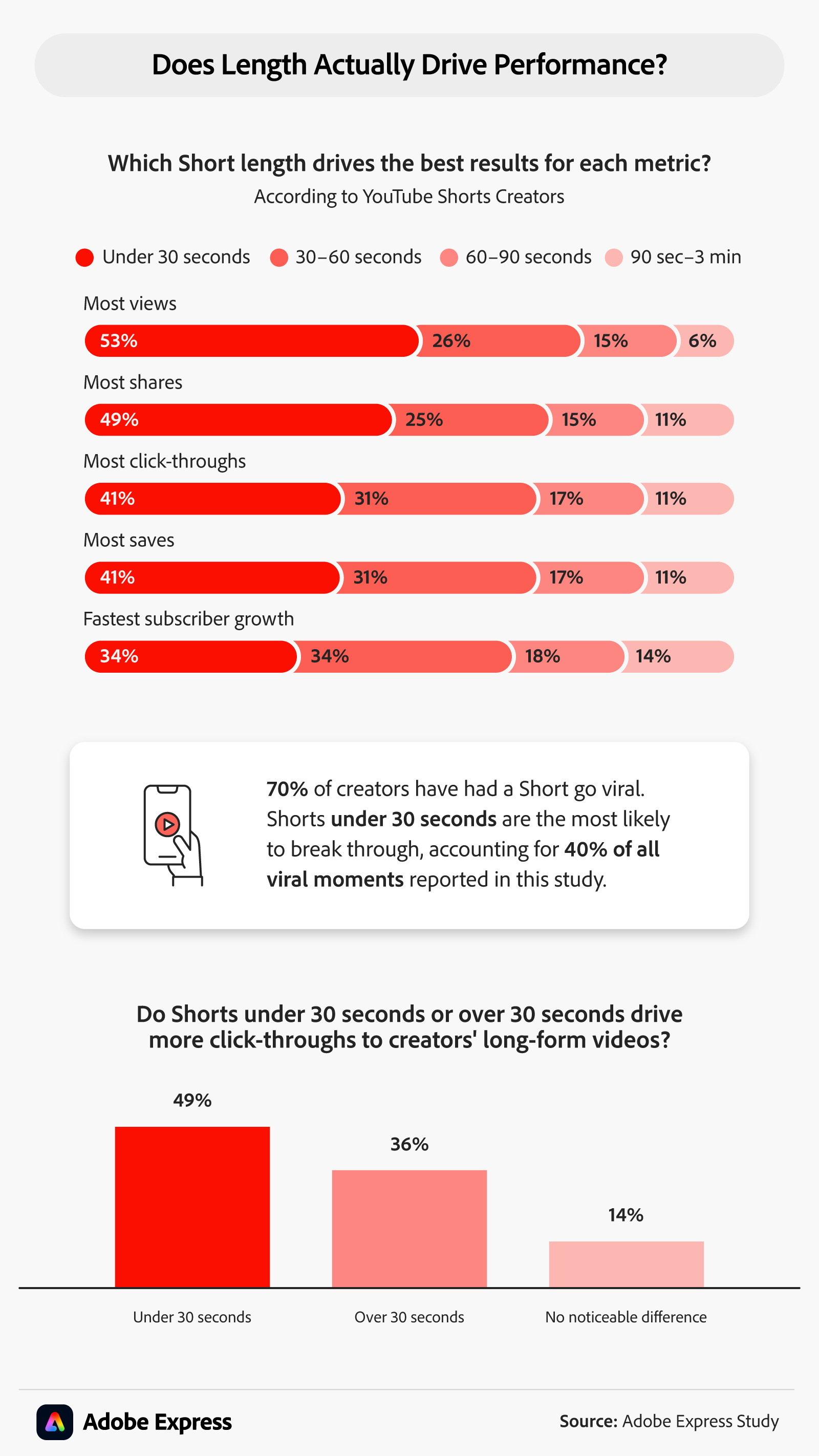
Adobe Express’ survey points to a consistent creator belief: under-30-second Shorts are the most effective format across several core distribution and engagement outcomes. On average, 46% of creators selected under 30 seconds as ideal for views, shares, click-throughs, and saves, and 53% chose under 30 seconds specifically for views.
That pattern matters because it frames Shorts as a high-speed “value delivery” unit. A Short is not a compressed long video. It is a different product with a different success condition: delivering enough value fast enough that the viewer chooses to continue with you.
A useful way to hold the numbers in your head:
- Brevity is the default advantage. Under 30 seconds is where creators most often see performance across key metrics.
- Shares cluster around “about 30 seconds.” Shorts around 30 seconds were cited by 49% of creators as top for shares.
- Virality trends short. 70% of creators said they have had a Short go viral, with videos under a minute most likely to break through.
The memorable observation here is that on Shorts, time is not a canvas, it is a cost. Every extra second has to earn its keep.
 ContentGrip
The strategic tension: reach efficiency vs subscriber intent
A common assumption is that shorter always wins. The study complicates that.
For driving click-throughs to long-form videos, 49% of creators said under-30-second Shorts generate more click-throughs than longer ones, compared to 36% who favored videos over 30 seconds. That reinforces Shorts as a discovery and routing tool.
But subscriber growth is where longer formats “hold their own.” In the survey, under 30 seconds and 30 to 60 seconds tied at 34% each as the best length for subscriber growth.
This is the strategic tension marketers should sit with: reach behaves like a swipe economy, but subscription behaves like a trust economy. The same creative that maximizes initial attention may not maximize the feeling of “this is worth following.”
A second quotable insight: Shorts can optimize for motion (views) or meaning (subscriptions), but rarely both with the same cut.
So the operational decision is not “pick the best length.” It is “pick the primary job” of each Short:
- If the job is routing viewers into a longer video, the study’s creator responses favor under 30 seconds.
- If the job is earning commitment, 30 to 60 seconds may give enough room for identity, voice, or payoff.
How niche and timing shape what “optimal” looks like
The study also frames “ideal length” as niche-sensitive.
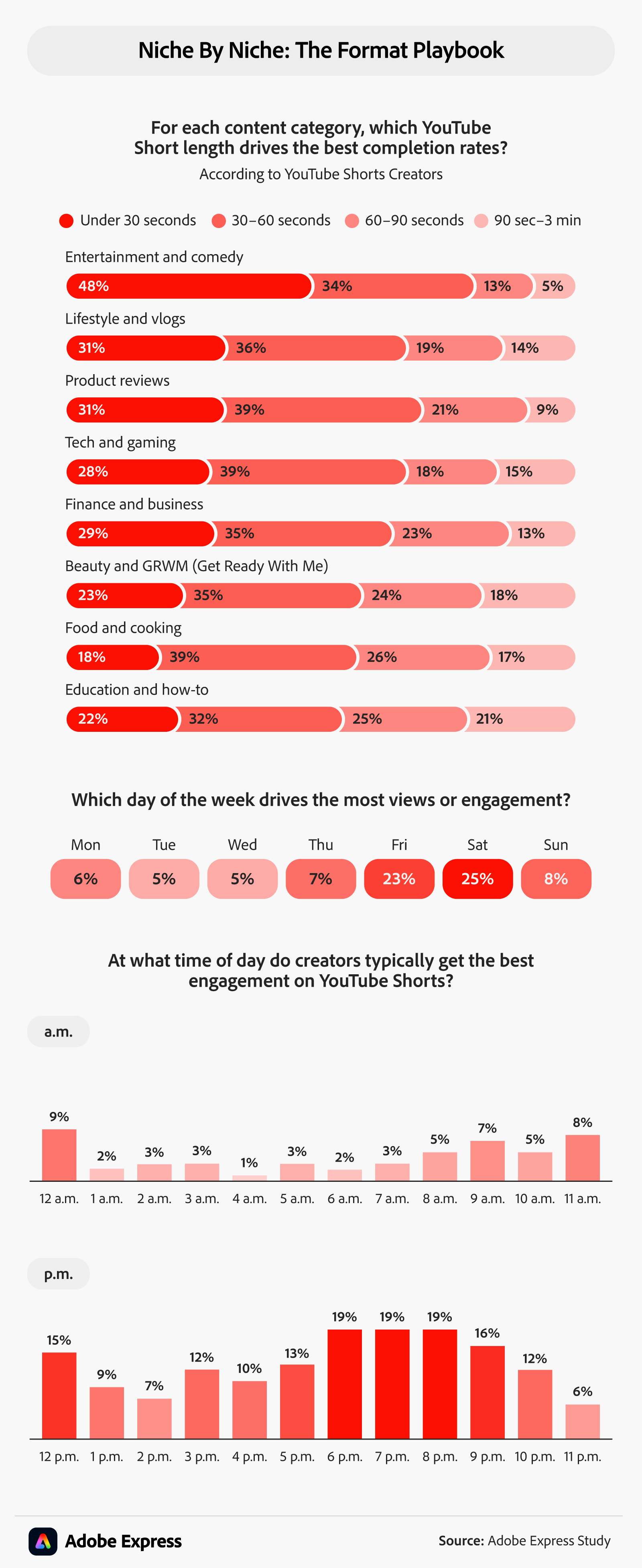
Entertainment and comedy creators leaned toward under-30-second Shorts, with 48% saying that format delivers the best results. At the same time, 82% in that category said it is the most likely to keep viewers engaged up to a minute, which suggests a range: punchy hooks can work fast, but the audience will also tolerate extension when the payoff is strong.
Lifestyle and vlog creators showed more flexibility, with 67% saying the ideal length falls under 60 seconds. That signals a different consumption expectation: context and personality can be part of the value, not a tax on attention.
Timing signals are also clear in the responses:
- Saturday was cited by 25% of creators as the best day for views or engagement, followed by Friday at 23%.
- Evenings (6–8 p.m.) stood out, with 19% reporting peak engagement at 6 p.m., 7 p.m., and 8 p.m.
- 21% said they do not track daily views or engagement, a reminder that “best time to post” advice often fails because measurement habits are inconsistent.
A third observation to keep: Optimization is not just creative. It is calendar literacy. If your team cannot consistently test dayparting and length together, you end up debating “best practices” instead of learning your own curve.
What this means for marketers using Shorts as a growth channel
The deeper shift is that Shorts is being treated less like a side format and more like a primary discovery surface. In the survey, 63% of creators said YouTube Shorts has become more valuable for channel discoverability this year.
Here’s what marketers should take from that, without turning it into a rigid formula:
- Treat “under 30 seconds” as the baseline creative constraintIf your goal is reach, click-throughs, or saves, the study’s creator responses consistently cluster under 30 seconds. Start there, then earn the right to go longer with proof.
- Separate “discovery Shorts” from “commitment Shorts”The tie on subscriber growth (34% under 30 vs 34% at 30–60) implies two different storytelling modes. Build a deliberate mix instead of forcing one duration to do every job.
- Design for the handoff, not just the viewNearly half of creators (49%) said under-30-second Shorts drive more click-throughs to long-form. That makes the bridge moment your core asset: what the Short promises must match what the long video delivers.
- Let niche shape pacing expectationsComedy and entertainment can reward speed, but lifestyle and vlog patterns suggest audiences allow more runway. “Optimal” is not universal; it is a contract between format and category.
- Make timing a test variable, not folkloreThe study highlights Saturdays and 6–8 p.m. as common peaks. The strategic point is not to copy those windows blindly, but to adopt the habit: length tests without posting-time discipline are incomplete experiments.
The more interesting question is what happens as more brands treat Shorts as a top-of-funnel media unit. When short video becomes a routable distribution layer, creative is less about storytelling craft alone and more about conversion architecture: hook, proof, handoff, and next action.
In that world, the “best” Short is not the one that says the most. It is the one that makes the next piece of content inevitable.