
Zillow brings its home-buying guidance into Google NotebookLM
Zillow curates a featured NotebookLM notebook with cited home-buying guidance, aiming to reach buyers earlier through Q&A and audio summaries.

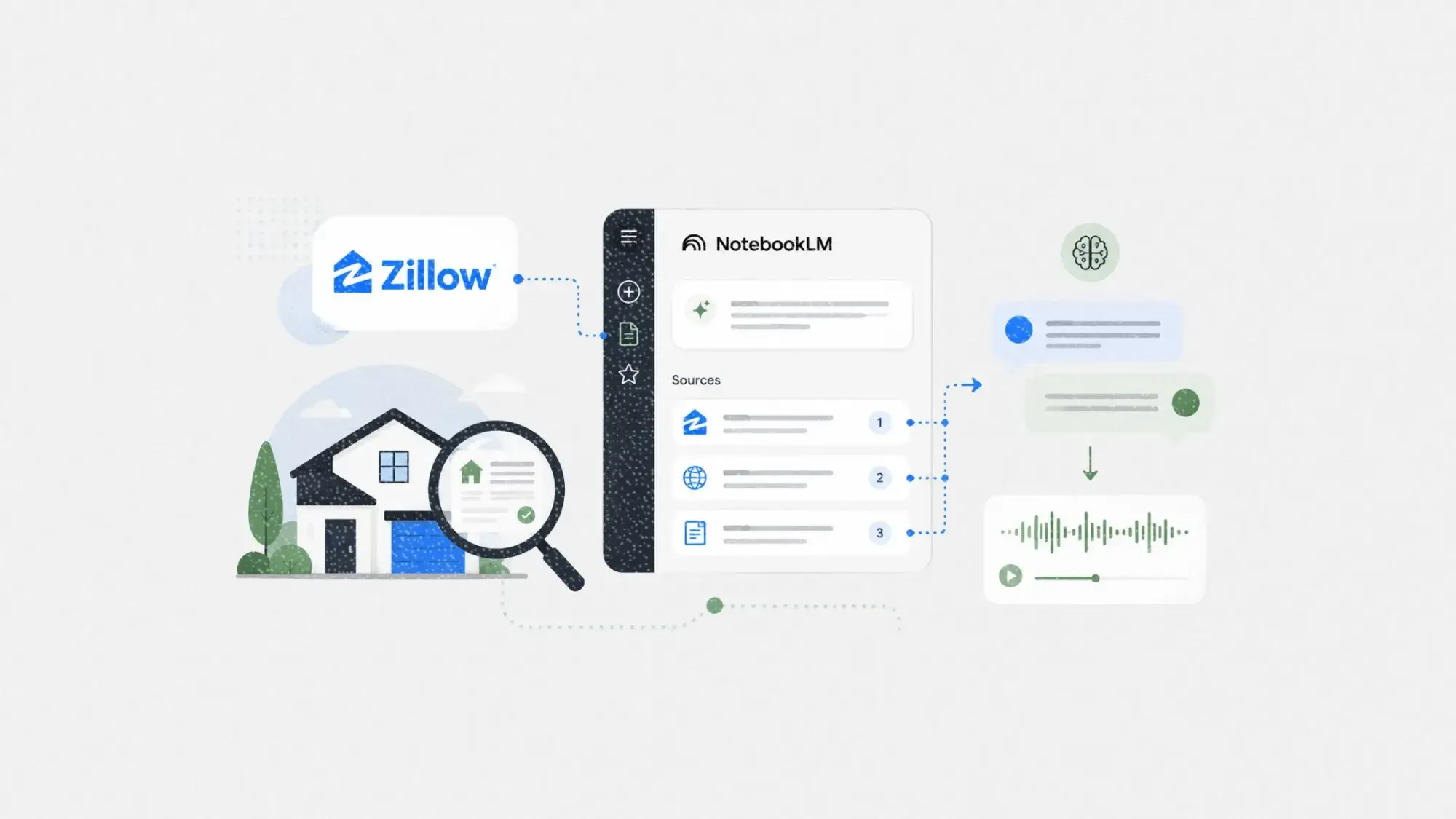
Zillow is partnering with Google NotebookLM to publish a featured notebook that packages its home-buying guidance into a question-and-answer experience grounded in Zillow’s own content, with citations back to Zillow.com.
The company outlined the collaboration in an official announcement, positioning the notebook as a way to reach buyers earlier in their research process with “fast, clear and accurate” answers tied to source material.

Table of contents
Jump to each section:
- What Zillow is building inside NotebookLM
- Why citations and “grounded” answers matter in high-stakes categories
- How Audio Overviews change content distribution and brand voice
- What this means for marketers
What Zillow is building inside NotebookLM
The core product move is a “featured notebook” curated by Zillow within Google NotebookLM. NotebookLM is described as a personalized AI research and thinking tool that helps users connect with and understand complex information.
In this implementation, users can ask questions and receive responses grounded in Zillow’s home-buying guidance, with direct citations to the original articles on Zillow.com (including content from Zillow’s Learning Center). The notebook is positioned as a way to reduce confusion in common decision points such as preapproval vs. prequalification, what happens after an offer is accepted, and budgeting for costs beyond the down payment.
Zillow also frames the notebook as complementary to agents, not a replacement, arguing that these tools can help buyers come to agent conversations better prepared while keeping agents central for high-stakes, personalized transactions.
 ContentGrip
Why citations and “grounded” answers matter in high-stakes categories
Zillow draws a clear contrast between general AI answers that “can vary in accuracy” and notebook-style experiences that are grounded in a defined set of source documents with citations. For consumer decision-making categories where the cost of misinformation is high, this design choice becomes part of the value proposition.
From a marketing perspective, that changes the content strategy target. Instead of only competing for search rankings or social distribution, the goal becomes: get authoritative guidance into the source set an AI tool references, and ensure it is structured so users can navigate it through questions.
It also puts pressure on editorial hygiene. If the AI experience points back to the original articles, the on-site content needs to be consistent, up to date, and written in a way that can survive being excerpted, cited, and re-contextualized into short answers without losing meaning.
How Audio Overviews change content distribution and brand voice
NotebookLM’s “Audio Overviews” feature is a second distribution format layered on top of Zillow’s written guides. Zillow says users can listen to two AI hosts discuss topics like the first step in buying a home or how to choose an agent.
That matters because it effectively turns a written content library into conversational audio without requiring a traditional podcast production workflow. It also shifts how brand voice is experienced: even if the underlying facts come from Zillow’s articles, the listener’s perception may be shaped by the AI hosts’ delivery, pacing, and framing.
For brands, this creates a new surface area to think about: how content reads when it is transformed into audio and dialogue, and whether core guidance, disclaimers, and nuance remain intact when consumed in a more entertainment-like format.
What this means for marketers
Zillow’s move is a practical example of how brands can extend existing guidance content into AI-native discovery environments, especially where users begin research with questions rather than keywords.
- Treat AI notebooks as a new “top of funnel” interface, not just a channel
Zillow explicitly frames the notebook as meeting buyers “at the start of their journey.” Marketers should interpret this as a shift in how early-stage intent is expressed: through iterative Q&A, not one-time searches.
- Citations are becoming a distribution mechanic
Zillow emphasizes direct citations back to original pages. If citations drive traffic and trust, content teams need to design pages that are easy to cite and useful when landed on mid-journey.
- Repurposing is moving from “format adaptation” to “interaction adaptation”
The content is not only being repackaged, it is being made interrogable. That raises the bar on information architecture, topic coverage, and consistency across a library of guides.
- Audio synth features introduce a brand safety and clarity requirement
With “Audio Overviews,” tone and interpretation become part of the experience. Marketers should anticipate the need to review how key guidance performs when rendered into conversational audio, especially for nuanced topics.
In the near term, the important signal is not that every brand needs a featured notebook. It is that consumers are starting to outsource comprehension to tools designed around guided exploration, summaries, and Q&A.
For marketing teams, that makes “where our guidance shows up” a broader problem than SEO alone. It is also a reminder that content quality is no longer only about readability on a page, but about how reliably it can power downstream AI experiences without drifting from what the brand intends to communicate.