
Adobe report finds agentic AI readiness lags behind adoption ambitions
New Adobe research shows organizations want autonomous AI, but most still lack the data, governance, and measurement foundations to support it.

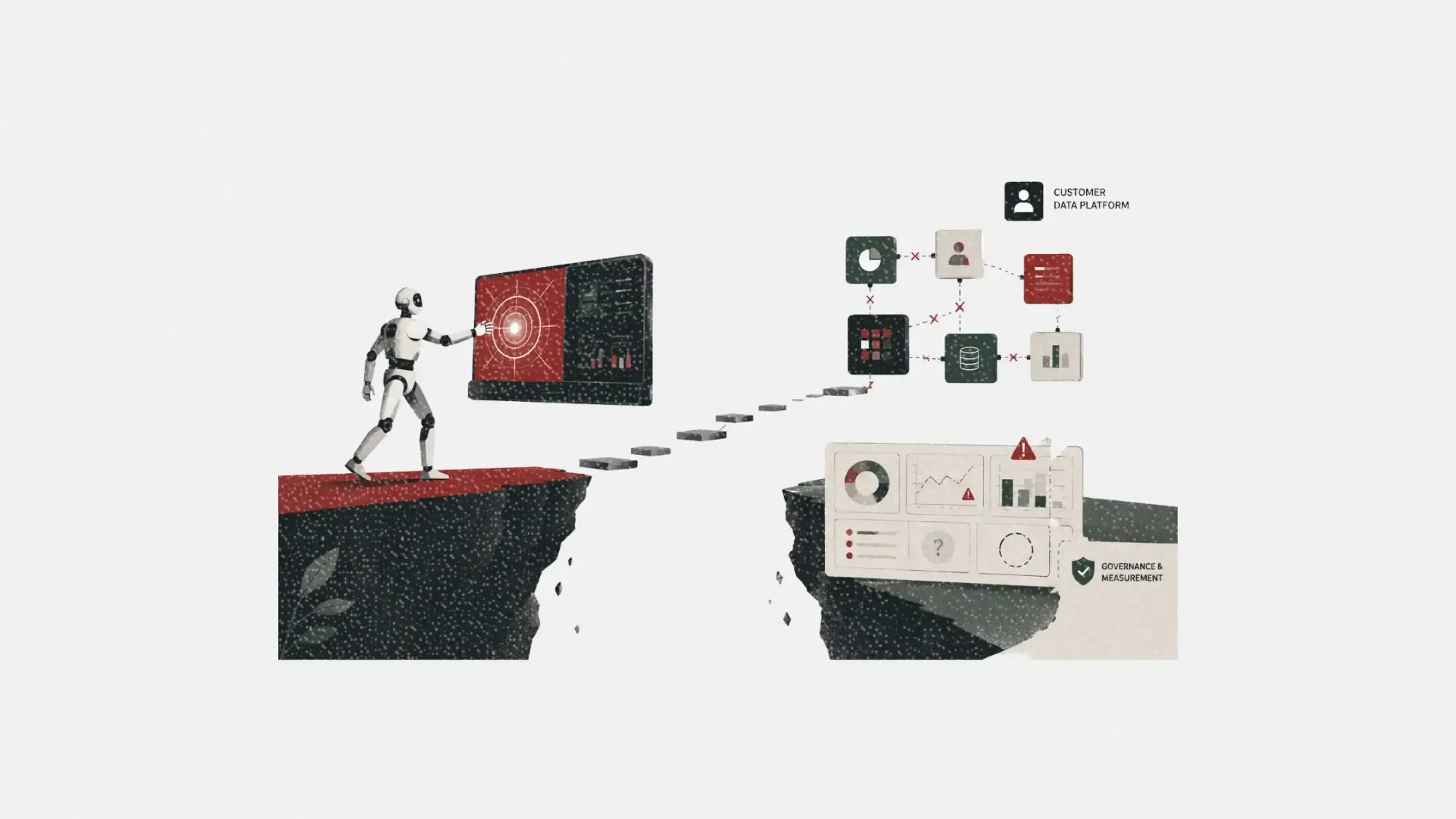
Organizations are increasingly excited about agentic AI, but most are still missing the infrastructure, data foundations, governance frameworks, and measurement systems needed to deploy it at scale.
New findings from Adobe’s 2026 AI and Digital Trends research reveal a widening gap between AI ambition and operational readiness, particularly when comparing agentic AI with more established generative AI initiatives.
The report, based on surveys of 3,000 executives and practitioners and 4,000 customers, highlights a recurring challenge for marketers: customer expectations are rising faster than organizations can build the systems needed to support AI-powered experiences. While brands see AI as critical for personalization, customer engagement, and productivity, many still struggle with data quality, ROI measurement, and internal alignment.
Table of contents
Jump to each section:
- What Adobe’s latest AI findings reveal
- Why agentic AI readiness is falling behind
- The growing disconnect between executives and practitioners
- What marketers should know
- Why AI adoption may outpace workforce readiness
 Patrecia Meliana
What Adobe's latest AI findings reveal
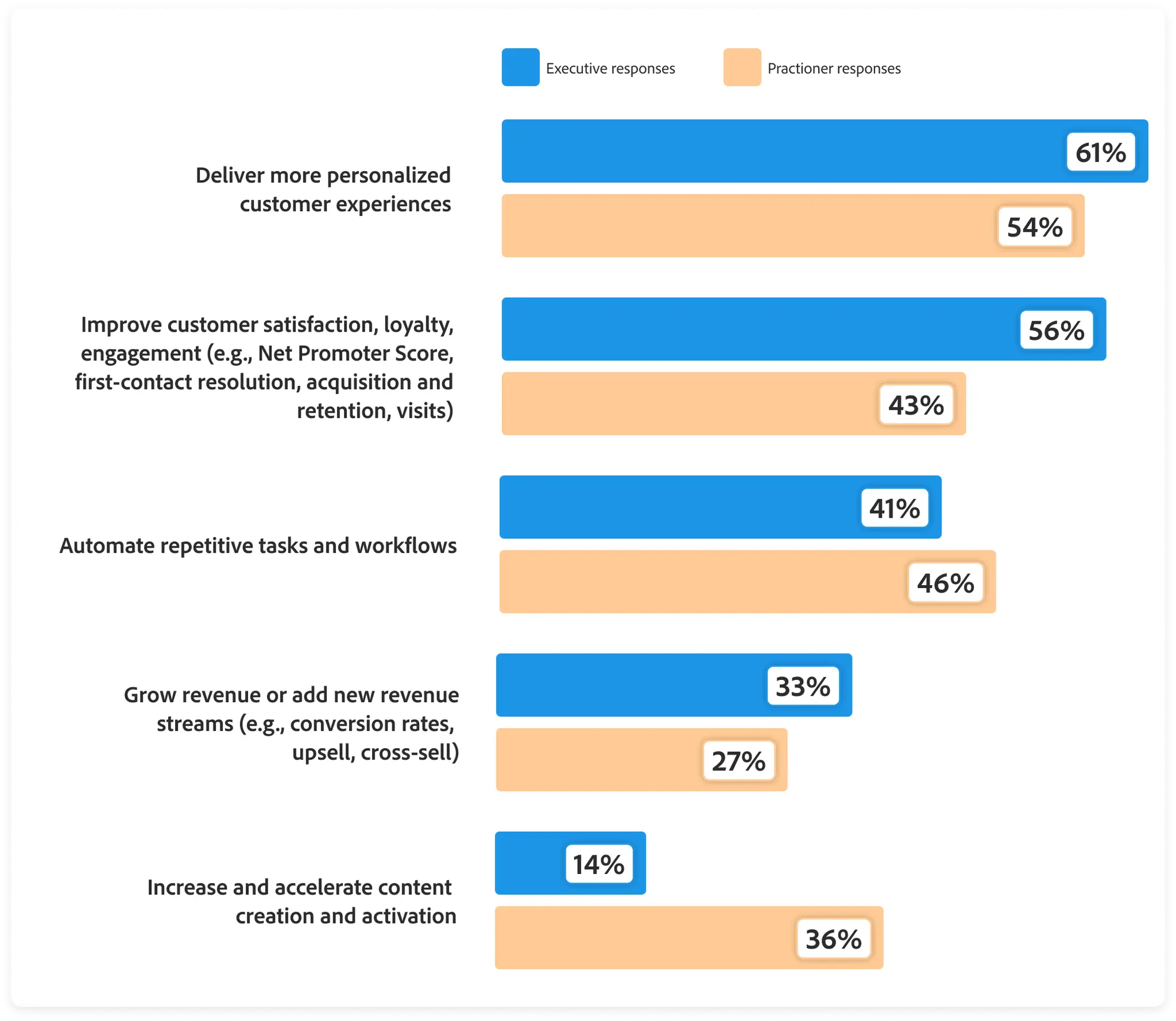
Adobe’s research shows organizations remain focused on practical business outcomes from AI investments. Executives prioritize personalization, customer satisfaction, revenue growth, and workflow automation, while practitioners place greater emphasis on content creation, activation, and operational execution.
Among executive respondents, 61% identified delivering more personalized customer experiences as a top AI goal, while 56% focused on improving customer satisfaction, loyalty, and engagement. Practitioners also ranked these goals highly but showed stronger interest in content creation and workflow automation.
The research also found strong expectations for AI across customer-facing functions:
- 78% expect AI to play a significant role in customer support.
- 70% point to post-purchase support.
- 69% see AI impacting customer sales and transactions.
- 63% expect AI to influence account management.
- 62% anticipate AI-driven conversational engagement.
Why agentic AI readiness is falling behind
The most striking finding is the readiness gap between generative AI and agentic AI.
While 89% of organizations report having cloud-based technology to support generative AI, only 51% say they have comparable infrastructure for agentic AI. Investments in governance, integration tools, employee training, customer data platforms, and responsible AI guidelines also lag significantly behind generative AI deployments.
Measurement remains another major challenge.
More than half (52%) of respondents say their organizations struggle to demonstrate measurable AI returns using customer experience metrics. Meanwhile, 56% say leadership primarily evaluates AI success through financial outcomes. Only 44% have implemented a measurement framework for generative AI, and just 31% have one for agentic AI. Nearly half either lack a framework entirely or are unsure whether one exists.
Data readiness presents another obstacle.
Only 44% of organizations believe their data quality and accessibility are currently adequate for AI initiatives, while just 39% have a shared customer data platform capable of supporting agentic AI. At the same time, 75% identify data integration and quality as the biggest challenge to implementing agentic AI solutions.
The growing disconnect between executives and practitioners
Adobe’s findings suggest that organizations may face an internal alignment problem as much as a technology problem.
Nearly one-third of respondents say executives and practitioners are misaligned on AI strategy, while another 47% report only partial alignment. The leading cause is executive misunderstanding of AI, cited by 61% of respondents.
The gap appears in several areas:
- Practitioners report deeper AI adoption across daily workflows.
- Practitioners are more likely to identify meaningful AI use cases already in production.
- Practitioners expect agentic AI adoption to accelerate faster than executives do.
- Practitioners are more likely to believe organizations that fail to adopt agentic AI risk becoming obsolete.
This divergence matters because executive buy-in often determines budgets, governance investments, and organizational priorities. When leadership underestimates adoption progress or overemphasizes short-term financial returns, foundational investments may be delayed.
What marketers should know
For marketing leaders, the report highlights several practical lessons.
1. Data strategy is becoming AI strategy
Many organizations still treat data modernization as a separate initiative from AI deployment. Adobe’s findings suggest that approach is increasingly unsustainable. Without unified customer data, AI systems cannot consistently deliver relevant experiences at scale.
2. Personalization remains the dominant business case
Both executives and practitioners continue to prioritize personalization above nearly every other AI outcome. This reinforces the need for marketers to focus on customer data quality, identity resolution, and real-time activation capabilities.
3. ROI frameworks need attention now
Organizations cannot scale AI investments indefinitely without proving impact. Marketers should establish measurement frameworks that connect AI initiatives to both customer experience metrics and business outcomes rather than relying solely on revenue or cost reduction indicators.
4. Agentic AI requires more than experimentation
Interest in autonomous AI agents is growing rapidly, but readiness remains low. Before deploying agents across customer-facing experiences, organizations need governance controls, integration infrastructure, training programs, and trusted data foundations.
Patrecia Meliana
Why AI adoption may outpace workforce readiness
The report also raises concerns about organizational preparedness.
According to respondents:
- 57% believe AI is changing work faster than employees can adapt.
- 58% believe employees who fail to embrace AI will fall behind.
- 61% now view AI as an indispensable coworker rather than simply a tool.
Yet only 45% say their organizations have sufficient AI training and upskilling programs, while just 44% believe employees are comfortable using AI in their roles.
For marketers, this suggests that technology adoption alone is not enough. Teams need operational support, education, and clear guidance if organizations want AI investments to produce meaningful business outcomes.
Adobe’s latest AI and Digital Trends research paints a picture of an industry moving quickly toward AI-powered customer experiences while struggling to build the foundations required for long-term success. Organizations recognize the value of personalization, automation, and agentic systems, but data quality, governance, measurement, and workforce readiness remain significant barriers.