Adobe Express study shows business cards beat LinkedIn for trust
A new Adobe Express survey finds that tactile design still drives connection and action in a digital world

In a world where a LinkedIn connection takes two seconds and digital contact info fits on a tap card, it might feel like printed business cards are outdated. But according to Adobe Express, that assumption could cost you trust and potential customers.
Adobe Express recently surveyed over 1,000 consumers and business owners to find out what makes a business card effective in 2025. The results reveal that even in a tech-driven networking environment, physical cards offer a level of credibility and memorability that digital formats have yet to replace.
This article breaks down the key insights from Adobe’s report and explores how marketers and brand leaders can apply them to make their printed collateral more strategic and impactful.
Short on time?
Here’s a table of contents for quick access:
- What the Adobe Express study reveals
- Why QR codes and color choices matter
- What consumers and business owners value differently
- Design tips for your next business card
 Falencia Naoenz
What the Adobe Express study reveals
Adobe Express created several mockups and surveyed 210 business owners and 790 consumers via SurveyMonkey. The goal was to find out what card designs people trust, remember, and act on.
The top-line takeaway: 62% of consumers say they’re more likely to do business with someone who hands them a physical card. Even more compelling, 70% said exchanging a physical card felt personal, compared to just 45% who felt that way about connecting on LinkedIn.
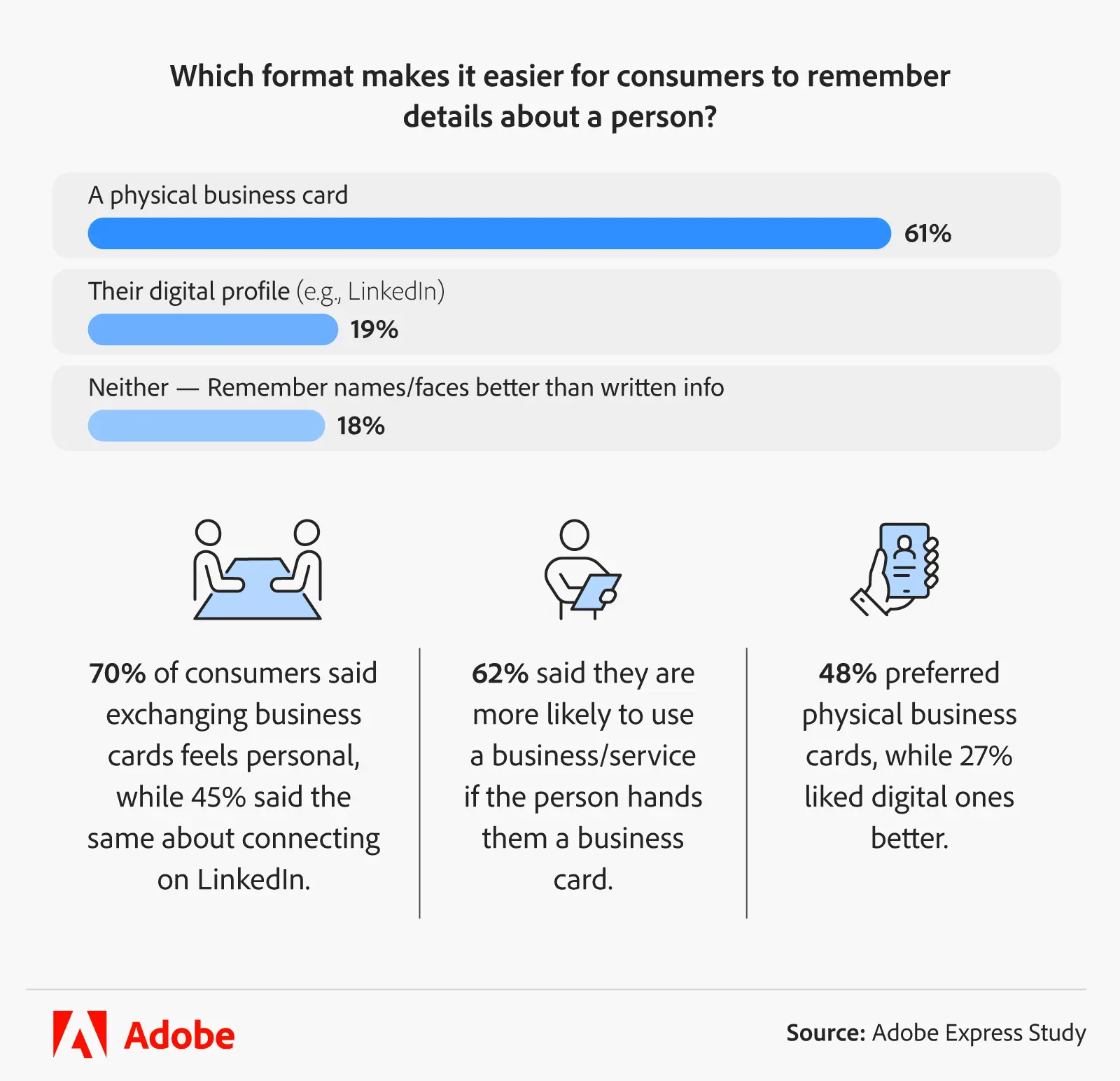
Despite digital innovations, 61% of respondents found it easier to recall someone’s details after receiving a paper card. Gen Z included: 38% of younger respondents actually preferred traditional cards over digital formats.
Why QR codes and color choices matter
A standout stat from the study is that adding a QR code can increase the likelihood of someone contacting your business by 69%. Yet only 21% of business owners currently prioritize this feature, highlighting a significant disconnect between what consumers want and what brands deliver.
When it comes to color, classic still rules. White cards were rated most trustworthy by 54% of consumers, followed by black at 30% and navy blue at 24%. Bolder hues and trendy gradients may look modern, but they aren’t doing your brand any favors in the trust department.
Horizontal layouts (43%) also outperform vertical formats, with consumers associating them with greater credibility. Foil finishes, minimalist designs, and textured paper all contribute to perceived value and professionalism.
What consumers and business owners value differently
While consumers gravitate toward ease of contact and visual trust signals like QR codes and classic design, business owners seem more focused on brand identity.
Top design priorities for business owners included:
- Logo (68%)
- Color (54%)
- Typography (50%)
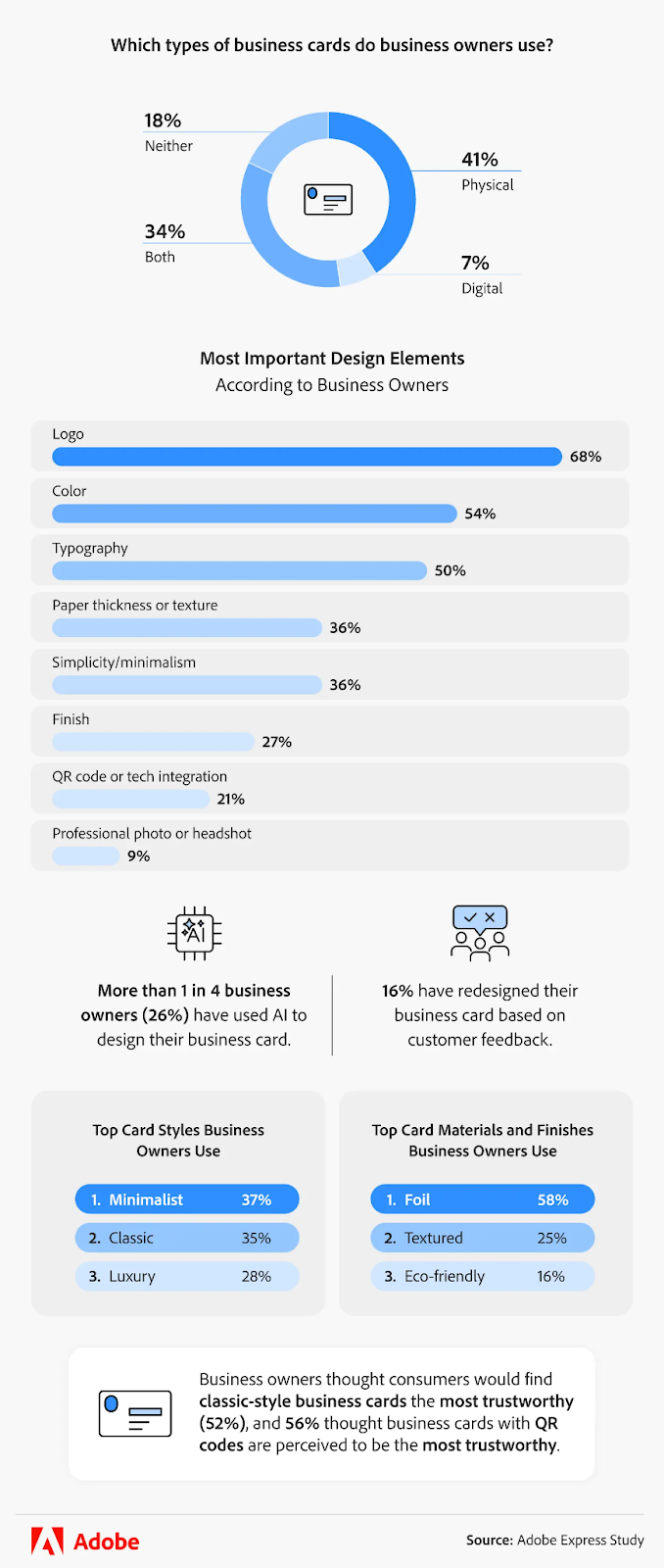
Interestingly, only 21% valued tech-forward features like QR codes or NFC integration, even though those were highly rated by consumers. Another key insight: 26% of business owners have already used AI tools to help design their cards, signaling growing adoption of creative automation in brand presentation.
The gap between what business owners care about and what consumers act on suggests a missed opportunity. Adding QR codes and simplifying design could better align business goals with user expectations.
Design tips for your next business card
Adobe’s study provides a clear playbook for creating cards that work in 2025:
- Use classic colors like white, black, or navy blue to build immediate trust
- Stick to horizontal layouts for readability and familiarity
- Add a QR code to link to your website, contact form, or portfolio
- Keep your design minimalist. Let your logo, font, and whitespace do the heavy lifting
- Use foil accents or textured paper to signal quality without overdoing it
If you’re designing or refreshing your card, Adobe Express offers several built-in tools, including an AI-powered layout engine, QR code generator, and customizable templates that align with these findings.
The Adobe Express survey confirms what many marketers may have suspected but couldn’t quantify. Print still plays a strategic role in branding and trust-building. In an age of digital overload, handing someone a well-designed business card isn’t just a formality. It’s a credibility signal.
Marketers should view business cards not as relics, but as low-cost, high-impact brand tools that still drive conversions. And by aligning your design with what today’s consumers actually trust and remember, you’re not just handing out contact info. You’re leaving a lasting impression.