AI discoverability strategy: why SEO alone is no longer enough
Search, chat, and AI recommendations are reshaping how brands get found. Learn how to build authority, citations, and visibility across AI-driven discovery surfaces.

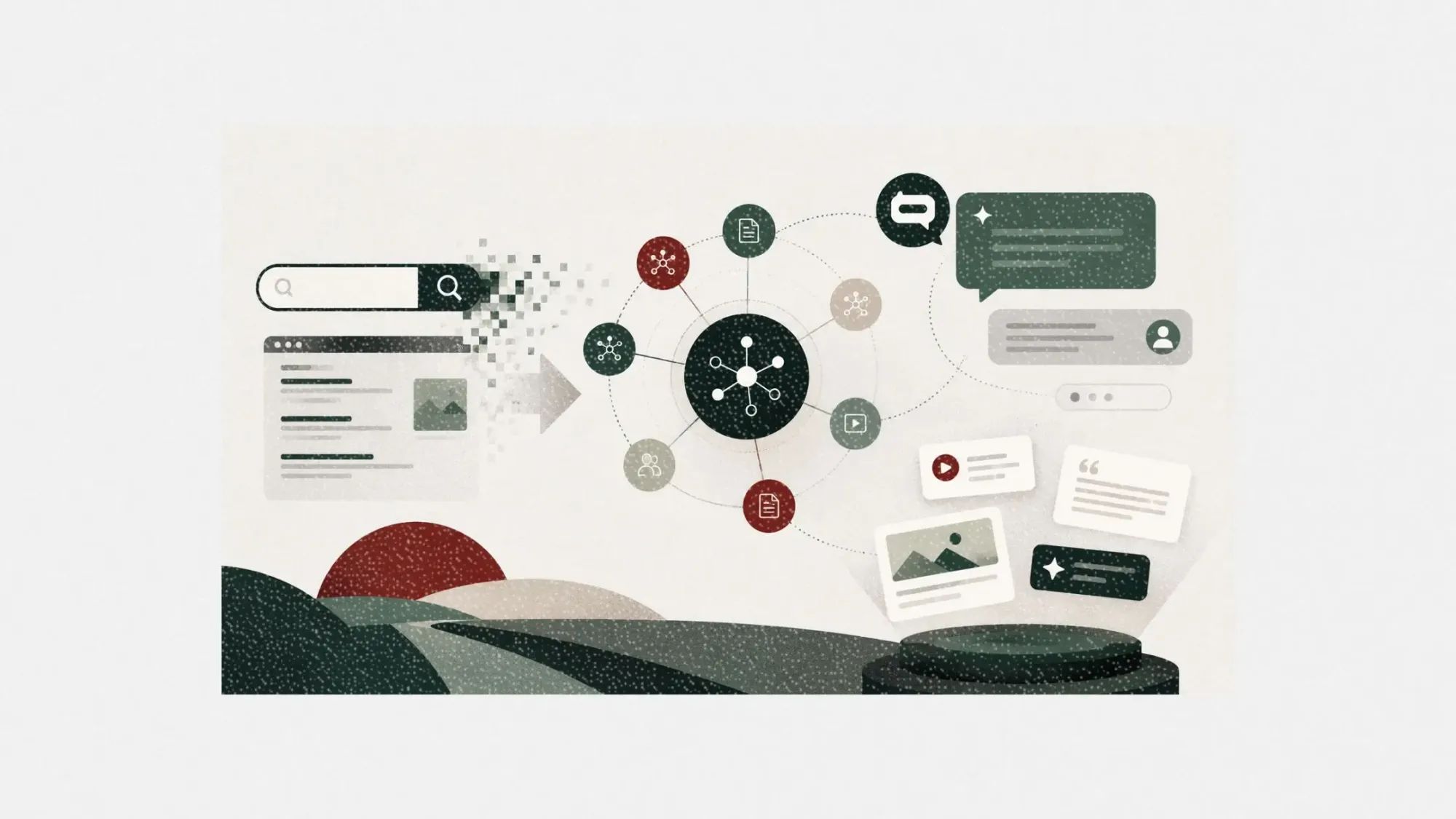
Search used to be a single-channel problem. You picked your keywords, built your pages, earned your backlinks, and watched your rankings. The discipline was narrow enough that one team, or sometimes one person, could own it.
That era is functionally over.
AI Overviews now appear in roughly a quarter of all US searches. ChatGPT has 800 million weekly active users and began running ads in February 2026, expanding internationally by May. Perplexity, Claude, and Gemini are fielding research queries that would have gone to Google two years ago. And the signals each of these surfaces uses to decide what to show and who to cite are different enough that running a single SEO program against all of them is like trying to win five sports with one playbook.
The teams that are adapting fastest are not the ones investing more in SEO. They are the ones rebuilding discoverability as a portfolio discipline: site architecture, earned authority, and conversational presence working in parallel.
Here is what that looks like in practice.
Table of contents
Jump to each section:
- Why discoverability is splitting across search, chat, and recommendation surfaces
- What AI systems now reward that old SEO programs often miss
- How PR, expert content, and internal linking now work together
- Where conversational ad inventory fits into the new visibility mix
- A portfolio framework for planning discoverability in 2026
- What this means for your team structure
Why discoverability is splitting across search, chat, and recommendation surfaces
The clearest way to understand what changed is to look at what the data actually shows about click behavior.
A Pew Research Center study tracking 68,000 real Google searches found that users clicked on a traditional result in only 8% of visits when an AI Overview was present, compared to 15% when it was not. That is a 47% relative reduction. Zero-click searches, meanwhile, rose from 56% to 69% of all Google queries between May 2024 and May 2025, according to Similarweb data.
Those numbers sound alarming, but they need context. Not all clicks are equally valuable, and the ones disappearing are not randomly distributed.
Google's VP of Search Liz Reid addressed this directly in a Google blog.
ContentGrip's coverage of Reid's comments breaks down the full implications: AI Overviews, she explained, are filtering out what she called "bounce clicks," the kind where a user loads a page, grabs a quick fact, and immediately returns to search. What remains, she argued, is a higher proportion of "deep clicks" from users who genuinely want to engage with richer content. Google's own data, Reid said, shows that click quality has actually increased even as some raw click volume has shifted.
The practical implication: traffic loss and visibility loss are no longer the same problem. If your content program is built around surface-level informational queries, you are losing real traffic. If it is built around depth, perspective, and expert-driven analysis, you may be holding or gaining ground on the clicks that actually convert.
The complication is that the web is no longer the only surface where discovery happens. ChatGPT handles hundreds of millions of conversations a week. Perplexity is fielding 780 million queries a month.
Users are starting research sessions in conversational interfaces, forming opinions there, and often not reaching a search engine until much later, if at all. Gartner projects that by the end of 2026, 25% of organic search traffic will have shifted to AI chatbots and voice assistants. That is not a niche shift. That is a structural one.
Discoverability, then, is not a search problem anymore. It is a presence problem across multiple mediated surfaces, each with its own authority logic.
What AI systems now reward that old SEO programs often miss
The working assumption in traditional SEO has been that what ranks well on Google will perform well everywhere. That assumption no longer holds.
Semrush's analysis of over 10 million keywords found that as of early 2026, AI Overviews appear for 25.8% of US searches, with informational queries triggering them in nearly 40% of cases. The content getting cited inside those overviews is not just the content that ranks in position one. Moz's 2026 analysis of 40,000 queries found that 88% of Google AI Mode citations do not appear in the organic top ten (via AuthorityTech). Citation and ranking are increasingly separate phenomena.
What do AI systems reward? The research points to a few consistent signals. For a broader primer on how to structure content for AI retrieval, ContentGrip's guide to generative engine optimization covers the foundational mechanics.
Topical depth and connected architecture. AI systems, including Google's, are better at assessing whether a site genuinely owns a topic cluster rather than just ranking for individual keywords. An isolated page optimized for one query is weaker than a connected cluster of pages that explain, link, and expand on a subject from multiple angles. Internal linking is not just a technical nicety in this environment. It is how you demonstrate to AI systems that your site is a coherent authority on a subject rather than a collection of disconnected articles.
Third-party authority signals. Multiple research streams point to the same finding: AI engines prefer earned media over brand-owned content by a wide margin. Muck Rack's May 2026 analysis of 25 million links across ChatGPT, Claude, and Gemini found that earned media accounts for 84% of all AI citations. Advertorial and paid content account for 0.3%.
A University of Toronto study confirmed the bias is structural, with AI search engines showing what researchers described as "systematic, overwhelming preference" for earned media over brand-owned content.
Structured, extractable information. A 2026 arXiv paper on citation absorption across ChatGPT, Gemini, and Perplexity found that high-influence pages tend to be more structured, more semantically aligned to the query, and richer in extractable evidence: definitions, comparisons, and numerical facts.
A brand's own summary of its positioning is weak signal. A concrete claim, a measurable result, or a named comparison is stronger because an AI system can lift it directly into an answer.
Entity coherence across the web. An Ahrefs study of 75,000 brands found that brand web mentions correlate three times more strongly with AI Overview visibility than backlinks. The signal is not just inbound links but consistent, coherent references to your brand across multiple trusted domains.
Your entity, how AI systems understand who you are and what you do, is built from what third-party sources say about you, not just what you say about yourself. ContentGrip's AI marketing statistics roundup tracks how fast these visibility dynamics are shifting across B2B verticals.
How PR, expert content, and internal linking now work together
The clearest shift in the discoverability landscape is that PR, content strategy, and technical SEO are converging on a single job: making your brand knowledge easy for AI systems to parse, trust, and cite.
For most teams, those three disciplines have operated separately. PR focused on relationships and coverage volume. Content focused on keywords and page production. SEO focused on technical health and link acquisition. That separation created a structural gap: no one owned the question of whether the brand's knowledge was actually legible to AI systems.
What the current data suggests is that all three need to be coordinated around the same output.
PR is now a discoverability input. Brands are 6.5 times more likely to be cited by AI systems through third-party sources than through their own domains, according to Superlines' 2026 research. Stacker and Scrunch ran a controlled study distributing content through third-party news outlets and found a 239% median lift in AI search visibility compared to the same content sitting on a brand's own site. The domain authority of the site hosting your story matters as much as the quality of the story itself, because AI systems weight the authority of the source, not just the content.
What this means for PR teams is that coverage strategy needs to change. A quote about company culture in a trade outlet does little for AI discoverability. A concrete, claim-rich story in a crawlable, authoritative publication, one that includes measurable outcomes, named comparisons, and specific category assertions, is far more likely to enter an AI citation set. The first reader of many earned media placements is now a machine deciding what to surface.
Expert content is the connective tissue. AI Overviews, ChatGPT, and Perplexity all reward content that demonstrates perspective, not just information. Reid has said publicly that Google's own data shows users click on "richer and deeper" content from AI Overviews, and that surface-level content "doesn't have much more than what an AI Overview would give."
If your content program is producing commodity summaries, you are training audiences and AI systems alike to skip you. Topical authority is the underlying concept: AI systems evaluate whether a domain has earned the right to be trusted on a subject, not just whether a single page is well-optimized.
Internal linking closes the loop. A connected site architecture signals topical authority to AI systems in the same way that a coherent body of published work signals expertise to a human reader.
Topic clusters, with a pillar page linking out to deep supporting content and those pages linking back, create the structural signal that AI systems use to evaluate whether a domain genuinely owns a subject. An isolated page, however well-optimized, is a weaker signal than a cluster of ten pages that reference, expand on, and contextualize each other.
The coordinated version of this looks like: PR secures a third-party citation in an authoritative outlet. That citation links to a deep pillar page on your site. The pillar page links out to a cluster of supporting content. The whole structure signals to AI systems that your brand is a coherent, well-evidenced authority on this topic. Each piece reinforces the others. None of them works as well alone.
Where conversational ad inventory fits into the new visibility mix
ChatGPT's advertising launch in February 2026 was not just a monetization story. It was a signal that conversational interfaces are formalizing into a distinct discovery and influence surface, one with its own ad inventory, its own authority logic, and its own audience behavior.
The numbers are moving fast. OpenAI's ad pilot launched at $60 CPM with a $200,000 minimum commitment. By March 2026, six weeks in, ChatGPT advertising had crossed $100 million in annualized revenue.
By April, OpenAI had opened self-serve access through a new Ads Manager tool, lowering the minimum spend threshold to $50,000. By May, the pilot had expanded to the UK, Japan, South Korea, Brazil, and Mexico. The company is targeting $2.5 billion in ad revenue for 2026.
The format is contextual. Ads appear at the bottom of chat responses when the user's conversation suggests relevance to a product or service. They are clearly labeled as sponsored and are kept separate from ChatGPT's answers. OpenAI has said it does not sell user data to advertisers or give them access to conversations.
This matters for discoverability planning in two ways.
First, the audience inside ChatGPT is intent-rich in ways that display advertising rarely is. A user asking "what project management tools work best for remote teams of 20?" is much further into an evaluation process than someone seeing a banner ad on a media site. Brands accustomed to broad display metrics will need to rethink how they measure performance in an environment where the query is the signal.
Second, conversational ad inventory will reward brands that have already built organic presence in AI answers, not just paid budgets. Seer Interactive's research found that brands cited in AI Overviews earn 35% more organic clicks and 91% more paid clicks. The paid lift from earned presence is real. A brand with no organic AI visibility stepping directly into ChatGPT ads is paying for reach without the authority foundation that makes that reach efficient.
AI-powered advertising more broadly is projected to grow from $35 billion, about 8% of US ad revenue, in 2025 to $142 billion, roughly 26% of total ad revenue, by 2030. That is a 306% increase in five years.
Conversational placement is a small slice of that today, but the direction of the category is clear. Mediaocean's 2026 ad spend outlook found that AI media, which includes placements on ChatGPT and Google AI Overviews, is now projected to grow faster than traditional search advertising among surveyed marketers.
The brands positioned to benefit from conversational advertising are the ones that have already done the foundational work: building earned authority, structuring their content for AI legibility, and establishing consistent entity presence across third-party sources. Paid spend in a conversational interface amplifies existing presence. It does not substitute for it.
A portfolio framework for planning discoverability in 2026
The way to think about discoverability in 2026 is as three interdependent layers, each contributing something the others cannot replace.
Layer one: Site architecture for AI legibility. This is the owned foundation. Topic clusters with strong internal linking, structured data, entity definitions, and content depth signal to AI systems that your domain is a coherent authority rather than a collection of pages.
The signal here is topical coherence. You are not optimizing for a keyword. You are building a body of evidence that AI systems can retrieve, trust, and assemble into answers.
Key question to ask: If an AI system were assembling an answer about your core topic, could it find a connected, internally consistent set of pages on your domain that provides depth beyond what any single page offers?
Layer two: Off-site earned authority. This is the external validation layer. Earned media coverage in crawlable, authoritative publications. Expert quotes that include concrete claims. Brand mentions that are consistent, specific, and distributed across multiple trusted domains. Third-party coverage that links back to your deep content.
Key question to ask: Does the coverage your PR program generates include the kind of structured, claim-rich content that AI systems can actually extract and cite? Not just impressions, but extractable authority.
Layer three: Conversational presence and paid placement. This is the emerging layer. Understanding which AI platforms your target audience uses for research, building organic visibility in those platforms through earned and structural signals, and then amplifying that presence through conversational ad inventory as it becomes accessible. ChatGPT's self-serve Ads Manager, now open to budgets starting at $50,000, makes this layer reachable for brands below enterprise scale for the first time.
Key question to ask: Are you building conversational presence through the first two layers before committing paid budget to the third? Paid placement in AI interfaces rewards existing authority. It does not create it.
How to measure across all three. Traditional metrics stop working here. Raw click volume is a misleading signal when click quality is shifting. Page rankings are a weak proxy for AI citation likelihood.
The metrics that matter now are: share of voice in AI-generated answers, brand mention velocity across third-party sources, citation frequency in AI Overviews, and assisted conversions from users who discovered the brand through a conversational interface before reaching your site.
What this means for your team structure
The practical implication of treating discoverability as a portfolio discipline is that the people responsible for it need to be talking to each other, and probably more often than they currently are.
A PR team optimizing for impressions in trade outlets without asking whether those outlets are AI-crawlable is leaving earned authority on the table. An SEO team building page clusters without asking whether the content is citation-worthy in conversational interfaces is optimizing for a smaller portion of the discovery landscape than they think. A paid search team planning media spend without accounting for how organic AI presence affects paid efficiency is miscalibrating their models.
None of this requires reorganizing your entire marketing department. It does require one person, or one coordination process, that owns the question of how your brand appears across all three layers.
The discoverability challenge in 2026 is not that any single channel is dying. It is that the channels have multiplied, each with different authority rules, and the brands treating them as one problem with one solution are going to keep losing ground to the ones that have figured out how they fit together.