
Amazon wants to reinvent the upfront with AI, live sports, and agentic shopping
Amazon is reframing upfront advertising around AI optimization, authenticated data, and commerce-driven streaming media.

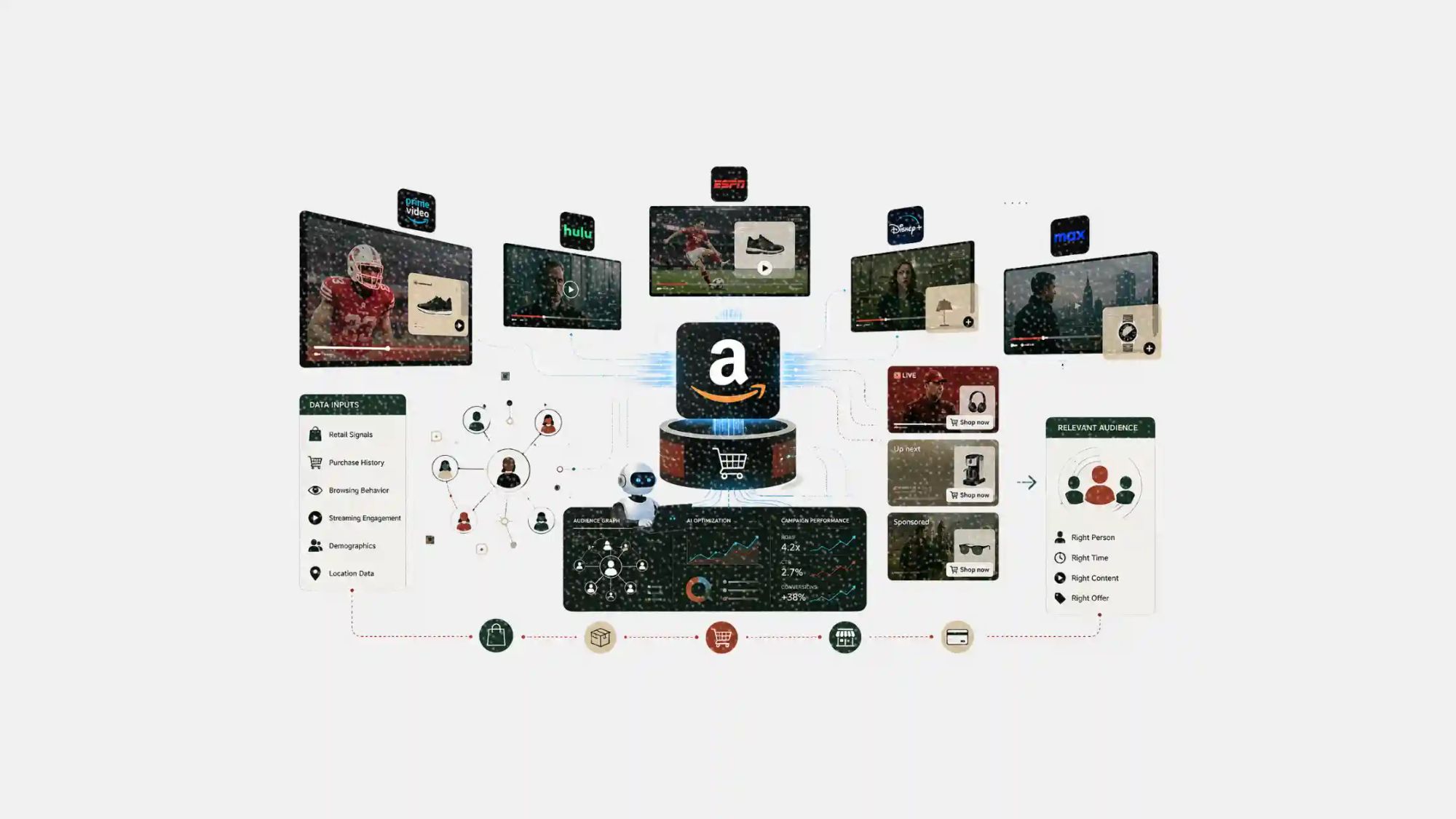
Amazon says the old upfront model is breaking down as streaming fragmentation, AI-driven ad buying, and commerce data reshape how brands plan media. The company’s latest pitch to advertisers goes far beyond securing premium content inventory. Instead, Amazon is positioning itself as the connective layer between streaming TV, retail signals, AI optimization, and full-funnel measurement.
Ahead of its upfront presentation, Amazon VP of global ad sales Alan Moss spoke with ADWEEK and outlined how the company is evolving its ad business around authenticated audience graphs, AI-powered campaign tools, and interactive formats designed to connect premium content directly to measurable commerce outcomes. The strategy reflects a larger shift happening across adtech and connected TV: media buying is becoming less about isolated placements and more about unified systems that optimize across channels in real time.
For marketers, the message is clear. The future upfront conversation is no longer just about what audiences are watching. It is about how AI, identity, and commerce signals work together to influence buying behavior across fragmented platforms.
Table of contents
Jump to each section:
- Why Amazon says the upfront model is changing
- How Amazon is combining AI, streaming, and commerce data
- Why agentic shopping could reshape digital advertising
- What marketers should know about Amazon’s AI ad strategy
- What this means for the future of upfront advertising
Why Amazon says the upfront model is changing
Amazon argues that the traditional upfront process is no longer aligned with how audiences consume media or how marketers measure performance.
According to Moss, buyers are shifting away from content-first decisions toward integrated systems that combine premium inventory, audience data, AI optimization, and measurable outcomes. Amazon believes streaming fragmentation has accelerated this shift, forcing advertisers to rethink how investments work together across platforms instead of treating media buys as isolated campaigns.
The company says its authenticated audience graph now reaches roughly 90% of US households through partnerships spanning Prime Video, Amazon DSP, Netflix, Disney, Roku, Spotify, and LinkedIn’s connected TV integrations. That scale allows Amazon to position itself less like a streaming platform and more like a centralized operating system for cross-platform advertising.
Live sports remain a major pillar of the strategy. Amazon continues expanding its portfolio with Thursday Night Football, NBA, WNBA, NASCAR, and other premium properties. But the company is increasingly packaging sports inventory with AI optimization, sponsorship integrations, and audience targeting capabilities instead of selling inventory alone.
That distinction matters. The streaming wars created massive inventory expansion over the last several years. Now platforms are competing on intelligence, interoperability, and measurable commerce outcomes.
How Amazon is combining AI, streaming, and commerce data
Amazon’s core argument is that premium content becomes significantly more valuable when paired with deterministic commerce signals and AI-driven campaign optimization.
The company says advertisers are increasingly focused on reducing waste, simplifying execution, and improving accountability across campaigns. To support that, Amazon is investing heavily in AI tools that automate campaign planning, audience selection, optimization, and measurement.
Several pieces stand out in Amazon’s current positioning:
- AI-assisted campaign management: Amazon says AI agents can help brands automate planning, optimization, and reporting workflows.
- Cross-platform identity resolution: Audience signals from Amazon shopping behavior and partner platforms are designed to improve targeting consistency across streaming environments.
- Interactive advertising formats: Amazon continues investing in pause ads, contextual ads, and interactive video units tied directly to shopping behavior.
- Creative scalability: AI-generated creative adaptation allows brands to repurpose assets across multiple placements and formats with less manual production work.
This reflects a broader industry trend where adtech companies are trying to merge media buying, retail media, and generative AI into unified systems. The pitch is operational efficiency: fewer disconnected tools, faster optimization cycles, and clearer attribution.
For large brands, that could mean improved campaign coordination across fragmented streaming environments. For smaller advertisers, Amazon argues AI lowers the barrier to entry for premium video and live sports advertising.
Why agentic shopping could reshape digital advertising
One of the more important signals from Amazon’s comments is its focus on “agentic shopping.”
The term refers to AI systems that actively assist consumers in discovering, comparing, and purchasing products with less manual searching or browsing. Instead of users navigating traditional shopping journeys, AI agents increasingly guide decision-making automatically based on preferences, history, and contextual behavior.
Amazon believes this shift is already underway.
That has serious implications for marketers:
- Traditional keyword targeting may become less important than structured product data and AI-readable signals.
- Brands may need to optimize for AI recommendation systems instead of just search rankings.
- Commerce content and contextual relevance could become more valuable than broad demographic targeting.
- Attribution models may become more complex as AI agents influence purchase paths behind the scenes.
This is especially relevant as generative AI platforms continue integrating commerce experiences directly into conversational interfaces.
The companies controlling both shopping intent and AI infrastructure could gain outsized influence over product discovery. Amazon clearly wants to position itself as one of those platforms.
What marketers should know about Amazon's AI ad strategy
For marketers evaluating Amazon’s evolving ad ecosystem, several strategic considerations stand out.
1. AI-native media planning is becoming operational reality
Many ad platforms previously treated AI as an optimization layer. Amazon is positioning AI as the foundation of campaign orchestration itself.
That means marketers should start preparing workflows where AI systems handle:
- Budget allocation
- Creative adaptation
- Audience segmentation
- Cross-channel optimization
- Real-time measurement adjustments
The operational advantage may shift toward teams that can supervise AI systems effectively instead of manually managing every campaign component.
2. Retail media and streaming are converging fast
Amazon’s strategy shows how retail media networks are moving directly into entertainment and streaming environments.
This convergence creates opportunities for:
- Closed-loop attribution
- Commerce-linked video campaigns
- Interactive shoppable ads
- Audience targeting tied to real purchase behavior
Brands that still separate retail media and brand advertising internally may struggle to adapt.
3. Interactive ads are becoming more important
Amazon continues emphasizing interactive and native video formats instead of passive linear-style ads.
That aligns with broader consumer behavior trends where viewers increasingly expect participation, personalization, and commerce integration inside streaming environments.
Marketers should experiment with:
- Interactive video creative
- Dynamic product overlays
- Shoppable streaming experiences
- Contextual AI-driven ad formats
4. First-party data remains critical
Amazon’s entire positioning depends on authenticated audience graphs and deterministic commerce signals.
As privacy restrictions continue limiting third-party tracking, platforms with strong first-party ecosystems gain leverage. Brands without robust first-party data strategies may become increasingly dependent on platform ecosystems like Amazon’s.
What this means for the future of upfront advertising
Amazon’s latest upfront strategy highlights how rapidly the advertising industry is changing.
The traditional upfront model was built around scarcity: securing premium inventory before competitors. But streaming fragmentation and AI-driven optimization are shifting the conversation toward interoperability, measurable outcomes, and commerce integration.
For marketers, the bigger story is not just Amazon’s expansion into AI-powered advertising. It is the growing fusion of media, retail, identity, and automation into unified ecosystems controlled by a handful of large platforms.
The next phase of digital advertising may be less about buying impressions and more about orchestrating AI-assisted consumer journeys across fragmented environments.
Brands that adapt early to AI-native planning, commerce-driven media, and interactive streaming formats will likely have a stronger advantage as these systems mature.