Brainlabs data reframes the cost of AI search traffic loss
Brainlabs' advertiser data shows AI search can reduce organic sessions while sending fewer, higher-intent visitors to brand websites.


Brainlabs has found that AI search is reducing organic traffic across much of its advertiser roster, but the visitors arriving from AI platforms appear more likely to complete valuable actions. The finding gives marketers a more useful way to interpret the zero-click shift: lost sessions do not automatically mean lost demand.
That distinction matters because most search dashboards were built for a world in which discovery and referral happened in the same place. AI Overviews and conversational tools now answer more questions before a user reaches a brand website. Marketers therefore need to measure what survives that filtering process, not only what disappears.
Table of contents
Jump to each section:
- What Brainlabs measured
- Why less traffic can still mean more value
- Category differences make one benchmark dangerous
- What this means for marketers
What Brainlabs measured
Brainlabs examined Google Analytics data from advertisers across the United States, Britain, and several other markets over a period spanning early 2025 through spring 2026. The agency treated the point at which Google AI Overviews became common in US search results as an inflection point, then compared organic sessions and traffic from AI platforms before and after it.
10.5% decline across 54 advertisers Organic sessions fell from 140.1 million to 125.4 million across the agency dataset after AI Overviews became common.
The decline was widespread, but not universal. At the same time, referrals from tools such as ChatGPT and Gemini expanded sharply from a much smaller base.
163% increase Sessions attributed to AI platforms grew over the same measurement period.
Those two movements should be read together. AI search is absorbing more informational activity while also becoming a new referral source for people who continue beyond the answer. Traffic is becoming a weaker proxy for demand precisely as intent becomes harder to observe.
 Patrecia Meliana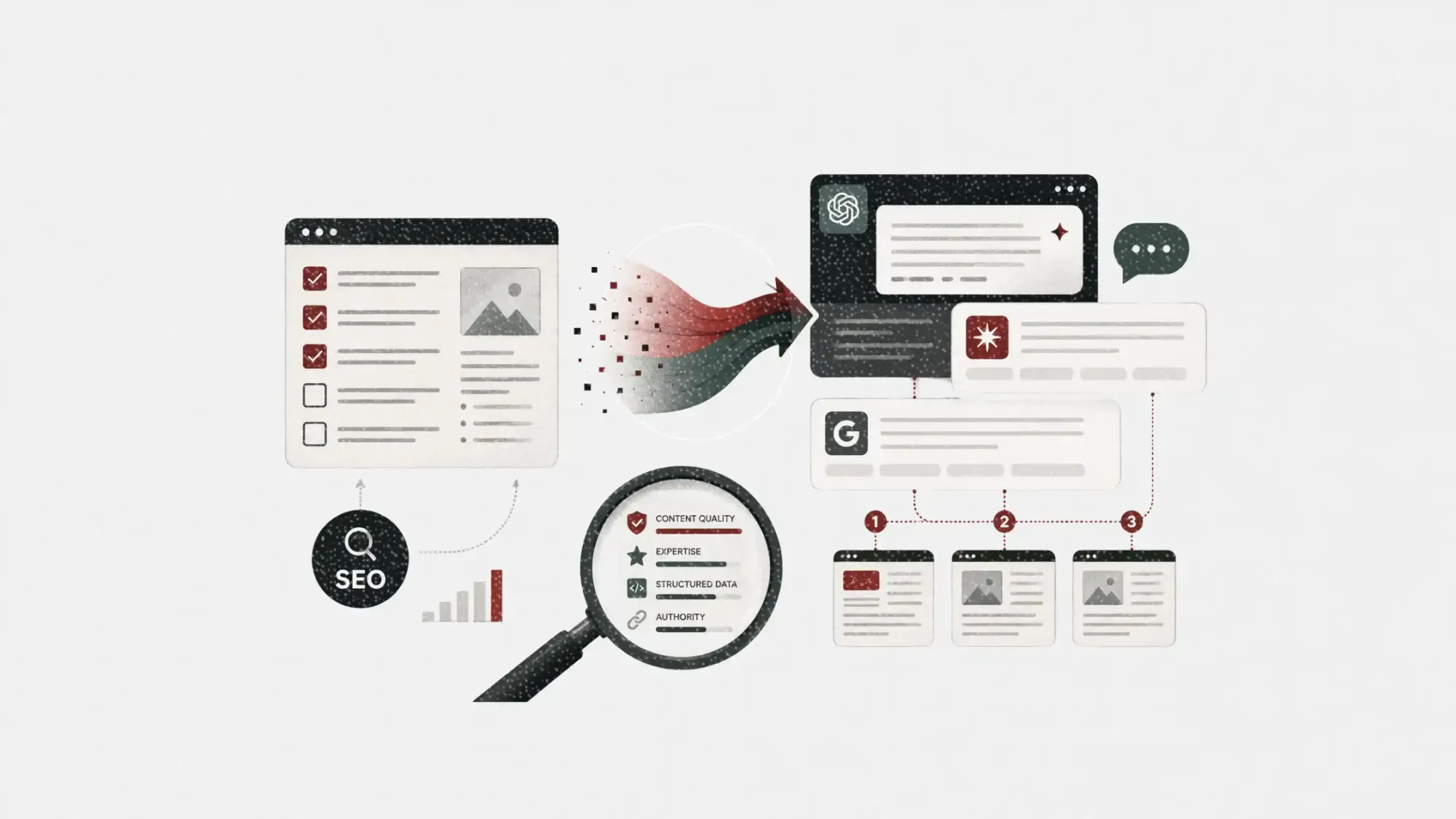
Why less traffic can still mean more value
The common assumption is that a shrinking organic audience must weaken commercial performance. Brainlabs' data points to a more complicated reality: much of the lost volume appears to sit around educational and discovery queries, while AI-referred visitors arrive after more of the evaluation has already happened. The strategic implication is that session loss and demand loss can no longer be treated as interchangeable.
Brainlabs tracked key events such as purchases, newsletter sign-ups, and deeper page engagement. These are broad signals rather than a single revenue metric, but they show whether a visit produces behavior the advertiser considers meaningful.
1.5 times higher The key-event rate for referrals from ChatGPT, Copilot, Gemini, and Perplexity exceeded the rate for organic search traffic.
A person who clicks from an AI answer may have already asked follow-up questions, compared options, and narrowed a shortlist. The brand website is no longer always the place where evaluation begins. It can become the destination for verification or action.
The pageview is losing its monopoly on proof.
This does not make traffic irrelevant. It changes the question from how many people arrived to what role the visit played in a longer, partly invisible decision process. A smaller audience can still carry more commercial intent, while a large audience built on easily summarized informational queries can vanish without an equivalent loss in sales.
Category differences make one benchmark dangerous
The effects were uneven across Brainlabs' clients. Fitness, fintech, insurance, and consumer packaged goods brands experienced some of the largest organic declines. Retail, beauty, and entertainment businesses saw smaller drops and stronger gains from AI referrals.
That pattern makes sense as a hypothesis, not a universal rule. Categories built around comparison and considered decisions give AI systems more opportunity to answer early-stage questions before users click. More transactional searches may still require product pages, prices, availability, imagery, and other details that are difficult to compress into a single summary.
AI search does not remove the funnel. It hides more of it.
For marketing leaders, this is a warning against importing a general AI-search benchmark into a category plan. A traffic decline that signals content displacement for an insurer may mean something different for a beauty retailer. The right baseline depends on query intent, buying cycle, content type, and the actions that matter after arrival.
It also changes how SEO and paid media teams should work together. If AI platforms concentrate higher-intent visitors while organic informational volume falls, channel planning needs a shared view of assisted influence. Otherwise, teams may cut content that helps shape decisions simply because the final click appears elsewhere.
What this means for marketers
The practical response is to rebuild measurement around the quality and role of a visit, while accepting that some discovery now happens outside the brand's analytics perimeter.
Separate volume from value. Track AI referrals alongside organic sessions, but compare their key-event and conversion rates rather than combining them into one traffic total.
Map results by query intent. Distinguish educational, comparison, navigational, and transactional content so traffic loss can be tied to the part of the journey AI is absorbing.
Use category-specific baselines. Compare performance with similar products and buying cycles. A single cross-industry benchmark can hide the difference between displaced curiosity and lost commercial demand.
Preserve evidence-rich content. Pages that clarify product details, answer evaluation questions, or substantiate claims may influence an AI-mediated decision even when they receive fewer direct visits.
Connect search and paid planning. Include AI referrals, key events, branded search, and later conversions in the same discussion so budget decisions reflect the whole discovery path.
The deeper shift is not simply from Google to AI. It is from observable journeys to mediated ones. Brands will increasingly influence decisions in environments where they cannot see every impression, question, or comparison.
That makes measurement less comfortable, but potentially more honest. Raw traffic always mixed curious visitors with serious prospects. AI search is exposing how little those sessions had in common.
The marketers who adapt will not dismiss declining traffic or celebrate high-intent referrals in isolation. They will learn to value the sequence between discovery, synthesis, verification, and action, even when the connecting steps are only partly visible.