
SponsorCX study maps a consumer trust shift across AI, reviews, and influencers
SponsorCX surveyed 1,000 U.S. adults. AI content and influencer promos face skepticism, while reviews and values-based partnerships shape trust decisions.

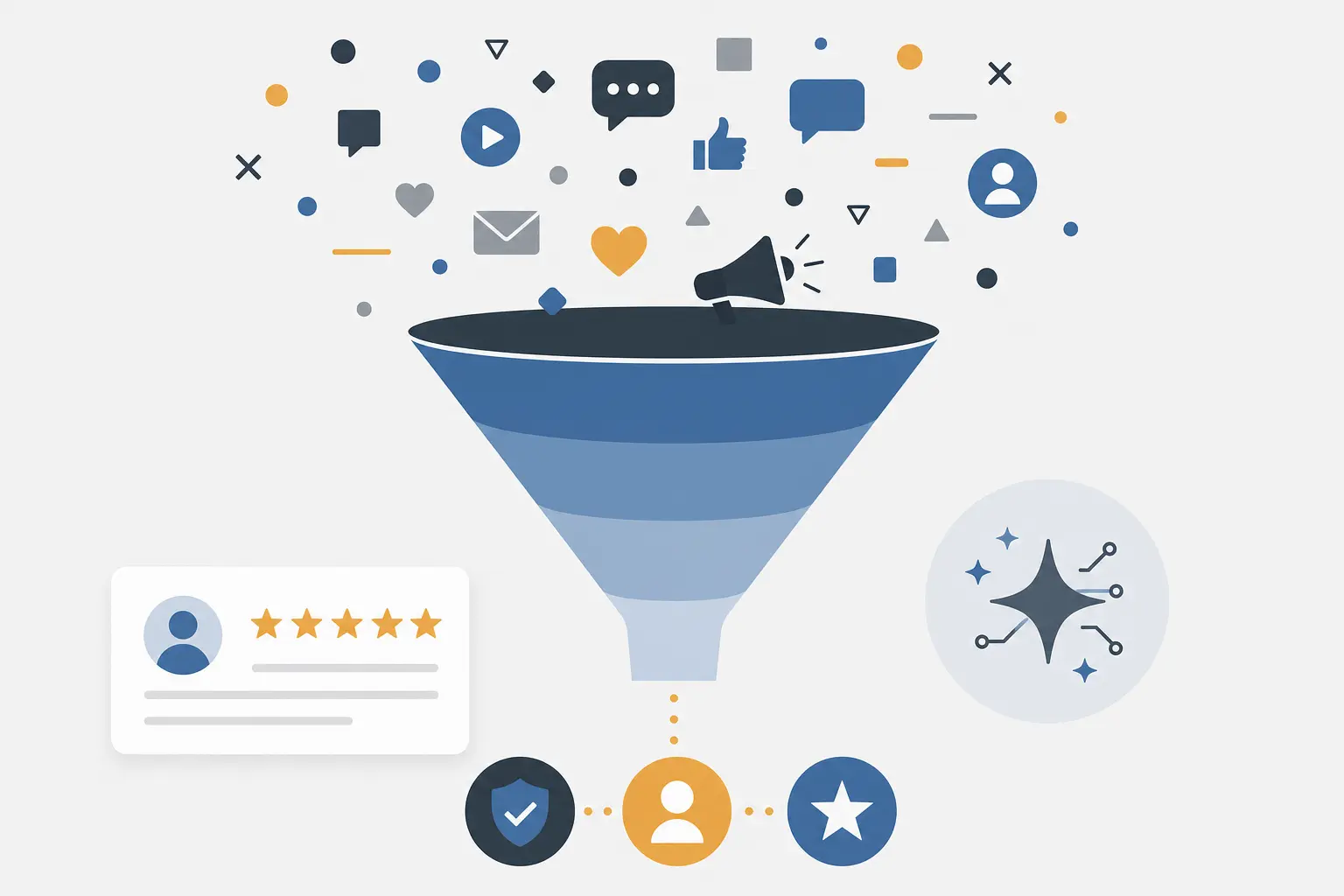
SponsorCX surveyed 1,000 U.S. adults and found a widening trust gap across digital persuasion, with friends and family still the strongest influence while AI content, online reviews, and influencer promotions face rising skepticism.
The details were outlined in the company’s official study page, including findings on review integrity, “authenticity” fatigue, and how consumers are starting to use AI tools to filter the internet’s growing volume of questionable content.
Table of contents
Jump to each section:
- Why “authentic” is losing its power as a trust signal
- Reviews remain mandatory, but review integrity is now the product
- Influencer marketing is hitting a credibility ceiling
- AI is both the trust problem and the new shopping interface
- Partnerships that add trust look more like alignment than amplification
- What this means for marketers
Why “authentic” is losing its power as a trust signal
A central finding is that consumers increasingly interpret “authenticity” as a packaging layer, not proof. In SponsorCX’s survey, 76% say marketing feels more performative than genuine, and 65% agree brands overuse the word “authentic” without backing it up.
The strategic tension here is uncomfortable for brand teams.
The common assumption is that saying the right values in the right tone builds trust. The contrasting reality is that values language, when repeated at scale, becomes another ad format. The implication is that trust now depends less on what you claim and more on what you can demonstrate.
A memorable way to frame it: When every brand speaks the language of authenticity, authenticity stops being a differentiator and becomes a liability.
SponsorCX also points to volume-driven fatigue: 74% say there is too much sponsored content on digital platforms, and 64% say search results are influenced more by marketing than by page quality. That context matters because even “good” brand messaging lands inside an environment consumers already suspect is engineered.
Another observation worth holding onto: Transparency is becoming a performance metric, not a compliance checkbox. In the same dataset, 59% say clearly labeled sponsorships increase trust, yet only 46% feel confident distinguishing paid from organic content. That is a trust gap brands do not fix with better copy.
 ContentGrip
Reviews remain mandatory, but review integrity is now the product
SponsorCX’s results show a paradox: 95% still use reviews, but 55% have avoided a brand due to suspicious or AI-generated reviews, and 82% say AI-generated content makes it harder to trust online reviews.
That distinction matters because “having reviews” is no longer a competitive advantage. Reviews are table stakes. The real differentiator is whether a shopper believes your review surface has been manipulated.
A concise observation: In 2026, the conversion lever is not review volume, it is review believability.
The red flags SponsorCX lists are revealing because they are not only about fraud. Alongside AI-generated reviews and suspicious reviews (both cited by 55%), consumers also avoid endorsements that feel fake (49%), AI-generated content (39%), and even “overly polished branding” (33%). Polished creative used to signal professionalism. In a skeptical feed, it can read as “too produced to trust.”
The survey also notes that 26% regret a purchase because reviews or content turned out misleading, rising to 38% among Gen Z. If you run performance marketing, that regret is not just a CX issue. It is a future CAC issue, because skeptical consumers raise the proof threshold before they click “buy” again.
Influencer marketing is hitting a credibility ceiling
SponsorCX reports only 16% trust influencer recommendations “very or completely,” and only 1% say they will purchase after seeing an influencer promotion. Even among Gen Z, which shows higher trust (37% in the survey), reported purchasing after influencer promotion is still just 3%.
This is not simply “influencer marketing is dead.” It is more specific: influencer content may still be attention-getting, but it is less likely to be closing.
A useful reframing: Influencers are increasingly a distribution channel for awareness, while trust is being decided elsewhere.
SponsorCX’s findings underline why. Nearly half (48%) of respondents say celebrity or influencer endorsements communicate that a brand paid for promotion, and only 8% believe an endorsement reflects the influencer’s genuine opinion. In other words, the persuasion mechanism has become too legible. People understand the transaction.
The more interesting question is what replaces the influencer trust function. SponsorCX’s data suggests it is not a single substitute, but a blended proof stack: user-generated content earns strong trust from 44%, and friends and family recommendations top the list at 70% trust.
AI is both the trust problem and the new shopping interface
SponsorCX’s survey captures a loop marketers should pay attention to: 82% say AI-generated content makes it harder to tell what is genuine online, yet 51% have used AI tools like ChatGPT to research a product instead of traditional reviews or search, with 70% of Gen Z doing so at least once.
A memorable way to put it: Consumers are outsourcing trust to the same class of technology they distrust.
This matters because it changes where brand messaging gets evaluated. If more shoppers ask an AI tool to summarize pros and cons, the “unit of persuasion” shifts from your landing page to the model’s synthesized answer, and from your star rating to the model’s interpretation of review credibility.
SponsorCX also notes segmentation by gender and age. Men report higher AI use for product research (58% vs. 45% for women), and women report lower trust in AI-generated recommendations (12% strongly trust vs. 23% for men). Marketers should treat “AI as shopping interface” adoption as uneven, not universal. Your trust-building system needs to work for both: the shopper who cross-references manually and the shopper who asks an AI tool to do it.
Partnerships that add trust look more like alignment than amplification
SponsorCX’s results suggest partnership strategy is splitting into two buckets: partnerships that signal alignment and partnerships that signal spend.
Cause-based partnerships increase trust for 46% of consumers, the strongest trust-positive partnership type in the survey. Traditional brand-to-brand collaborations also perform well (39% increase trust, 10% decrease). Meanwhile, celebrity and influencer partnerships decrease trust for roughly 25% of consumers each, and influencer collaborations are effectively net-neutral.
The strategic implication is not “do more cause marketing.” It is that consumers are rewarding partnerships that feel hard to fake. Alignment is harder to counterfeit than reach.
A concise observation: The partnership that wins now is the one that explains the brand, not the one that broadcasts it.
SponsorCX’s data also shows this trust shift is not confined to one generation. While Gen Z responds strongly to cause-based partnerships (57% say they increase trust), the pattern holds broadly: “purpose” is outperforming “popularity” as a shortcut to credibility.
What this means for marketers
The SponsorCX findings point to a simple but demanding reality: trust is becoming a system property, not a campaign outcome.
- Treat review integrity as a core brand asset, not a conversion tactic
With 55% avoiding brands due to suspicious or AI-generated reviews and 95% still relying on reviews, your operational choices shape perception. How reviews are collected, verified, and moderated is part of marketing now. - Use “authentic” claims sparingly, and replace them with proof
When 65% believe the term is overused, repeating it adds risk. Show receipts: specific practices, visible tradeoffs, and consistent behavior across touchpoints. Consumers are distinguishing philosophy from tactic. - Re-scope influencer programs toward discovery, not guaranteed purchase
If only 1% report purchasing after influencer promotions, build measurement and creative around attention and consideration, then hand off to higher-trust assets like UGC and credible reviews. - Prepare for AI-mediated shopping journeys without assuming universal adoption
With 51% having used AI tools for product research (and 70% of Gen Z doing so at least once), AI summaries are becoming part of the funnel. But adoption and trust vary by demographic, so your trust signals must work in multiple evaluation modes. - Shift partnership selection from reach-first to alignment-first
Cause-based partnerships raising trust for 46% suggests a direction: partnerships that clarify values and community connection. It is less about “who can amplify us” and more about “who makes our intent believable.”
Zooming out, the deeper shift is that consumers are not rejecting marketing. They are rejecting ambiguity. They will accept persuasion, but they want to see the wires.
As AI content scales, the brands that keep trust will likely be the ones that make verification easy, not the ones that make messaging louder.
That is the long game: building a brand people can validate quickly, even when they assume the internet is trying to trick them.