Influencer marketing KPIs every B2B marketer should track (and 6 to ignore)
The metrics that move budgets versus the ones that fill slides.

Nine in ten marketers say sponsored influencer content outperforms brand-owned content on engagement. Eighty-three percent say it converts better. Those are striking numbers from the Sprout Social Q1 2025 Pulse Survey, and they are quoted constantly in agency decks and budget proposals.
What those numbers do not tell you is which metrics you should use to prove it to your CFO. Engagement outperforming brand content is a relative claim. It says nothing about whether the engagement drove the pipeline, accelerated deals, or justified the spend. For B2B marketers, that distinction is where influencer programs either earn their budget line or lose it.
The problem is not a shortage of metrics. Most influencer marketing platforms surface dozens of them. The problem is that the default metrics were built for consumer brands running 72-hour promotional cycles on Instagram.
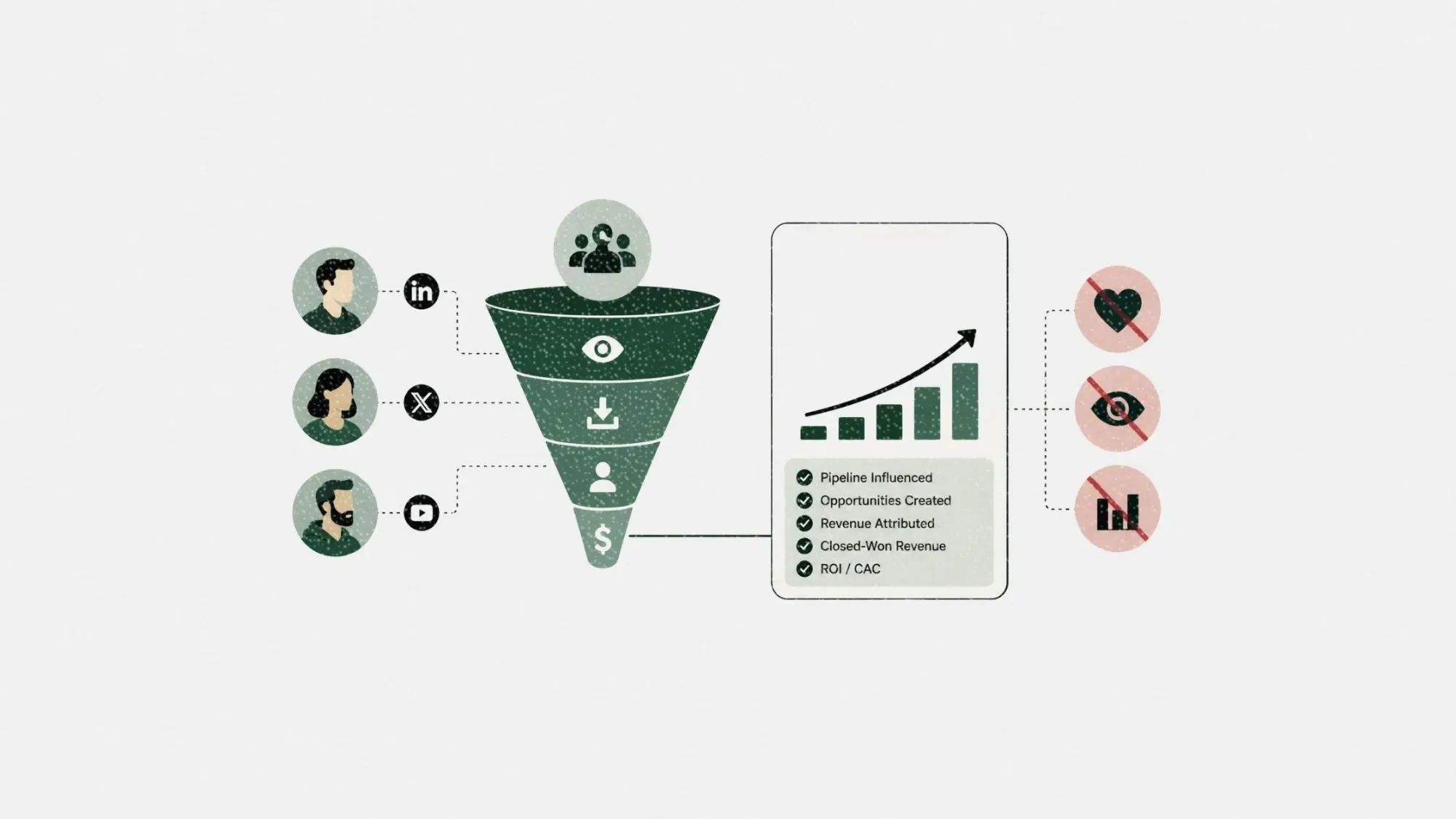
B2B buying does not work that way. When a CFO asks what your influencer program returned, they are not asking about engagement rate. They are asking about cost per opportunity, pipeline influence, and deal velocity. The KPIs that answer those questions are different from the ones most platforms put at the top of their dashboards.
This article separates the two lists. The first section covers the KPIs that carry weight in B2B budget conversations. The second covers six metrics that appear in almost every influencer report and belong in the footnotes, not the headline.
Table of contents
Jump to each section:
- Why B2B KPIs require a different framework
- The KPIs B2B marketers should track
- 6 KPIs to stop leading with
- How to build your B2B influencer KPI stack
- Matching KPIs to program maturity
- The metric your CFO is actually waiting for
Why B2B KPIs require a different framework
The Sprout Social data on sponsored content outperforming brand content is real and useful, but it comes with a caveat that rarely makes it into the headline: for B2B marketers specifically, the conversion advantage drops significantly. According to Chief Marketer's analysis of the same Sprout survey, the share of B2B marketers who see better conversions from influencer content versus organic content is 59%, compared to 83% across all marketers. And 40% of B2B marketers see virtually no difference between the two.
That gap is not evidence that influencer marketing underperforms in B2B. It is evidence that the conversion metrics being measured are the wrong ones for B2B contexts. When a B2C brand tracks conversions, they mean purchases. When a B2B brand tracks conversions, they should mean demo bookings, MQL hand-offs, trial signups, or pipeline entries, all of which operate on a fundamentally longer timeline and involve more stakeholders.
The right KPI framework for B2B influencer programs is built around three questions your finance team can actually evaluate.
- Did creator activity generate a qualified pipeline? This requires connecting creator touchpoints to CRM opportunity data, not just website traffic.
- Did creator-influenced prospects behave differently from other prospects? This requires cohort comparison: close rates, deal velocity, and average contract value for creator-influenced versus non-influenced leads.
- Did the program justify its cost relative to other acquisition channels? This requires a cost-per-outcome comparison using the same units your paid media team reports in, not a proprietary EMV calculation.
Every KPI worth tracking in B2B flows from one of those three questions.
"The moment a B2B marketing team walks into a budget review with an influencer report headlined by impressions and engagement rate, they have already lost the room," says Dinda Anandita, Account Director at content-led comms agency Content Collision. "Finance teams speak in pipeline and cost per acquisition. If your KPIs cannot translate into that language, the program looks like a cost centre rather than a growth channel, regardless of how well it actually performed."
The KPIs B2B marketers should track
Pipeline influence rate
Pipeline influence rate measures the percentage of your current open opportunities that had at least one documented touchpoint with creator content before entering the pipeline. It does not require direct attribution. It requires CRM tagging.
When a contact arrives at your website via a creator-specific UTM link, downloads a gated asset, or books a demo through a creator-tagged landing page, that contact gets tagged in your CRM as creator-influenced. Over time, you can report on what percentage of open and closed deals passed through a creator touchpoint at some stage in their journey.
This is the single most important B2B influencer KPI because it speaks the language of revenue operations. It does not claim that creator content caused the deal. It documents that creator content was present in the deal journey, which is the honest and defensible version of influence attribution.
Cost per influenced opportunity
Once you are tracking pipeline influence rate, cost per influenced opportunity becomes straightforward to calculate: total program cost divided by the number of opportunities where at least one creator touchpoint was documented.
Compare this number against your cost per opportunity from other acquisition channels: paid search, content marketing, events, and outbound. If creator-influenced opportunities cost less than comparable channels and convert at a similar or better rate, the program is generating positive return even before you account for brand authority and compounding content effects.
Deal velocity comparison
Deal velocity measures the average number of days from first touch to closed-won, compared between creator-influenced and non-creator-influenced prospects. Research cited across multiple B2B attribution studies indicates that prospects who engage with creator content before a discovery call tend to close faster than cold leads, because they arrive with pre-formed awareness of your brand and product category.
If your baseline deal cycle is 90 days and creator-influenced prospects close in 72 days on average, that 18-day reduction has a calculable dollar value: faster-closing deals free up sales capacity, reduce CAC, and lower the risk of deal attrition during a long evaluation process.
Demo and trial bookings from creator-sourced traffic
This is the conversion KPI that most closely resembles the metrics CFOs already understand from paid media campaigns. Track the volume of demo bookings, free trial signups, and gated content downloads that arrive from creator-specific UTM sources over a 90-day attribution window.
Segment this by creator, by platform, and by content type to identify which combination of factors produces the highest conversion rate. A LinkedIn thought leader whose posts drive 30 demo bookings per month at a consistent quality level is quantifiably more valuable than one generating higher raw traffic but lower conversion intent.
Branded search volume lift
Branded search lift measures the change in Google Search Console impressions and clicks for your brand name during and after active creator campaign periods. It is an indirect but meaningful indicator of awareness and consideration that does not require direct attribution.
A creator campaign that generates genuine curiosity will produce a measurable uptick in branded search, typically lagging the content by one to three weeks as audiences process what they saw and move to independent research. Tracking this metric over multiple campaign cycles lets you correlate creator activity with brand discovery in a way that is visible to finance and leadership without requiring perfect attribution infrastructure.
Comment quality index
Comment quality is the only qualitative KPI on this list, and it belongs here because it is the leading indicator most predictive of audience relevance for B2B programs.
Build a simple scoring system: audit the comments on a creator's posts monthly and classify them as substantive (specific reference to content, professional context, genuine question or disagreement) or passive (generic affirmation, emoji, unrelated). A creator whose posts generate 60% substantive comments from professionals in your target vertical is demonstrably more valuable to your pipeline than one with higher engagement volume but lower comment specificity.
This cannot be fully automated. Budget 30 to 60 minutes per creator per quarter to audit it manually. The insight it produces consistently outperforms what any automated sentiment tool delivers for B2B contexts.
Content-to-conversion rate on high-intent pages
Track the conversion rate of visitors arriving from creator-sourced links specifically on your highest-intent pages: pricing, demo booking, case study, and ROI calculator pages. Compare this rate against the conversion rate of visitors arriving from other sources on the same pages.
If creator-sourced visitors convert on your demo page at 4.2% versus an overall conversion rate of 2.8%, that differential tells you creator content is attracting a higher-intent audience than your average traffic. It also tells you that the creator's framing of your product or category is aligned with buyer intent, which is useful intelligence for brief development.
Creator-attributed MQLs and SQLs
At the campaign reporting level, track the volume of marketing-qualified leads (MQLs) and sales-qualified leads (SQLs) sourced from creator-tagged contacts over each reporting period. Compare this against MQL and SQL volume from other content and paid channels using a consistent definition of qualification.
B2B teams using an always-on influencer approach, meaning continuous creator relationships rather than one-off campaigns, rate their programs as effective 99% of the time according to TopRank Marketing's 2025 B2B Influencer Marketing Research. Part of that effectiveness comes from the cumulative MQL data that always-on programs generate over time. One campaign produces noise. Six months of continuous creator activity produces signal.
6 KPIs to stop leading with
These are not useless metrics. They are context metrics. They belong in the appendix of a B2B influencer report, not the executive summary.
1. Total impressions
Impressions measure how many times your content appeared on a screen. For B2B, this number is almost entirely meaningless without context. A LinkedIn post seen 40,000 times by marketers, founders, and operators in your target vertical is worth more than a post seen 400,000 times by a general professional audience. Impressions do not distinguish between the two. Report impressions only alongside audience demographic segmentation, and never as a standalone headline metric.
2. Follower count of the creator
A creator's follower count at the time of partnership is not a B2B performance metric. It is a discovery filter that helps you build a candidate list. Once you are evaluating whether to run a campaign, follower count should be subordinate to audience quality, niche specificity, and past campaign performance.
A 4,000-follower head of supply chain on LinkedIn who can influence procurement decisions at mid-market manufacturing companies is worth more to a B2B SaaS brand than a 200,000-follower generalist business creator whose audience is primarily aspiring entrepreneurs.
2. Estimated media value
Estimated media value, or EMV, attempts to assign a dollar value to influencer coverage by calculating the equivalent cost if the same reach had been purchased as paid advertising. The methodology is inconsistent across platforms and agencies. There is no standardized formula, and IMV figures vary dramatically depending on which impressions and engagement types the platform decides to value.
For B2B finance conversations, EMV almost never lands. Most CFOs understand CPM-equivalent logic, and when they do the math on what EMV implies about cost-per-impression, the number rarely justifies the influencer spend compared to actual paid media alternatives. Use EMV internally for rough benchmarking if it helps. Remove it from your executive reporting.
4. Raw engagement rate
Engagement rate is a useful signal during the vetting stage. As a campaign performance metric, it loses most of its meaning when presented without the denominator. A 3.8% engagement rate on a creator post tells you nothing without knowing whether the engaged audience was your ICP, whether the engagement was substantive or passive, and whether any of it converted. Lead with comment quality and conversion data. Leave raw engagement rate in the supporting metrics section.
5. Hashtag performance
Hashtag impressions and usage volume peaked as meaningful metrics around 2023. Instagram has publicly confirmed that hashtags no longer meaningfully boost reach. On LinkedIn, hashtag following is minimal. On TikTok, hashtags still contribute to discovery, but hashtag-specific attribution is unreliable. For B2B campaigns, the branded hashtag is a useful organizational tool for collecting UGC. It is not a KPI that belongs in a leadership report.
6. Video views in isolation
Video view counts are the influencer equivalent of page views: a top-of-funnel signal that tells you content was served, not that it influenced anything. In B2B, video completion rate, the percentage of viewers who watched past the 75% mark, is a meaningfully better signal of genuine engagement. Pair it with downstream conversion data from creator-specific UTMs to give view counts any analytical weight. Until those two data points are connected, a video view count tells you someone opened the content, not that they acted on it.
How to build your B2B influencer KPI stack
A functional B2B influencer KPI stack has three tiers, each serving a different stakeholder audience.
The operations tier is for the marketing team running the program day to day. It includes comment quality index, creator-specific UTM conversion rates, demo bookings by creator, and MQL volume by source. This tier informs optimization decisions: which creators to continue, which briefs to revise, which content formats are producing intent signals.
The performance tier is for marketing leadership and revenue operations. It includes pipeline influence rate, cost per influenced opportunity, deal velocity comparison, and creator-attributed MQL and SQL volume. This tier connects influencer activity to the same revenue language used to evaluate every other marketing channel.
The authority tier is for brand and content strategy. It includes branded search volume lift, share of voice in relevant search categories, and content repurposing ROI. These metrics are slower-moving and harder to attribute, but they capture the compounding brand value that influencer programs build over time.
Report the operations tier weekly or biweekly to the program team. Report the performance tier monthly to marketing leadership and RevOps. Report the authority tier quarterly to CMO and CFO-level stakeholders alongside the performance tier summary.
Matching KPIs to program maturity
The right KPIs also depend on where your program is in its maturity cycle. Measuring deal velocity in month one of a new influencer program will produce meaningless data. Measuring branded search lift before you have established a pre-campaign baseline will give you nothing to compare against.
In months one to three, focus exclusively on the operations tier. Build your tracking infrastructure, establish baseline conversion rates, and produce your first comment quality audits. Do not attempt to report to CFO-level stakeholders during this phase.
In months four to six, introduce the performance tier metrics. You should now have enough CRM-tagged contacts to begin comparing creator-influenced and non-influenced conversion rates, even if the sample size is not yet statistically significant. Frame early performance tier data as directional, not conclusive.
From month seven onward, report the full three-tier stack. Cohort data across two or more campaign cycles produces the trend lines that make B2B influencer ROI arguments defensible. A single campaign's data is too noisy. Patterns across multiple cycles are persuasive.
The metric your CFO is actually waiting for
Every KPI discussion ultimately comes back to one question: did this program generate more value than it cost, compared to what else we could have done with the budget?
For B2B influencer programs, that question is best answered with a single slide showing cost per influenced opportunity alongside the equivalent cost per opportunity from your two or three other primary acquisition channels. If your influencer program produces influenced opportunities at US$800 and your paid search produces opportunities at US$1,400, the comparison makes the case without requiring a complex attribution argument.
That comparison requires only two things: consistent CRM tagging of creator-touched contacts from day one, and a 90-day attribution window that reflects your actual sales cycle. Neither requires enterprise tooling. Both require discipline and a decision to prioritize measurement before the first post goes live.
Build the measurement architecture first. The KPIs follow naturally. The CFO conversation becomes much easier when the data is already there. For a deeper look at how to structure attribution windows and connect creator activity to your CRM, see our B2B influencer marketing ROI framework. For the cost-side inputs you will need to calculate cost per influenced opportunity, our influencer marketing cost guide covers rate benchmarks across tiers and platforms.