Influencer marketing ethics: the decisions brands need to make before creators post
A practical framework for disclosure, truthful claims, creator independence, audience risk, synthetic content, and campaign escalation.


Influencer marketing ethics is not just a disclosure problem. It is the set of choices a brand and creator make about what they are willing to say, how clearly they explain the commercial relationship, and how much audience trust they are prepared to spend for a campaign result. A post can carry #ad and still be ethically weak if the claim is exaggerated, the creator has never used the product, or the brief forces an opinion the creator does not actually hold.
That distinction matters because creator marketing works by borrowing credibility from a person, not just buying media space. Disclosure is one baseline, but a defensible program also needs rules for claims, creator independence, audience risk, synthetic content, and escalation.
Table of contents
Jump to each section:
- What influencer marketing ethics actually covers
- The six decisions an ethical creator program gets right
- Where brand control becomes unethical control
- High-stakes claims and vulnerable audiences need a higher bar
- What the TruHeight case shows about stacked trust failures
- Build the ethics workflow before the creator brief goes out
- Make ethics part of campaign design, not cleanup
What influencer marketing ethics actually covers
The legal minimum is the easiest place to start because it is concrete. The FTC's Disclosures 101 guidance says creators should disclose a material connection when they are paid, receive free or discounted products, have an employment relationship, or have certain personal or family relationships with a brand. It also says disclosure should be hard to miss, sit with the endorsement itself, and not rely on vague shorthand or a platform tool alone.
Ethics goes further than asking whether the disclosure exists. A useful test is whether an ordinary audience member would understand why this person is recommending the product and what could be shaping that recommendation. Free products and affiliate commissions should not be presented as spontaneous, independent discovery.
The second layer is truthfulness. The FTC's endorsement guidance says endorsers should not describe an experience they did not have or make claims that require evidence the advertiser does not possess. Claim review therefore belongs inside creator marketing, not in legal clean-up after editing.

The six decisions an ethical creator program gets right
An ethical program does not need a 40-page policy. It needs a small number of decisions that are settled before the creator starts producing content. Those decisions should be visible in the brief, contract, approval process, and reporting workflow so the team is not improvising standards when a risky post is already scheduled.
- Disclosure: What relationship must be disclosed, in what language, and where should the disclosure appear in a Reel, Story, video, livestream, newsletter, or LinkedIn post?
- Claims: Which statements are factual claims that need evidence, and which are clearly framed as the creator's opinion or personal experience?
- Creator independence: What can the brand require, and what should remain the creator's own judgment, wording, and experience?
- Audience risk: Does the campaign involve children, teenagers, health concerns, personal finance, safety, or another area where a bad recommendation can cause more than buyer's remorse?
- Synthetic content: If AI changes a creator's face, voice, testimonial, translation, or demonstration, will the audience still understand what is real, edited, or simulated?
- Escalation: Who can stop publication when the creator, agency, legal team, or brand lead sees a problem that cannot be fixed with a caption edit?
The important part is the combination. A campaign can pass the disclosure test and still fail the claims test. It can have accurate claims but pressure a creator into pretending they love something they do not. Ethical review should look for stacked risks, not a single compliance checkbox.
Where brand control becomes unethical control
Brands need control over facts. They should correct inaccurate prices, unsupported claims, missing safety caveats, weak disclosures, confidential information, regulated language, trademarks, and launch timing.
The problem begins when approval expands from factual control into manufactured opinion. A brief that says "mention these three verified product features" is different from one that says "say this is the best tool you have ever used" when the creator does not believe it. A skincare creator should be able to say a texture did not suit their skin, just as a B2B creator should be able to explain who a software product is not for.
Marketers sometimes treat every critical note as a defect, while audiences can read specificity and restraint as signs the creator is still speaking in their own voice. The goal is to avoid a recommendation so tightly controlled that the creator's credibility becomes decorative.
Dinda Anandita, Account Director at content-led comms agency Content Collision: "The ethical line is easier to see when you separate facts from opinions. Brands should be strict about claims, disclosure, and anything that could mislead people, but they should be much more careful about scripting the creator's judgment. If every sentence has to sound like brand copy, you are no longer borrowing trust. You are asking the creator to disguise an ad as their own voice."
A practical approval rule is simple: brand teams can own the evidence; creators should own their genuine experience. If a creator's honest view makes the partnership impossible, the problem may be creator selection rather than copy editing.

High-stakes claims and vulnerable audiences need a higher bar
Not every creator campaign carries the same downside. The more a product touches health, money, safety, children, or other high-stakes decisions, the less room a campaign has for improvisation around claims.
Brands should separate what a creator can personally say from what requires substantiation. "I found the onboarding easy" is an experience. "This will double your income" is a measurable claim. "I like how this tastes" is different from "this will make your child grow taller."
Audience vulnerability should also change the review process. The FTC's updated Endorsement Guides announcement specifically flags child-directed advertising as an area of special concern, and that logic should affect creator selection as much as copy review. If teenagers make up a meaningful part of a creator's audience, a brand selling supplements, financial products, cosmetic procedures, or other consequential products should treat that as a campaign-design issue, not a demographic footnote.
Synthetic content adds another version of the same question: could a reasonable viewer misunderstand what actually happened? If a brand uses AI dubbing, a cloned voice, a virtual influencer, or an edited demonstration, the ethical standard should not be "the platform allowed it." Teams should ask whether the edit changes the apparent experience, identity, or evidence behind the recommendation and disclose accordingly when omission would mislead the audience.
What the TruHeight case shows about stacked trust failures
A recent FTC action shows why these risks should be reviewed together. In July 2026, the FTC finalized an order against supplement seller TruHeight requiring a US$750,000 payment and restricting unsupported health claims after alleging deceptive advertising around products marketed for height growth in children and teenagers. According to the FTC's final-order announcement, the agency also alleged that the company used reviews written by employees or vendors, incentivized five-star reviews, and fake social media profiles operated by bots.
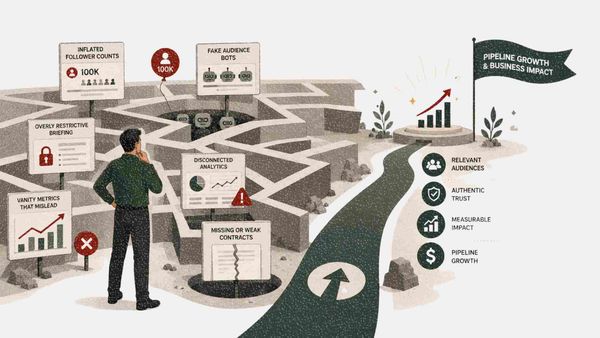
The case is useful because several trust failures sat on top of each other: consequential health claims, young audiences, reviews with undisclosed interests, incentives tied to positive sentiment, and artificial social proof. Fixing only one would not have made the marketing defensible.
That is the pattern brand teams should learn to spot. When a campaign involves a sensitive product, a vulnerable audience, aggressive claims, paid recommendations, and pressure for uniformly positive sentiment, risk compounds. The correct response is not a stronger #ad label. It is to redesign the campaign.
This also explains why ethics belongs upstream in creator selection. A creator with a history of making absolute health or financial claims may be a poor fit even if their reach is excellent. A brand that wants only glowing coverage may be a poor partner for a creator whose audience trusts them because they routinely explain tradeoffs.
Build the ethics workflow before the creator brief goes out
Make ethical review a short sequence with named owners. Do not ask a social manager to interpret legal risk after filming or a creator to guess which claims need substantiation.
- Classify the campaign risk. Flag high-stakes products, younger audiences, regulated claims, affiliate incentives, synthetic content, and paid amplification before creators are shortlisted.
- Vet for behavior, not just audience metrics. Review past sponsored posts for disclosure habits, exaggerated claims, sudden category jumps, and whether the creator can disagree with brands without turning every partnership into a crisis.
- Write the non-negotiables into the contract. Cover disclosure, factual claims, review rights, usage rights, AI alteration, and a clear process for pausing content that creates material risk.
- Brief evidence separately from opinion. Give creators approved facts, substantiation, and prohibited claims in one section. Put creative direction, angles, and optional talking points somewhere else.
- Review the final asset in context. A disclosure that works in a caption may fail in a Story. A disclaimer that works on desktop may disappear behind "more" on mobile. Review the actual format people will see.
- Keep a record of what ran. Save the approved asset, disclosure, key claims, links, and any material changes. If a question appears later, the team should be able to reconstruct the decision without relying on a Slack search.
FTC guidance for marketers and influencers places responsibility on both sides: creators need to disclose material connections, while marketers need to educate and monitor endorsers acting on their behalf. Monitoring belongs in campaign operations, but it is not a license to micromanage every adjective.
A useful escalation policy also protects creators. If a brand stakeholder asks for a disclosure to be removed, a claim to be strengthened without evidence, or a critical opinion to be rewritten as praise, the creator or agency should know exactly who can stop the request. An ethics policy without a stop button is mostly decoration.
Make ethics part of campaign design, not cleanup
The strongest influencer marketing ethics policy is not the one with the most rules. It is the one a campaign team can actually use before money, deadlines, and approval politics make a bad decision harder to reverse. Good programs make the commercial relationship visible, keep claims inside the evidence, preserve enough creator independence for the recommendation to mean something, and apply a higher standard when the audience or product carries more risk.
That approach is also better creator strategy. Trust is the asset a brand is trying to access in the first place, and it is expensive to rebuild once audiences decide a creator is saying whatever a sponsor wants. Protecting that trust is not a constraint on performance. It is part of the product you are buying.