Influencer contract templates: clauses every B2B marketer needs in 2026
The B2B influencer contract template most brands are missing

Most influencer contract templates were written for DTC brands selling skincare and sneakers. They cover deliverables, payment, and a disclosure line that references #ad. For a B2B marketer running creator programs on LinkedIn or co-producing thought leadership content for a 90-day sales cycle, that template is dangerously thin.
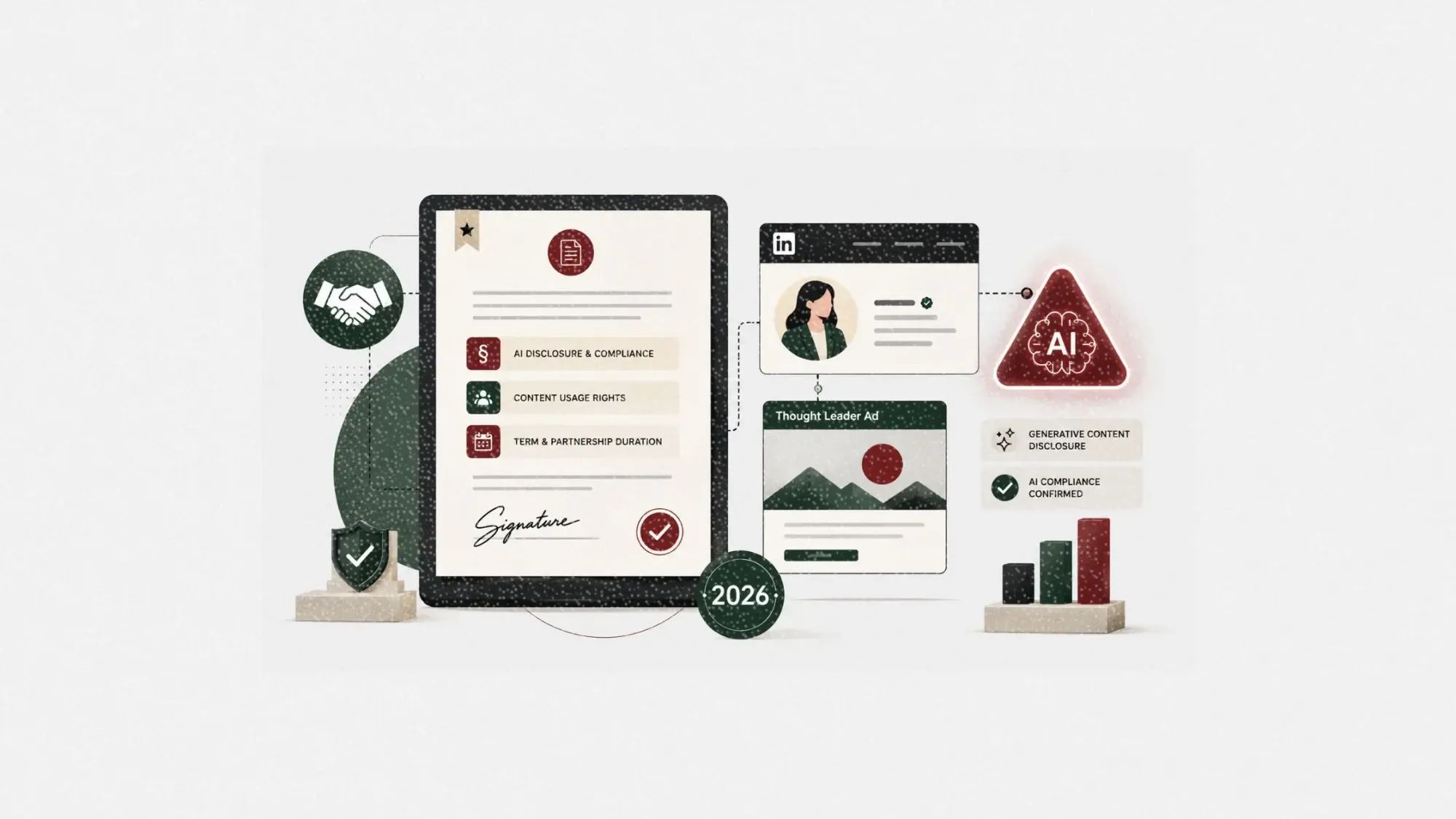
The gap between a generic influencer contract and one built for B2B reality is not minor. It covers everything from how you license a creator's LinkedIn post for Thought Leader Ads, to who bears liability when a platform's generative AI retroactively alters a sponsored video, to what a kill fee looks like when your review cycle has already run three rounds of legal approval.
This guide walks through the eight clauses that separate a B2B-grade influencer contract from the off-the-shelf version, with specific language considerations for LinkedIn-native campaigns, gated content collaborations, and the AI-disclosure requirements now appearing in active contracts in 2026.
Table of contents
Jump to each section:
- Why B2B influencer contracts need their own template
- Scope of deliverables: the B2B brief clause
- Usage rights and content licensing
- Whitelisting and Thought Leader Ads access
- Exclusivity: write it by category, not by brand list
- FTC disclosure: what the contract must say
- AI-content disclosure in 2026
- Indemnification and kill fees
- Sign smart, not just fast
Why B2B influencer contracts need their own template
The fundamental difference between B2B and B2C influencer contracts is not the dollar amount. It is the extended chain of stakeholders, approval timelines, and downstream usage that a single creator post can trigger in a B2B context.
A DTC brand books a creator, approves content in 48 hours, and the campaign runs. A B2B SaaS brand may co-develop a thought leadership series with a LinkedIn operator-creator, route each post through legal and product marketing for factual review, whitelist the content as a Thought Leader Ad targeting VP-level buyers, and repurpose the creator's original post inside a gated ABM playbook three months later. None of that complexity exists inside a standard template.
LinkedIn's data on B2B creator behavior also points to a structural difference: LinkedIn influencer content has a longer organic lifespan than consumer platform content, meaning the rights window you negotiate matters far more than it would for a 24-hour Instagram Story. A clause that grants usage rights for 90 days may expire before your demand generation team has even activated the asset.
B2B contracts also need to handle a different kind of audience sensitivity. Creator content that reaches procurement leaders, CFOs, or compliance teams carries a higher accuracy standard than consumer-facing endorsements. Factual review cycles, approval SLAs, and revision limits need to be written into the agreement itself, not managed informally.
Scope of deliverables: the B2B brief clause
The deliverables clause in a B2B influencer contract should read like a production brief, not a bullet point. Vague language like "two LinkedIn posts and a newsletter mention" creates disputes about format, length, inclusion of key messages, and whether the creator-authored content or a brand-supplied draft was the agreed baseline.
For B2B specifically, the scope clause should define:
The content format in full. A LinkedIn carousel is not the same as a LinkedIn text post. A podcast episode is not a podcast mention. Specify format, approximate length, platform, and whether the deliverable is creator-led or co-developed with brand input.
Revision rounds and approval timelines. B2B brands typically run longer review cycles. Build in a defined number of revision rounds (two is common) and a brand approval SLA of 48 to 72 hours per round. Without this, a creator can reasonably argue that delayed brand feedback broke the delivery schedule.
Post duration. Specify how long the content must remain live on the creator's channel. LinkedIn posts can serve ongoing pipeline for months. If you need content live for 90 or 180 days before the creator can archive it, write that into the contract.
Whether the creator is expected to respond to comments. For B2B operator-creators with engaged professional audiences, comment engagement is often where the real conversion activity happens. Some brands negotiate a defined comment engagement window as part of the deliverables.
Usage rights and content licensing
Usage rights are the single most commonly misunderstood clause in influencer agreements, and the failure mode is almost always the same: the brand assumes rights it never contractually acquired, the creator discovers their content running in a paid ad campaign they never agreed to, and the relationship breaks down.
The contract needs to define rights across four dimensions: where the content can be used (platform and channel), how it can be used (organic repost versus paid amplification), what edits are permitted, and for how long. These are not a single clause; they are four separate parameters that should each be spelled out.
For B2B, the usage matrix often looks like this:
Organic reuse on brand-owned channels (website, email sequences, organic social) is standard and typically included in the base fee. Paid advertising use, meaning the brand uploads the creator's content into a paid campaign through the brand's own ad account, carries additional value and should be priced separately. According to Influencer Hero's 2025 rate guide via SmartSMSSolutions, usage rights, whitelisting, and exclusivity typically add 25% to 100% or more on top of the base creation fee.
For B2B specifically, gated asset repurposing is a common scenario that generic templates miss entirely. If you intend to embed a creator's LinkedIn post, interview excerpt, or video clip inside a gated whitepaper or ABM playbook, that use case needs to be explicitly listed. "Owned-channel organic use" does not automatically cover a downloadable PDF sent to named accounts.
Whitelisting and thought leader ads access
Whitelisting is the practice of running a paid advertisement through the creator's account handle, rather than the brand's own account. On LinkedIn, the equivalent is LinkedIn Thought Leader Ads, which allows brands to sponsor an individual creator's organic post as paid content targeted at specific audiences.
Both require explicit contractual authorization. Standard usage rights language does not cover it. A standalone whitelisting clause should address three things: permission, access mechanics, and fees.
Permission language should confirm that the creator grants the brand the right to run paid advertisements through or boosted from the creator's handle or profile, on the named platform, for a defined period. The Cirqle's 2025 analysis of whitelisting governance recommends the clause also specify geo constraints, whether derivative edits (subtitles, caption changes, cutdowns) are permitted, and the brand's data rights, including whether the brand can build audience segments from engagement generated by the creator's handle.
Access mechanics matter because they differ by platform. LinkedIn Thought Leader Ads require the creator to authorize the brand through LinkedIn Campaign Manager. Meta requires Business Partner or ad-account-level permission. TikTok Spark Ads require a time-limited Spark Code. The contract should name the access method and set a timeline for the creator to grant it, typically five business days before the campaign launch date.
On fees, Influencer Marketing Hub's whitelisting rate guidance identifies an industry-standard surcharge of approximately 25% of the base content creation fee per 30-day boosting window. A creator with a US$10,000 base fee would add US$2,500 per 30-day period of whitelisting. For B2B campaigns with longer nurture cycles, it is common to negotiate 60- or 90-day windows upfront.
The clause should also include a takedown right: the brand's ability to pause or stop the whitelisted ad immediately, with a defined response window from the creator to revoke platform access, in case of a brand safety incident.
Exclusivity: write it by category, not by brand list
Exclusivity clauses exist to prevent a creator from endorsing a direct competitor during or shortly after your campaign window. The two ways they go wrong: they are written too broadly, creating disputes about what counts as a competitor, or they are written as a named brand list, which immediately becomes outdated as the competitive landscape changes.
The B2B-appropriate approach is to define exclusivity by product category. "Creator agrees not to promote any provider of CRM software, marketing automation platforms, or B2B sales engagement tools" is more defensible than a list of ten specific software names. It is also easier to enforce and less likely to be challenged as an unreasonable restraint on the creator's livelihood.
Specify three parameters: the category covered, the channels covered (if you are booking a LinkedIn creator, the exclusivity should apply to LinkedIn at minimum, and potentially all public channels), and the duration. Analysis of influencer agreement disputes from 2024 and 2025 confirms that exclusivity windows longer than 90 days for non-exclusive creator relationships are frequently contested, and courts have declined to enforce overly broad category restrictions. A 30- to 60-day window around the campaign, category-scoped, is the B2B standard.
If you are running an always-on creator partnership, exclusivity terms should match the partnership term and be renewed explicitly at each agreement renewal, not carried forward indefinitely.
FTC disclosure: what the contract must say
The FTC's Endorsement Guides, last updated in 2023, place disclosure obligations on both the creator and the brand. The brand is not protected from liability simply because the contract requires the creator to disclose. If the brand had oversight responsibility and failed to monitor compliance, it can still face enforcement action.
The FTC's June 2025 enforcement proposals went further, recasting virtually any "promotion" as a paid endorsement subject to disclosure, and adding joint liability language that explicitly covers brands that "have the ability to monitor and control sponsored content." Violations can reach US$50,000 per post under current civil penalty guidelines.
The disclosure clause in your contract should do four things:
First, name the exact disclosure language required. Do not leave this to the creator's judgment. The clause should specify "paid partnership" or "#ad" as the required terms, positioned above the fold in any caption and visible in the first frame of any video. "Thanks to our sponsor" or vague brand tags are not compliant.
Second, require platform-native disclosure tools in addition to caption disclosure. Instagram's Branded Content label, LinkedIn's "Promoting" tag, and TikTok's "Paid Partnership" toggle are required alongside, not instead of, explicit caption disclosure.
Third, grant the brand audit rights. The contract should allow the brand to review all published content against disclosure requirements and require the creator to correct non-compliant posts within 48 hours of written notice.
Fourth, extend disclosure requirements to all derivative reposts. If the creator shares a sponsored post on a second platform, or if the post is reshared by a third party the creator controls, disclosure requirements follow the content.
Dinda Anandita, Account Director at Content Collision, a content-led comms agency, puts it directly: "B2B brands often treat FTC disclosure as a creator problem, but the moment your name is on the content, you share the liability. The contracts we see that hold up under scrutiny are the ones where disclosure requirements are written out word for word, not delegated to the creator's interpretation of what 'clear and conspicuous' means."
AI-content disclosure in 2026
This is the clause that most contracts written before 2025 are missing, and its absence is now an active compliance risk.
Two distinct AI scenarios require contract coverage. The first is creator-generated AI content: the creator uses generative tools to draft, edit, or produce content that will be published as part of the campaign. The FTC's position, confirmed in their ongoing enforcement posture through 2026, is that AI-generated or AI-materially-enhanced endorsements carry the same disclosure obligations as human-created ones. The contract should require the creator to disclose AI-assisted production where it materially affects the content, and prohibit the use of AI to fabricate product claims or simulate testimonials.
The second scenario is more complex: platform-initiated AI modification. Reporting from Influencers-Time in May 2026 documents how TikTok's Generative Remix feature, Instagram's AI editing suite, and Meta's auto-enhancement systems can retroactively alter sponsored content after publication, changing product appearance, voiceovers, or visual context. The FTC's current framework assigns liability to whoever "has the power to correct non-compliant content," which typically means the brand.
The contract clause should require the creator to opt out of platform AI transformation features for sponsored content wherever the platform allows, notify the brand within 24 hours if platform-initiated AI changes are detected, and cooperate with removal or correction requests. It should also include an indemnification provision covering disclosure failures caused by platform-initiated AI modifications, specifying which party bears the remediation cost.
Indemnification and kill fees
Indemnification in influencer contracts typically runs one direction: the creator indemnifies the brand against claims arising from the creator's content, including copyright infringement, FTC violations, and defamation. In B2B contracts, the clause should be bilateral to a degree. The brand should also indemnify the creator for any liability arising from brand-directed modifications to the content, especially for paid ad variants where the brand has edited the creator's original post.
The kill fee is the clause that prevents disputes from becoming lawsuits when a campaign is cancelled mid-production. Without a defined kill fee, the only legal remedy for either party is a damages claim, which costs more than almost any influencer deal.
For B2B contracts, the kill fee should account for the extended review cycle. A standard structure: 0% fee if cancellation occurs before the brand approves the creative brief; 50% of total contracted fee if cancellation occurs after brief approval but before final content delivery; 100% of total contracted fee if cancellation occurs after final content delivery regardless of whether the content was published. Add a parallel clause for creator-side cancellation: the creator owes a refund of any advance paid, plus a defined multiple (typically 1x to 1.5x the advance) as a penalty for late cancellation.
For multi-deliverable campaigns, specify kill fees per deliverable rather than on the total contract value. A campaign covering six LinkedIn posts over three months should have a kill fee calculation that reflects which deliverables were completed at the time of cancellation.
Sign smart, not just fast
The pressure to move quickly on creator partnerships is real, especially in B2B where a creator's editorial calendar fills up months in advance. But the cost of a contract that does not address whitelisting access, AI modification liability, or platform-specific disclosure is not theoretical.
The eight clauses above are not exhaustive. Governing law and dispute resolution (mediation before arbitration), data rights, and payment schedules with explicit late-fee terms all belong in a complete B2B influencer agreement. For campaigns above US$25,000, legal review is standard practice and pays for itself against the risk of a single unresolved usage-rights dispute.
The template that closes the deal is not the longest one. It is the one with the right specificity at every clause. A well-drafted B2B influencer contract does not slow down the relationship; it creates the operational clarity that lets the relationship compound over time.
For more context on what B2B influencer campaigns cost and how to build out your program's budget, see Influencer marketing cost: what brands are actually paying.