Influencer marketing for cybersecurity, fintech, and healthcare B2B categories
The compliance-first guide to influencer marketing in cybersecurity, fintech, and healthcare B2B

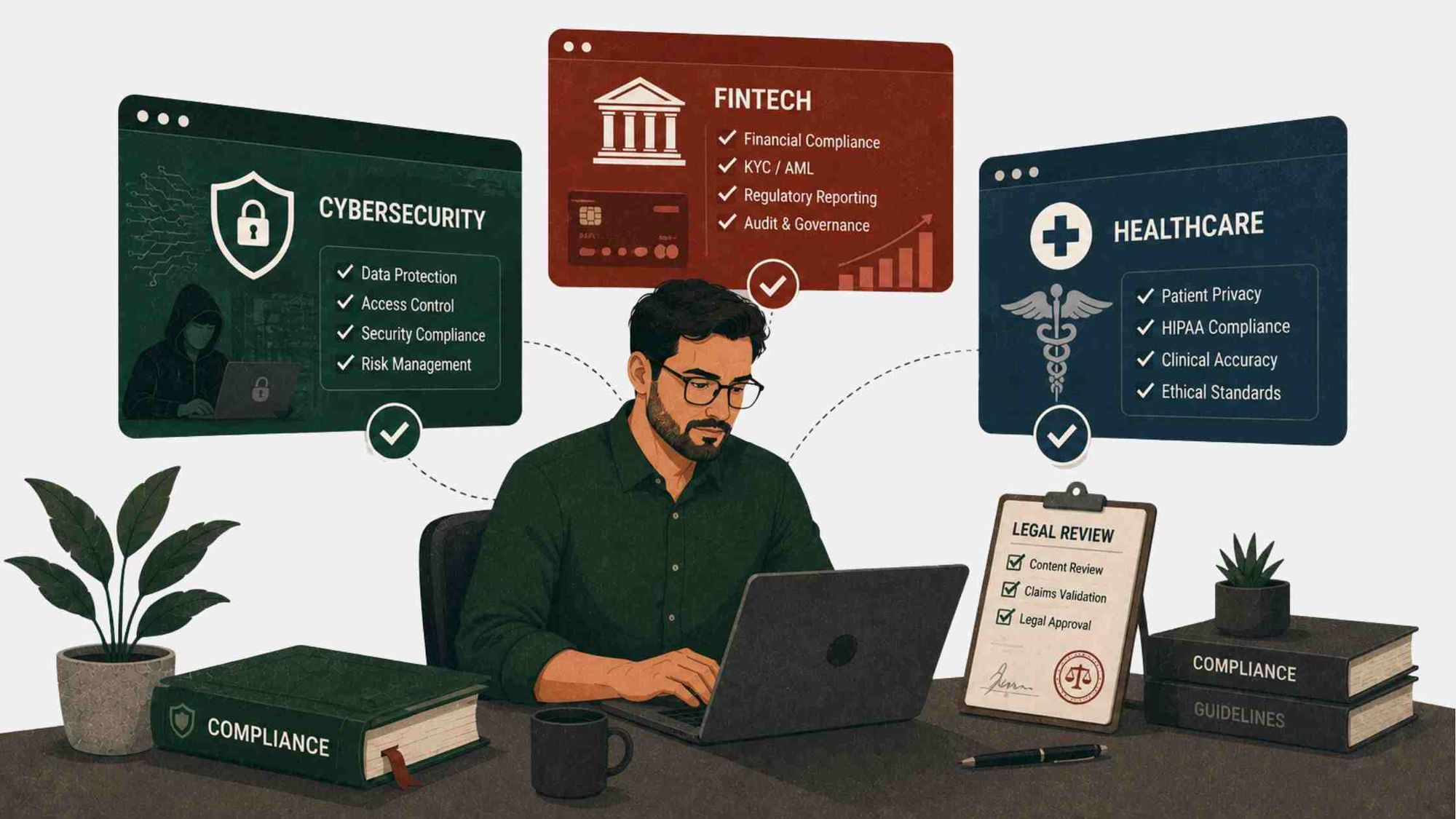
Most of the influencer marketing playbook was written for industries where the biggest compliance question is whether a creator forgot to add #ad. Cybersecurity, fintech, and regulated healthcare B2B companies operate under an entirely different set of rules, and the gap between generic B2B influencer advice and what actually works in these verticals is wide enough to create real legal and reputational exposure.
This is not a reason to avoid influencer marketing in regulated categories. It is a reason to build the program correctly from the beginning. The brands that have figured this out are generating trust signals their competitors cannot replicate through paid media alone.
Table of contents
Jump to each section:
- Why regulated B2B categories require a different influencer marketing approach
- Influencer marketing for cybersecurity brands
- Influencer marketing in fintech: what FINRA's finfluencer sweep changed
- Influencer marketing for healthcare and pharma B2B brands
- Building a compliance-first influencer program across all categories
- The right way to start in regulated B2B influencer marketing
Why regulated B2B categories require a different influencer marketing approach
Standard B2B marketing frameworks center on credibility, expertise, and long attribution windows. All of that applies in regulated categories too. What changes is the consequence profile. In cybersecurity, a creator who overstates a product's threat protection capability can mislead buyers making security architecture decisions with real business risk attached.
In fintech, a post that implies guaranteed returns or omits required risk disclosures can trigger regulatory enforcement regardless of whether the brand approved the content. In pharma-adjacent healthcare B2B, the FTC and FDA both have jurisdiction, and the same post can simultaneously violate fair balance requirements and endorsement disclosure rules.
 Ariana Sorensen
The mistake most regulated-category marketers make is treating compliance as a filter applied at the end of the process, after the creator has been briefed and content has been produced. By the time non-compliant content is caught and corrected, the brand has already exposed itself to liability, wasted production time, and damaged the creator relationship. Compliance has to be structural, built into creator selection, brief design, content approval, and contract language before a single post goes live.
This does not mean conservative or bland content. Some of the most effective influencer programs in cybersecurity and fintech are built on creators who say things brands cannot say from their own accounts. The compliance layer protects that candor rather than suppressing it.
Influencer marketing for cybersecurity brands
Cybersecurity buyers are among the most skeptical B2B audiences in any category. CISOs, CTOs, and security architects are professionally trained to distrust claims, verify sources, and look for the gap between what a vendor says and what the product actually does. Traditional brand advertising fails in this environment precisely because it sounds like advertising.
Creator-led content works in cybersecurity because the trust signal travels differently. A security practitioner with 8,000 LinkedIn followers who has spent three years documenting their threat modeling approach has built credibility the brand cannot rent through a sponsored post on its own channels. When that practitioner shares a review, a use case, or a technical walkthrough involving your product, the audience processes it as peer knowledge rather than promotion, and that distinction drives actual evaluation behavior.
The practical implication for cybersecurity brands is that creator selection has to be credential-first, not audience-first. A CISO-turned-independent-consultant with 6,000 followers who reaches the exact decision-maker tier your sales team is targeting will outperform a broader tech creator with 200,000 followers on every metric that matters: content quality, audience receptivity, and downstream sales influence.
The cybersecurity creator market is full of practitioners who have built genuine technical authority through years of original content on LinkedIn, Substack, and specialist podcasts. Most of them are underpriced relative to the conversion value they generate.
The compliance angle for cybersecurity influencer marketing is less about external regulators and more about accuracy. Claims about product efficacy, threat detection rates, compliance certifications, and integration capabilities need to be factually verified before a creator repeats them.
The FTC's endorsement rules still apply, and a security practitioner with an undisclosed paid relationship who makes unsubstantiated performance claims creates liability for both the creator and the brand. Contracts should specify which product claims are pre-approved for creator use, require factual review of any technical content before publication, and include explicit disclosure requirements for all paid relationships.
Influencer marketing in fintech: what FINRA's finfluencer sweep changed
Fintech is the regulated B2B category where influencer marketing enforcement has moved furthest from theory to documented consequence. FINRA's targeted examination of broker-dealer finfluencer programs, which commenced in September 2021, produced a February 2023 update identifying widespread supervisory deficiencies, and then three formal enforcement actions in 2024.
The first and most prominent was FINRA's March 2024 action against M1 Finance, which resulted in an US$850,000 fine. FINRA found that M1 Finance's influencers had made promotional posts that were not fair or balanced, contained exaggerated or promissory claims, and that the firm had failed to review, pre-approve, or retain records of those communications as required by FINRA Rule 2210.
During the investigation period, more than 39,400 new accounts were opened and funded through the firm's influencer referral program. The scale of the program made the supervisory failures more consequential, but the compliance gaps themselves were basic: no content review, no pre-approval, no record retention.
The April 2024 action against Cobra Trading followed a similar pattern. Between 2019 and 2023, Cobra's influencer program generated 775 new accounts, each funded with at least US$25,000. One influencer had promoted the firm with claims like "I took a US$30K account and turned it into US$133K in less than 30 days," which FINRA found to be unbalanced and promissory in violation of the same advertising rules. A third enforcement action followed in June 2024.
For fintech B2B brands, the FINRA sweep produces five concrete requirements. Influencer content must be pre-approved by a registered principal before publication. All influencer communications must be retained as required under FINRA Rule 2210.
Posts must be fair and balanced, which means benefit claims must be accompanied by proportionate risk information. Referral compensation arrangements require their own disclosure framework. And supervisory systems must be documented in written supervisory procedures that address social media specifically.
The SEC has added another layer. In September 2024, the SEC charged nine investment advisers with combined penalties exceeding US$1.2 million for violations that included improper use of testimonials and endorsements under the Investment Advisers Act Marketing Rule. The pattern in these cases was paid endorsements and social media testimonials used without required disclosures.
None of this means fintech B2B brands should avoid influencer marketing. It means the program has to be built with legal and compliance as structural partners, not reviewers at the end of the content chain.
Influencer marketing for healthcare and pharma B2B brands
Healthcare B2B brands cover a wide range of regulatory exposure, from health tech platforms with no direct drug claims to pharmaceutical manufacturers running patient influencer programs under full FDA scrutiny. The compliance requirements scale accordingly, but the principle that governs all of them is the same: if a brand has a material relationship with a creator whose content could influence clinical, procurement, or patient decisions, that relationship must be disclosed and the content must be accurate.
For pharmaceutical brands running any campaign involving prescription drugs, the FDA's Office of Prescription Drug Promotion applies the same standards to influencer content as it does to traditional advertising. Benefit claims must be balanced with proportionate risk information. The product's indication must be clearly identified. Unbranded content that drives prescription behavior without identifying the drug is not a compliance shortcut, it is a separate category of liability.
The enforcement landscape shifted significantly in September 2025 when HHS and FDA jointly announced a crackdown on deceptive DTC pharmaceutical advertising, explicitly naming "undisclosed paid influencer promotion" as part of the problem.
The announcement followed a presidential directive and was accompanied by thousands of warning letters and approximately 100 cease-and-desist letters to pharmaceutical and telehealth companies. FDA's own statement characterized deceptive advertising on social media channels as "sadly the current norm," citing research showing the majority of social posts for top-selling drugs failed to follow fair balance requirements.
For health tech and healthcare SaaS B2B brands not in the direct pharma category, the regulatory floor is lower but not absent. The FTC's endorsement rules apply to any creator with a material relationship to the brand. The Federal Anti-Kickback Statute applies when healthcare providers are involved in any arrangement that involves remuneration tied to medical services or referrals. And HIPAA implications arise the moment patient data or medical decision-making enters the content.
Dinda Anandita, Account Director at content-led comms agency Content Collision, frames the challenge as an operational one rather than a creative one: "The brands that run clean influencer programs in regulated categories are not the ones with the most cautious lawyers. They are the ones who built the review process into the campaign timeline from day one, so compliance is part of production rather than a gate that stops it."
The practical implication for healthcare B2B brands is that the content approval workflow needs to include medical, legal, and regulatory review before any creator posts. That review takes time, and campaign timelines need to account for it. A creator who posts off-brief because the approval process took too long is not a creator problem. It is a planning problem.
Building a compliance-first influencer program across categories
Across cybersecurity, fintech, and healthcare B2B, the same five structural elements separate compliant programs from ones that create liability.
The first is creator due diligence. Beyond audience fit and content quality, regulated categories require verification of professional credentials, prior enforcement history, and existing brand relationships that could create conflicts. A fintech creator with a prior FINRA action against them, or a healthcare creator who has received previous FDA warning letters for promotional content, represents a compliance risk regardless of their audience quality.
The second is contract design. Contracts in these verticals need to specify pre-approved claim language, prohibit specific categories of statements (performance projections, off-label references, unverified risk comparisons), require content submission for review before publication, define disclosure obligations in detail, and include indemnification provisions for content that violates regulatory requirements despite brand approval.
 Ariana Sorensen
The third is a documented content approval workflow. FINRA explicitly faulted M1 Finance and Cobra Trading for failing to pre-approve and retain influencer communications. FDA warning letters in pharma have cited the same failure. Pre-approval is not optional in regulated categories. It is a regulatory requirement in some verticals and a basic risk management practice in all of them. The approval workflow should be documented, timestamped, and archived.
The fourth is record retention. Every influencer post, every piece of creator communication related to the campaign, every contract and brief and approval record needs to be retained for the period required by the relevant regulator. In financial services, FINRA Rule 2210 specifies retention requirements. In pharma, 21 CFR Part 314 requires submission of promotional materials to FDA at first use. Generic record retention practices built for marketing operations do not meet these requirements.
The fifth is ongoing monitoring. A creator who received brand approval for a specific post can deviate in follow-on content. Platform-initiated AI modifications can alter approved content after publication. Audience comments can draw the creator into unscripted claims. Regulated-category programs need monitoring systems that catch compliance issues in real time, not only during the pre-approval phase.
The right way to start in regulated B2B influencer marketing
The companies that run the most effective influencer programs in regulated categories tend to start smaller and slower than their counterparts in less constrained verticals. A pilot program with two or three carefully vetted creators, a fully documented approval workflow, and a clear set of compliant content parameters produces more usable learning than a broad campaign that moves fast and generates compliance issues.
Building a B2B influencer marketing strategy for a regulated category should start with legal and compliance counsel rather than with creator research. The compliance constraints in your specific vertical need to be understood before creator selection or brief design begins.
What claims are pre-approved, what categories of content require external review, what disclosure language is required, and what record retention obligations apply should all be documented before the first creator conversation.
Creator selection in these verticals rewards patience. The most valuable creators in cybersecurity, fintech, and healthcare B2B are practitioners with genuine professional credibility, not influencers who happened to build an audience in a tangentially related space. They are often cautious about endorsement relationships precisely because their professional reputation is tied to their content. That caution is a signal of quality, not an obstacle to work around.
The long-term compounding advantage of getting this right is significant. A regulated-category brand with a documented history of clean, transparent creator programs builds a type of earned credibility that advertising cannot produce. Buyers in these verticals are sophisticated enough to notice which brands work with credible practitioners and disclose those relationships properly. That track record becomes a competitive asset over time, and it is one that late-moving competitors will have difficulty replicating quickly.