
How to measure AI agent ROI in marketing workflows
A four-layer approach to tracking cost savings, performance gains, and business impact from AI agents in marketing.

Most marketing teams deploying AI agents run into the same wall: they can show that the tool is busy, but they cannot show that it is working. Activity metrics pile up while leadership asks a different question: what is this actually returning?
Measuring AI agent ROI in marketing workflows is not the same as measuring software ROI. Agents do not just automate a single step. They make decisions, trigger downstream actions, and interact across systems. That means the measurement framework has to account for compounding effects, not just time saved on one task.
This guide walks through how to build that framework from the ground up.
Table of contents
Jump to each section:
- Why standard ROI formulas fall short for AI agents
- The four measurement layers
- Building the ROI report your leadership will accept
- Common measurement mistakes and how to avoid them
- What the data says about where marketing teams are finding returns
- Next steps
 Patrecia Meliana
Why standard ROI formulas fall short for AI agents
Traditional ROI calculation is straightforward: divide net gain by cost, multiply by 100. That works when you are measuring a tool with a fixed output, like a scheduler or a reporting dashboard.
AI agents are different because their outputs are variable and often invisible. An agent that qualifies leads does not just save an hour of manual review. It changes which leads get followed up, which deals close, and how quickly the pipeline moves. Attributing revenue impact to that agent requires a different methodology than a simple before-and-after comparison.
There is also a compounding problem. When multiple agents interact (a research agent feeding a content agent feeding a distribution agent), the output of one affects the output of all. Isolating individual agent ROI while also capturing system-level return requires tracking at both levels simultaneously.
The four measurement layers
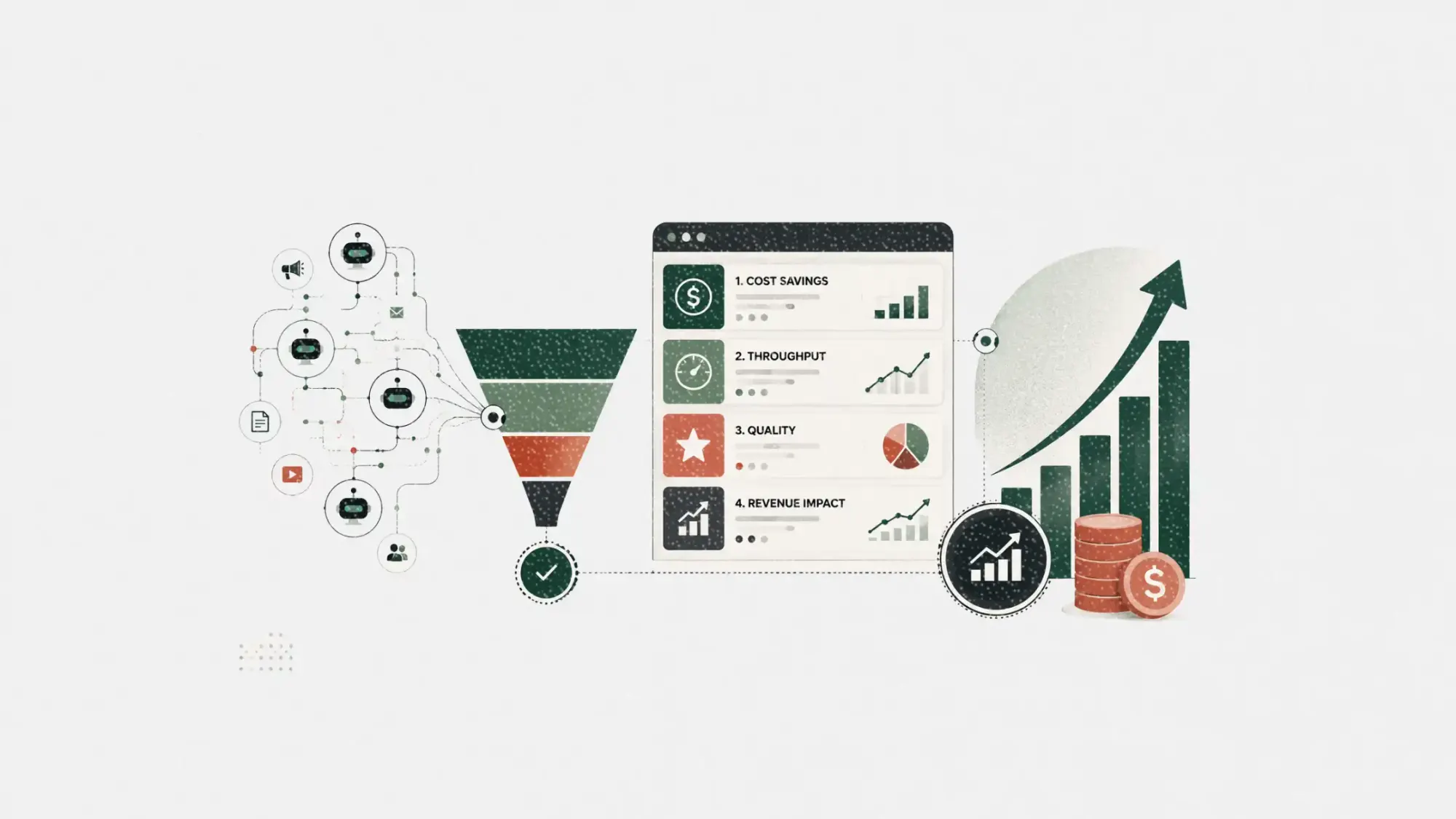
A reliable AI agent ROI framework for marketing operates across four layers.
Layer 1: Time and cost displacement
This is the most direct measure. Calculate the hours previously spent on the tasks the agent now handles, multiply by the loaded cost of the role performing them, and compare to the agent's operating cost (licensing, maintenance, prompt engineering, human oversight).
Be precise about what "hours saved" means. It should reflect time that is genuinely redirected to higher-value work, not time that disappears into less productive activity. The difference matters for both accuracy and for making the case internally.
Layer 2: Throughput and output volume
Agents do not just speed up existing work, they allow marketing teams to produce more than they could before. Track output volume before and after deployment: number of content pieces published, campaigns launched, A/B tests run, leads scored, or sequences activated per sprint.
This layer captures capacity expansion, which time savings alone misses. A team that went from publishing 8 articles a month to 30 with the same headcount has a story that a cost-per-hour calculation would understate.
Layer 3: Quality and performance metrics
Higher volume means nothing if quality drops. Layer 3 tracks whether the agent-assisted outputs actually perform. For content workflows, this means organic traffic, ranking improvements, and engagement rates. For lead qualification agents, this means lead-to-opportunity conversion and sales cycle length. For campaign agents, this means cost per acquisition and return on ad spend.
This layer takes longer to populate because marketing outcomes lag activity. Build a 90-day measurement window into your evaluation plan from the start.
Layer 4: Strategic reallocation value
The hardest layer to quantify but often the most significant. When AI agents absorb execution work, skilled marketers redirect their time toward strategy, relationships, and creative judgment. That reallocation has value that does not show up in throughput or performance metrics.
Capture it through output proxies: number of new partnerships initiated, share of time spent on high-leverage activities versus maintenance, or qualitative assessments from quarterly reviews.
Building the ROI report your leadership will accept
Once data is flowing across the four layers, the reporting format matters as much as the numbers.
Frame the ROI report around three outputs your leadership team cares about most: cost efficiency, revenue contribution, and team capacity. Pull one strong number from each layer for each.
A sample structure:
- Cost efficiency: hours displaced per month, agent operating cost, net cost saving
- Revenue contribution: pipeline influenced by agent-qualified leads, revenue from agent-assisted content
- Team capacity: output volume change, reallocation of strategist hours to high-value work
Keep the report to one page. If the numbers require a long explanation to look positive, the measurement framework needs work before the report goes up the chain.
Common measurement mistakes and how to avoid them
- Measuring the wrong outcome
An agent deployed to speed up content production should be measured on content performance, not just publishing cadence. Tie measurement to the business outcome the workflow is supposed to drive, not the activity it is automating.
- Ignoring oversight costs
AI agents require human monitoring, prompt refinement, and periodic audits. Teams that report ROI without accounting for ongoing maintenance systematically overstate returns. Include oversight time in your cost calculation.
- Conflating correlation with attribution
If organic traffic improves in the quarter after deploying a content agent, the agent is a contributing factor, but so is seasonality, Google updates, and any other changes made during that period. Use controlled comparisons where possible: run the agent on one content cluster while keeping another constant, then compare performance between them.
- Measuring too early
Organizations projecting an average AI agent ROI of 171%, a figure cited in recent enterprise surveys, are almost certainly measuring over 12 months or longer, not 30 days. Marketing ROI cycles require patience. Set explicit review windows at 30, 60, and 90 days for activity metrics, and 6 to 12 months for business impact metrics.
What the data says about where marketing teams are finding returns
Three data points anchor where ROI is actually materializing in marketing AI agent deployments right now.
First, AI content drafting delivers an average 3.2x ROI, with personalization engines close behind at 2.7x, according to McKinsey's Global AI Survey. The return is not from producing content faster in isolation, it is from the combination of speed, scale, and freeing senior marketers for distribution and strategy.
Second, companies using AI agents in their workflows report 55% higher operational efficiency and an average 35% reduction in costs compared to non-adopters. These figures, drawn from a 2025 industry analysis, reflect the compounding effect of agents operating across multiple workflow layers rather than a single point.
Third, organizations across industries project an average AI agent ROI of 171%, with U.S.-based enterprises estimating 192%. The gap between projection and realized returns for most marketing teams is a measurement problem, not a performance problem. Teams that build the four-layer framework before deployment close that gap significantly faster.
Next steps
Start with one workflow, not the entire marketing stack. Pick the highest-volume, most repeatable workflow your team runs. Content production, lead qualification, and campaign reporting are common starting points. Deploy the baseline measurement process, let it run for four weeks, then bring in the agent.
Measure across all four layers from day one. Build the report format before you have data to fill it, so the structure is in place when the numbers start flowing.
The teams generating the strongest returns from AI agents in marketing are not the ones with the most sophisticated technology. They are the ones that decided in advance what a win would look like and then built the measurement infrastructure to prove it.