Stitch Fix expands Vision to generate “see it on me” outfit images
Stitch Fix expands Vision so clients can generate “see it on me” outfit images. A move toward on-demand, customer-led personalization.

Stitch Fix has expanded Stitch Fix Vision, adding on-demand AI image generation that lets clients upload a selfie and preview recommended outfits on their own likeness inside the mobile app.
The update matters less for “cool tech” reasons and more because it changes how personalization gets experienced: from a weekly delivery of styled inspiration to an interactive, client-controlled feedback loop. Stitch Fix outlined the details in an official announcement.
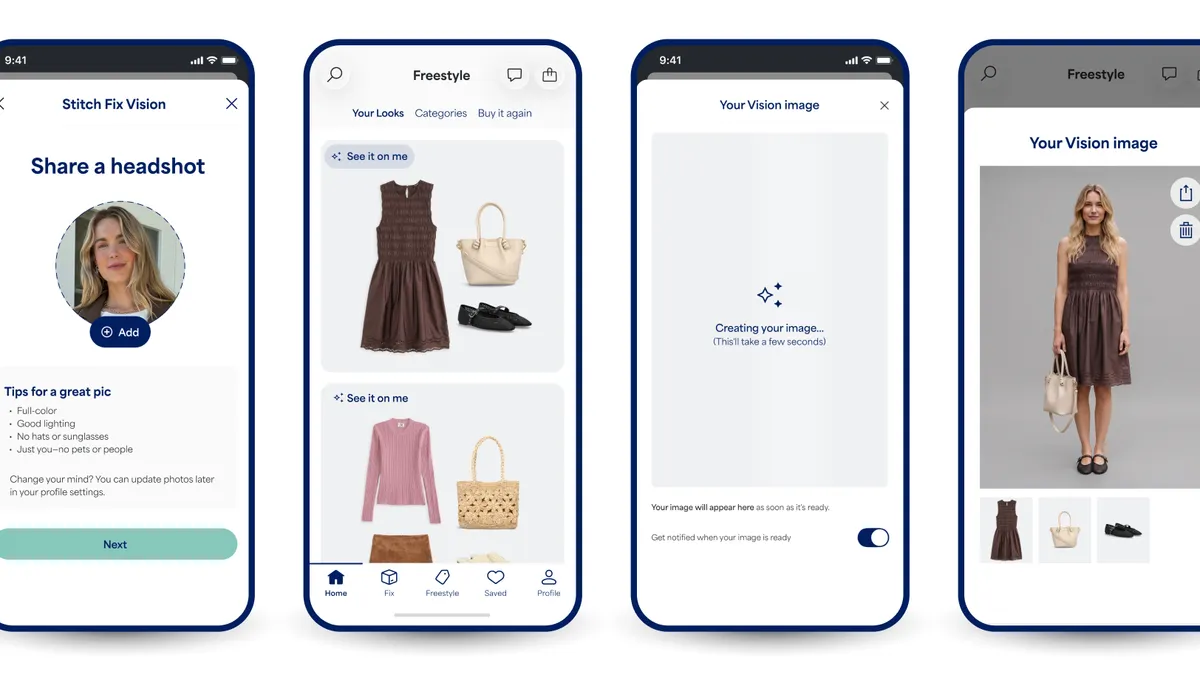
Table of contents
Jump to each section:
- How Stitch Fix Vision is changing the personalization loop
- Why “on-demand visualization” is a conversion lever, not a gimmick
- What the Q3 growth context signals about scaling AI in retail
- What this means for marketers
How Stitch Fix Vision is changing the personalization loop
Stitch Fix Vision now lets users create images of themselves wearing recommended looks, on demand. Clients upload a selfie in the Stitch Fix app, select an outfit recommendation, and tap “See it on me.”
What’s structurally new is the creation of a persistent “Vision gallery.” Saving AI-generated looks turns one-off recommendations into a personal, accumulating style library.
A useful way to think about it: personalization is moving from “we picked this for you” to “we can show you, instantly, how it fits your identity.”
Stitch Fix positions Vision as a blend of “billions of data points” on client preferences, generative AI, and human expertise from Stitch Fix stylists. That hybrid framing is not accidental. It is an attempt to keep trust high while increasing automation.
Strategic observation: When personalization becomes visual, it stops being a backend algorithm and becomes a brand promise customers can verify with their own eyes.
 ContentGrip
Why “on-demand visualization” is a conversion lever, not a gimmick
The common assumption is that the hard part of online apparel is product discovery. The contrasting reality is that many customers stall after discovery, at the moment of self-doubt: “Will this actually look like me?”
On-demand visualization targets that hesitation directly. A weekly drop of outfit inspiration can be engaging, but it is still a broadcast cadence. On-demand generation shifts the interaction to the moment of intent, when the customer is already evaluating a specific look.
Strategic observation: The closer personalization gets to the decision point, the more it behaves like a performance channel, even when it looks like a brand experience.
It also changes what “personalization at scale” means operationally. Instead of only optimizing what the system sends, teams can optimize what the user pulls, when and where they request it. That pulls measurement toward micro-moments: which looks trigger “See it on me,” which generated images get saved to the gallery, and which style directions get revisited.
The deeper shift is that generative AI is being used as interface design, not just content production. The AI output is the UI.
Strategic observation: In retail, generative AI that lives inside the product experience often matters more than generative AI that lives inside the marketing stack.
What the Q3 growth context signals about scaling AI in retail
Stitch Fix’s Vision expansion arrives alongside measurable business momentum. The company reported Q3 net revenue of US$340 million, up 4.7% year over year, and said active clients increased quarter over quarter to 2.3 million, marking a fifth consecutive quarter of growth.
Those numbers do not “prove” the feature drove growth, but they change the strategic interpretation: this is not a defensive experiment. It is a product-level bet made while the business is stabilizing, which typically means higher internal confidence in the data infrastructure and operating cadence required to support AI-driven experiences.
Leadership context reinforces that point. Stitch Fix named Sree Sreedhararaj as chief product and technology officer to oversee data science, product, IT, and technology teams, succeeding Tony Bacos (retiring Aug. 1). When a company concentrates these functions under one leader, it often signals an intent to make personalization a core platform capability rather than a standalone feature.
Strategic observation: AI personalization scales fastest when it is treated as product infrastructure, not a campaign layer.
What this means for marketers
The interesting question is not whether AI-generated “try-on” images are novel. It is whether brands can turn subjective taste into a measurable, repeatable growth loop without flattening identity into a template.
- Personalization is becoming customer-controlledStitch Fix moved from weekly, proactive imagery to on-demand generation. Marketers should expect “control” to become a standard expectation: customers will increasingly want to request, test, and save personalized variations, not just receive them.
- Saved outputs create a new kind of first-party preference signalA Vision gallery is more than a scrapbook. It is behavioral data about what a customer chooses to visualize and keep. For marketing teams, that is a different signal than clicks or purchases, because it captures aspiration and exploration.
- Generative AI can reduce decision friction without changing the assortmentThe product catalog might stay the same, but confidence can change. If “See it on me” reduces uncertainty at the point of evaluation, conversion and retention improvements can come from experience design, not just merchandising changes.
- Hybrid AI plus human expertise is a trust strategyStitch Fix explicitly frames Vision as combining client data, generative AI, and stylists. That blend is a reminder that in sensitive, identity-adjacent categories, “fully automated” is not always the message that wins.
- The interface is the marketingWhen AI outputs sit inside the shopping flow, the product experience becomes the primary persuasion surface. That can shift marketing’s role toward orchestrating in-product storytelling, measurement, and lifecycle learning across touchpoints.
The wider implication is that personalization is shifting from segmentation to simulation. Brands will compete on how quickly they can help a customer answer a personal question: “Is this me?”
As more retail journeys become interactive and generated, the definition of “creative” expands. It is no longer only the assets a brand publishes. It is also the personalized experiences a customer can produce on demand.
And that raises the new differentiator: not who can generate the most content, but who can generate the most confidence.