YouTube influencer marketing for B2B: long-form, trust, and the SaaS demo economy
YouTube influencer marketing for B2B: long-form, trust, and the SaaS demo economy

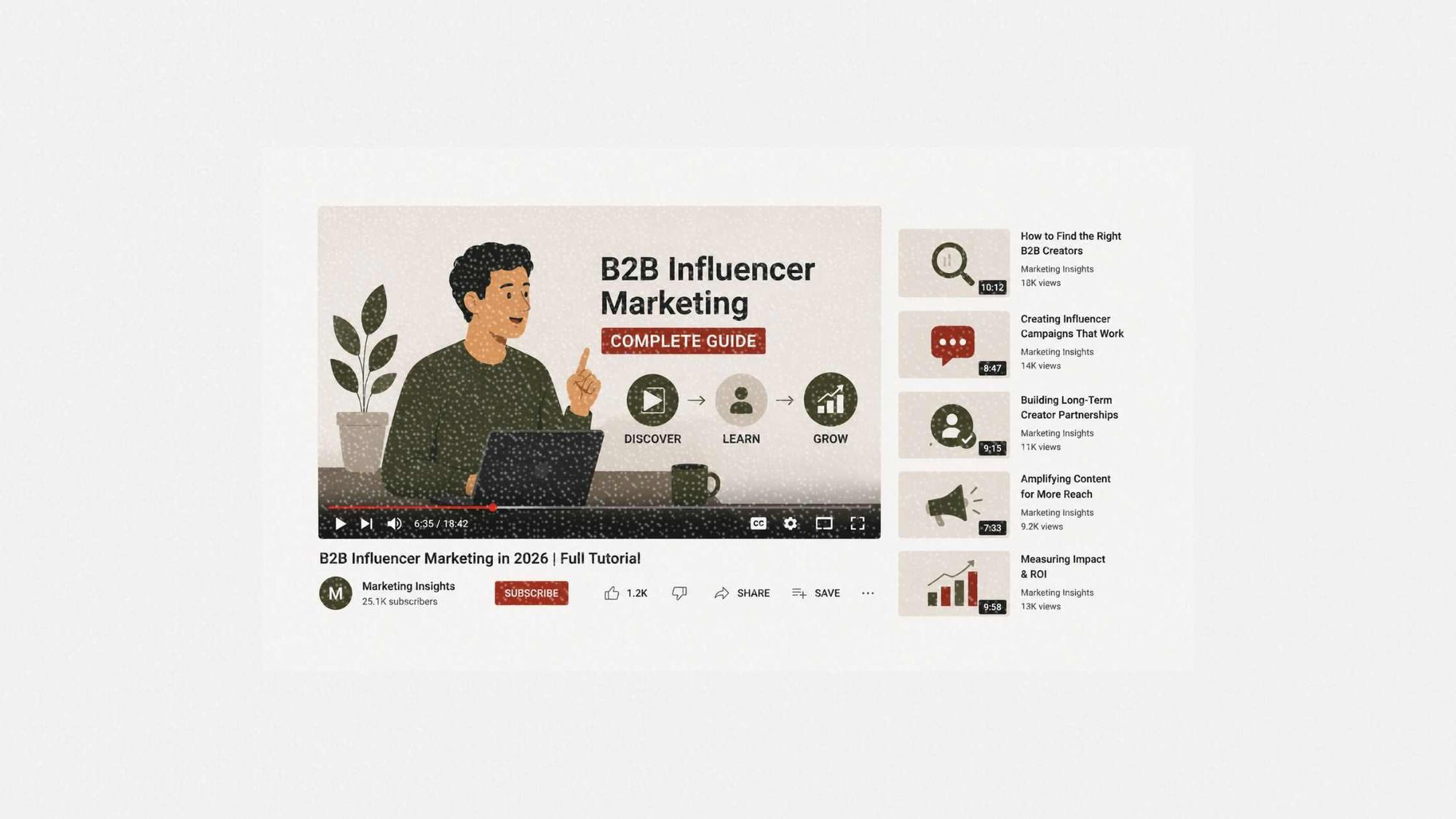
Most B2B marketing teams have a LinkedIn strategy. A growing number have a TikTok experiment. Very few have seriously considered YouTube, and that gap is quietly becoming expensive. According to DemandSage, 51% of B2B buyers already use YouTube videos to research purchases before making a decision. They are watching 10-minute software walkthroughs, comparing competing tools in creator-led reviews, and forming vendor opinions before your SDR ever sends a cold email.
YouTube is not a consumer platform that B2B marketers occasionally borrow. It is a bottom-funnel research engine that operates on a completely different trust model from every other social platform, and for SaaS companies with a complex product story to tell, it may be the highest-ROI influencer channel available.
This guide covers how YouTube influencer marketing actually works for B2B and SaaS brands, which creator types move the needle, how to structure and measure campaigns, and what you should expect to pay.
Table of contents
Jump to each section:
- Why YouTube's B2B power is still underestimated
- The SaaS demo economy: how creators replace the mid-funnel
- Types of B2B YouTube creators worth partnering with
- How to vet a B2B YouTube creator before you sign
- Structuring your B2B YouTube influencer campaign
- YouTube influencer rates for B2B SaaS in 2026
- Measuring ROI from YouTube influencer campaigns
Why YouTube's B2B power is still underestimated
The conventional wisdom in B2B marketing is that YouTube works for awareness. The data says something different. Research compiled by Whitehat SEO shows 70% of B2B buyers incorporate video into their purchase decisions, 59% of senior executives prefer video over text when researching solutions, and 93% of B2B buyers say video builds trust in the buying process. Trust, not just awareness.
The trust gap between YouTube and other platforms is wide. An Ipsos survey cited by CreatorIQ found users are 98% more likely to trust creator recommendations on YouTube than recommendations from creators on other social platforms. A separate YouTube-commissioned study conducted in late 2025 and published by PPC Land found 79% of Gen Z viewers trust creator recommendations on the platform, and 74% said YouTube creators provide the helpful context they need to make confident purchase decisions.
There is a structural reason for this. YouTube's long-form format rewards creators who can demonstrate, explain, and debate products at depth. The audience that follows a 45,000-subscriber DevOps channel or a 120,000-subscriber revenue operations YouTuber has been self-selecting into that creator's content for months or years. That relationship is qualitatively different from a social feed follow. It is closer to trust in a specialist colleague.
For B2B brands, this translates directly. The audience is smaller, the production effort is higher, and the results compound in ways that Instagram or TikTok campaigns rarely do.
The SaaS demo economy: how creators replace the mid-funnel
For SaaS and B2B technology companies, YouTube has generated an informal but highly effective category of content: the practitioner review. A developer walks through a workflow automation tool in real conditions. A marketing ops professional shows their actual Salesforce setup. A RevOps practitioner compares two CRM integrations side by side.
This content is not produced by the brands themselves. It comes from creators who use the tools professionally, and because it reflects genuine experience rather than polished messaging, it carries disproportionate credibility. Partnr UP describes it directly: a 10-minute YouTube walkthrough from a trusted creator can do the work of a cold email sequence, a retargeting ad campaign, and a sales demo combined.
The compounding effect is the other factor most B2B marketers underestimate. Influencer Fee's B2B SaaS influencer marketing guide notes that YouTube product review integrations consistently generate long-tail trial sign-ups for 12 to 24 months after publication. Because YouTube is a search engine as well as a platform, a video reviewing your product in month one continues to surface for "tool X vs. tool Y" search queries for the next two years. There is no equivalent in paid social.
This is what the SaaS demo economy looks like in practice: buyers who would previously have booked a 30-minute product demo are instead watching four or five creator-led reviews before they ever enter your sales funnel. By the time they fill in a trial form, they already have a formed opinion. The question for B2B marketers is whether that opinion was shaped by your brand's positioning or by whatever the creator happened to say.
Dinda Anandita, Account Director at Content Collision, puts it plainly: "Most B2B brands treat YouTube as a brand-awareness play and miss the point entirely. The creators who are actually moving SaaS evaluations are sitting in the consideration and decision stages, not the top of the funnel. A micro-channel with 30,000 subscribers in the right niche can do more bottom-funnel work for a B2B product than a macro-influencer campaign on any other platform."
Types of B2B YouTube creators worth partnering with
B2B YouTube does not look like consumer YouTube. The channel counts are smaller, the production is more utilitarian, and the content is built around professional utility rather than entertainment. That is exactly what makes it effective.
The creators most valuable to B2B SaaS brands fall into four categories.
Practitioner reviewers are software users who document their genuine workflows on camera. A developer who builds automation tutorials, an analyst who reverse-engineers SaaS pricing, a marketer who reviews martech tools every month. Their audiences are highly ICP-aligned and come specifically for evaluation content.
Niche educators build audiences around a professional skill set (analytics, design operations, revenue management, growth marketing) and incorporate tool reviews as part of their teaching. They are often more trusted than dedicated reviewers because the product appears in context rather than as a standalone sponsored segment.
Software comparison creators have built channels specifically around "tool A vs. tool B" and "best software for [use case]" content. These channels rank well in YouTube search and capture buyers at exactly the moment of active evaluation. A placement here can generate trial sign-ups for years.
Operator-creators are founders, consultants, or senior practitioners who narrate their real work. Think of a fractional CMO documenting a client engagement, or a B2B startup founder sharing their stack decisions. Audiences are small but senior, and the fit for a SaaS positioning conversation is very high.
How to vet a B2B YouTube creator before you sign
Subscriber count is the least reliable signal in B2B YouTube. According to research published by Accio, 43% of business content consumers on YouTube fit what the study calls a "Researcher Profile," watching three to five videos per product category and spending significantly more time on technical specifications. These viewers convert to purchases at a rate 78% higher than casual viewers. The question is whether a creator's channel attracts that profile.
For B2B vetting, focus on these signals:
Watch time and retention rate on professional content. A channel where 12-minute tutorial videos retain 55% of viewers through to the end is far more valuable than a channel with twice the subscribers but mostly entertainment content that drops off at two minutes.
Comment quality. Read through comments on recent videos. Are viewers asking specific product questions, sharing use case context, and debating trade-offs? That engagement pattern reflects an audience actively evaluating.
Partnr UP also points out DevOps YouTuber with 22,000 subscribers whose entire channel covers workflow automation tools will drive meaningfully more trial sign-ups for a relevant SaaS product than a broad tech influencer with 800,000 followers and a mixed content catalog.
Sponsorship history also matters. Review the creator's recent sponsored segments. Do they maintain editorial standards in sponsored content, disclosing clearly and integrating naturally? Creators who run every sponsor the same way, with identical scripts and generic CTAs, will underperform against creators who genuinely engage with the product before filming.
Structuring your B2B YouTube influencer campaign
Unlike a social campaign designed for reach and impressions, a B2B YouTube campaign is a long-play investment. The structures that work are built around content that stays discoverable.
Product integrations in tutorial videos are the default format and for good reason. The creator produces a piece of genuinely useful content (a tutorial, a comparison, a workflow deep-dive) and integrates your product where it is editorially relevant. This format ages well and ranks in YouTube search over time.
Dedicated review videos are higher investment and higher return. The entire video is about your product, which generates the strongest bottom-funnel search traffic. A creator who typically produces 10 to 12-minute review content in your niche can produce something that ranks for "[your product] review" and "[your product] vs [competitor]" queries for years.
Series partnerships work well when there is a workflow story to tell. A five-part series on building a RevOps stack with your product integrated across multiple episodes gives the creator room to show depth and gives buyers the kind of sustained exposure that shortens deal cycles.
For B2B campaigns with longer sales cycles, the brief matters more than the budget. Give the creator genuine access to the product, offer real usage context rather than a polished marketing narrative, and leave room for honest criticism in the final content. A creator who notes one or two limitations and then explains why the trade-off is worth it is more persuasive than a creator who reads a feature list.
YouTube influencer rates for B2B SaaS in 2026
YouTube commands the highest per-video rates of any influencer platform, and B2B SaaS adds a further premium on top. The audience value is simply higher: every viewer is a potential enterprise customer or procurement decision-maker, not a consumer browsing a feed.
ContentGrip's 2026 influencer rate card breaks down the core YouTube benchmarks. Micro-influencer integrations (10,000 to 100,000 subscribers) run US$500 to US$5,000 per video. Mid-tier channels (100,000 to 500,000 subscribers) charge US$5,000 to US$20,000 for a dedicated video.
The niche premium compounds those figures significantly. According to OutlierKit's 2026 YouTube sponsorship rate analysis, B2B SaaS content commands a 1.8 to 2.5 times multiplier over baseline platform rates. Finance and B2B SaaS channels typically command US$40 to US$80 CPM versus US$15 to US$25 CPM for lifestyle and gaming content.
The math works for SaaS brands in a way it rarely does for consumer products. A US$10,000 YouTube sponsorship with a 60,000-subscriber DevOps creator that generates 20 enterprise trial sign-ups at a product with US$500 per month ACV returns US$120,000 in first-year revenue if those trials convert. That is a very different ROI calculation from an awareness campaign.
Influencer Fee's B2B SaaS rates guide puts mid-market YouTube reviewer rates at US$2,000 to US$25,000 per video for channels between 50,000 and 500,000 subscribers, noting that B2B rates run 25 to 50% above equivalent consumer influencer rates precisely because of the customer lifetime value differential.
One additional pricing consideration for B2B brands: evergreen usage rights. Because YouTube reviews compound in value over time, negotiating a multi-year or perpetual usage rights clause is worth the additional fee. A video that continues driving trial sign-ups 18 months after publication should not require renegotiation.
Measuring ROI from YouTube influencer campaigns
Standard influencer metrics (views, likes, comments) are a weak proxy for B2B YouTube performance. The metrics that actually matter are downstream and require proper attribution setup before the campaign launches.
UTM parameters on all creator links remain the baseline. Every description box link, pinned comment link, and in-video CTA should carry distinct UTM tags that feed into your CRM. This gives you session data, sign-up attribution, and, if your sales pipeline is connected, MQL and SQL sourcing.
Watch time and viewer retention data from YouTube Studio (shareable by the creator) reveal whether the integration is landing. High average view duration on a sponsored segment means the content is genuinely useful, not just seen and skipped.
For SaaS brands tracking long-term value, search traffic monitoring is essential. After a review video publishes, watch whether branded and comparison search queries increase. A well-placed YouTube review often lifts branded search significantly in the weeks following publication, and that lift is attributable even if direct clicks do not show the source.
Trial quality is the ultimate signal. Are the users arriving from YouTube showing higher intent on the sign-up form? Do they convert to paid faster? Do they use more features on day one, suggesting they watched the tutorial before signing up? These indicators distinguish a genuinely effective B2B YouTube campaign from one that drove sign-ups but no pipeline.
Multi-touch attribution models (time-decay or position-based) tend to capture YouTube's role better than first-touch or last-touch models, because YouTube often sits in the middle of a research journey that started on LinkedIn and ended with a Google search. Make sure your attribution model assigns credit to the consideration-stage touchpoints, not just the final conversion.