Adobe Express study shows AI video tools are now core to creator workflows and budgets
What B2B marketers should learn from rising adoption, performance gains, and automation demand

AI video tools have quietly crossed a threshold.
What used to be experimental is now embedded in how content gets produced, optimized, and monetized. Adobe Express’s latest study of US-based creators signals a clear shift from curiosity to operational dependency.
This article explores how AI video tools are reshaping creator workflows, where the real performance gains are showing up, and what B2B marketers should take away as video becomes more automated, data-driven, and scalable.
Short on time?
Here’s a table of contents for quick access:
- How AI video tools became standard in creator workflows
- Where AI is delivering measurable gains in content performance
- What creators want next from AI video tools
- What marketers should know about AI-driven video strategy
 Patrecia Meliana
How AI video tools became standard in creator workflows
Adobe’s survey of 384 US creators shows that AI video tools are no longer niche. 71% of creators have already used AI for video generation or editing, with 41% using these tools weekly.
Adoption spans platforms, but usage intensity varies. LinkedIn leads with 58% of creators using AI tools weekly, followed by educational platforms and Facebook at 40%. TikTok sits lower at 30%, suggesting different maturity levels across ecosystems.
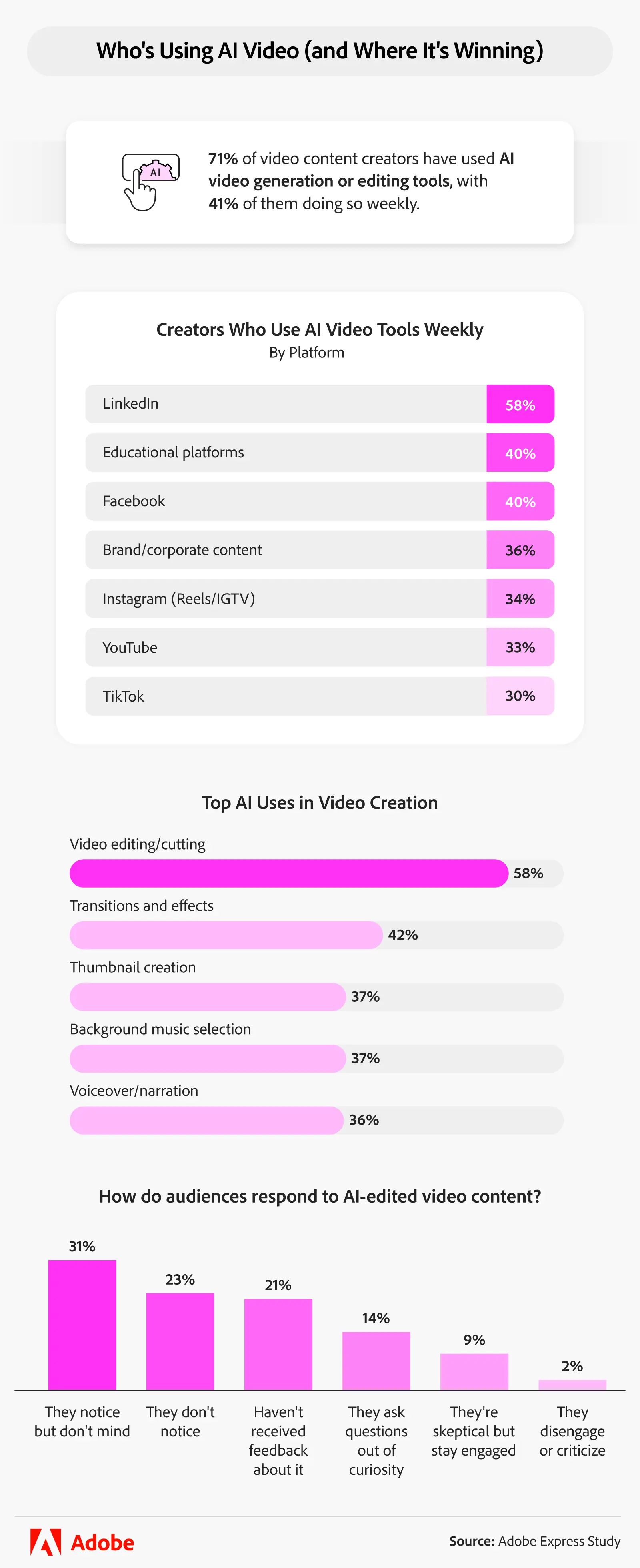
The use cases are practical rather than experimental. Editing and cutting dominate at 58%, followed by transitions and effects at 42%, and thumbnail creation and music selection at 37% each. Voiceover and narration also rank high at 36%.
This signals a key shift. AI is not replacing creativity. It is compressing production time and removing friction from repetitive tasks.
Audience response is also largely neutral to positive. 31% notice AI edits but do not mind, 23% do not notice at all, and only 2% react negatively. That removes a major perceived risk for brands concerned about authenticity.
Atikah Amalia
Where AI is delivering measurable gains in content performance
The impact of AI goes beyond efficiency. It is changing output, consistency, and even revenue potential.
Time savings are significant. 56% of creators save more than 30 minutes per video, and 10% cut more than four hours from their workflow. Larger teams benefit the most, with 50% saving two or more hours per video compared to 25% of small teams and 18% of solo creators.
Performance improvements are more nuanced but still meaningful:
- 27% report higher confidence in final edits
- 26% see improved posting consistency and faster turnaround
- 24% use AI to expand creative experimentation
- 19% report higher watch time or completion rates
- 17% see improved engagement
Monetization signals are emerging as well. Among creators doing brand deals:
- 42% report higher client satisfaction
- 40% see more brand partnerships
- 28% report higher sponsorship rates or CPM
- 24% say they are landing more sponsorships
This suggests AI is not just a cost-saving layer. It is starting to influence revenue outcomes, especially for creators operating at scale.
Patrecia Meliana
What creators want next from AI video tools
Despite strong adoption, creators are already pushing for more advanced capabilities.
Automation is the dominant theme. The most requested features include:
- Auto-repurposing long-form video into shorts, clips, and social posts at 19%
- AI-assisted editing during filming at 14%
- Instant platform-specific formatting at 14%
- Predictive tools that forecast audience reaction at 13%
- AI strategists that recommend what to create next at 11%
At the same time, investment trends reinforce confidence. 50% of creators plan to increase spending on AI tools, while 33% will maintain their budgets. Only 3% expect to reduce spend.
There is also competitive pressure. Half of creators say they feel the need to adopt AI tools just to stay competitive.
Interestingly, policy concerns remain low. 79% have not encountered platform-related issues when using AI, suggesting that governance is not yet a major barrier to adoption.
Patrecia Meliana
What marketers should know about AI-driven video strategy
For B2B marketers and PR professionals, the implications go beyond creator behavior. This is about how video production and distribution are evolving as a system.
Here are the key takeaways:
- AI is becoming the default production layer
Video workflows are increasingly AI-assisted by default. Marketers should assume faster production cycles and higher content volume across competitors.
- Efficiency is now a competitive advantage
Time savings translate directly into output and consistency. Teams that adopt AI can test more formats, publish more frequently, and iterate faster.
- Automation is moving upstream into strategy
Demand is shifting from editing tools to decision-making tools. Predictive analytics and AI content planning will become the next battleground.
- Platform strategy needs to adapt
LinkedIn’s high weekly usage signals growing importance for AI-optimized B2B video. This is where professional content and automation intersect most strongly.
- Audience resistance is minimal
Concerns about AI hurting engagement appear overstated. Most audiences either do not notice or do not mind, which lowers the risk of adoption.
- Monetization is the long-term play
The real upside is not just cost reduction. It is improved deal flow, higher CPMs, and scalable content production that attracts partnerships.
Patrecia Meliana
AI video tools are no longer an optional layer in content creation. They are becoming the infrastructure behind how content is produced, optimized, and monetized.
For marketers, the takeaway is simple. The advantage is shifting from who creates the best content to who can create, test, and scale it the fastest. AI is enabling that shift, and the gap between adopters and non-adopters is likely to widen quickly.
The next phase will not just be about better editing. It will be about smarter systems that guide what to create, where to publish, and how to maximize performance.