Brand monitoring: how PR teams catch reputation shifts before they become reports
A practical brand monitoring guide for PR and B2B teams covering signals, tools, metrics, workflows, AI answers, and reputation risk.

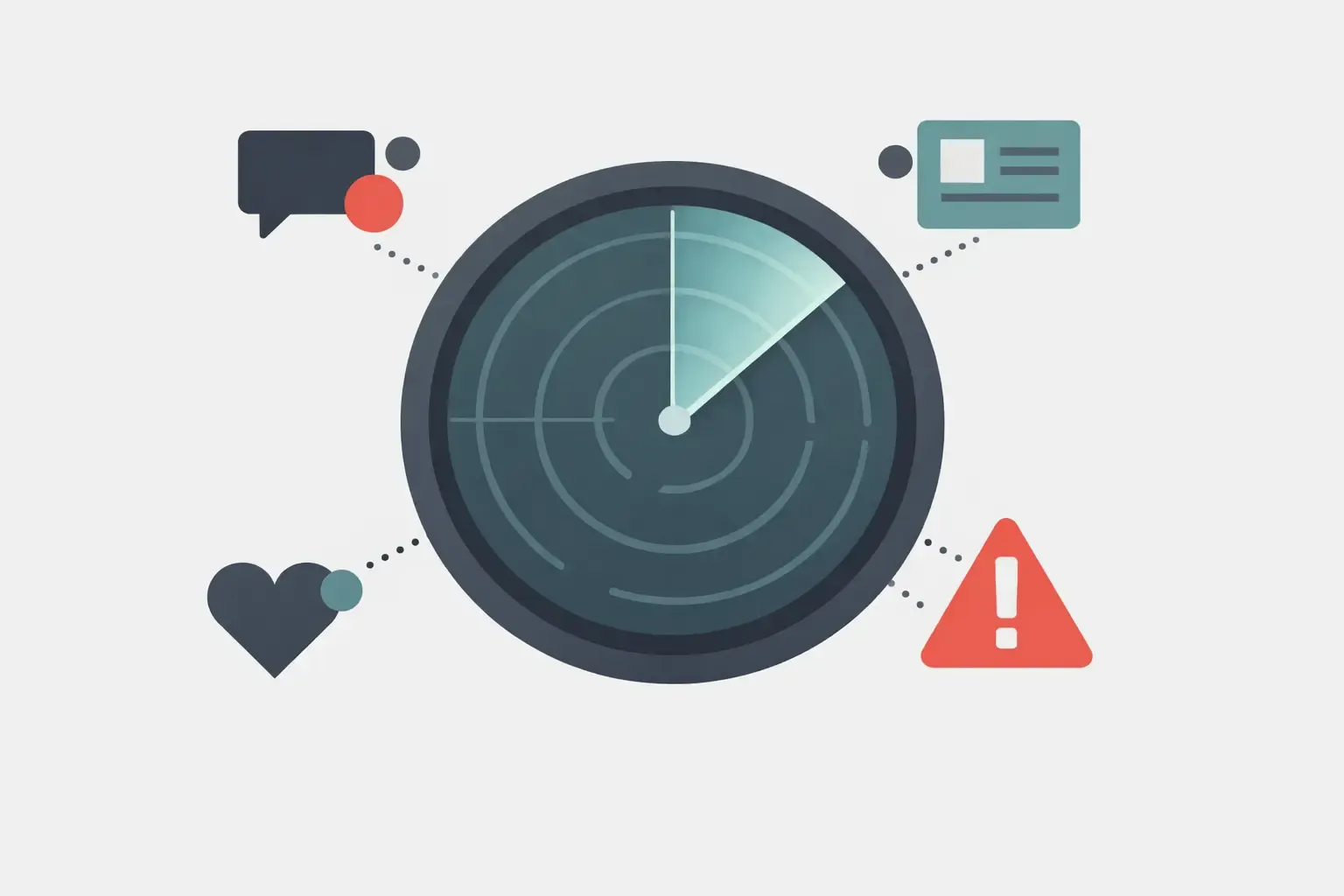
Brand monitoring is the always-on process of tracking what people, publishers, customers, competitors, creators, forums, and AI answer systems say about your brand. For PR and B2B marketing teams, it is no longer just a dashboard for mentions. It is an early warning system for reputation risk, campaign feedback, message drift, journalist interest, and competitor positioning.
That matters because brand perception now changes in public, often before a stakeholder meeting, customer ticket, or quarterly report catches up. A useful monitoring setup helps teams see the story while it is still forming, decide whether it needs a response, and explain what changed afterward with evidence instead of vibes.
Table of contents
Jump to each section:
- What brand monitoring means now
- What to monitor beyond tagged mentions
- How brand monitoring differs from social listening and media monitoring
- A practical brand monitoring workflow
- What Sonos shows about monitoring before the apology
- Metrics that make monitoring useful for PR
- Recommended brand monitoring tools
- Common mistakes that create false confidence
- How to turn monitoring into action
What brand monitoring means now
Brand monitoring starts with finding public mentions of your company, products, executives, campaigns, and competitors. But the useful version goes further: it groups those signals by source, topic, sentiment, influence, business risk, and action needed.
ContentGrip's digital PR guide is a useful companion here because monitoring only matters if it feeds a visibility strategy. A brand can be mentioned often and still be misunderstood. A competitor can be mentioned less often but own the topic that buyers actually trust.
Several tool vendors define the category broadly. Hootsuite describes brand monitoring as tracking, analyzing, and acting on what people say across social media, news, forums, podcasts, review sites, and more. Sprout Social frames it as a wider practice than social monitoring because it scans social and non-social channels.
For PR teams, the key phrase is acting on. A mention count is only the input. The output should be a decision: respond, pitch, brief leadership, update messaging, correct a misconception, prepare a statement, or leave the conversation alone because it has no real risk.
What to monitor beyond tagged mentions
Tagged mentions are the easiest signal to collect and one of the easiest to overvalue. The bigger reputation shifts often happen in places where the brand is not tagged, such as Reddit threads, product review pages, analyst notes, podcasts, newsletters, industry Slack communities, creator videos, and search results.
A serious monitoring setup should cover at least six query groups:
- Brand identity terms: company name, product names, abbreviations, misspellings, campaign names, and branded hashtags.
- Executive and spokesperson terms: founder names, leadership names, board members, public experts, and common title plus company combinations.
- Competitor terms: direct competitors, substitute products, category leaders, and emerging players that buyers compare against you.
- Category terms: the phrases buyers, journalists, analysts, and AI systems use to describe the problem you solve.
- Risk terms: outage, scam, lawsuit, boycott, pricing, bug, breach, layoffs, refund, cancel, or other words that change by sector.
- Message terms: the proof points, claims, differentiators, and narratives your team wants the market to associate with the brand.
The last group is easy to miss. If a campaign is supposed to make the market associate a SaaS company with "secure customer data collaboration," monitoring only the company name is not enough. You need to track whether that phrase, its close variants, and the underlying idea are appearing near the brand in coverage, reviews, social posts, and AI-generated summaries.
How brand monitoring differs from social listening and media monitoring
Brand monitoring, social listening, and media monitoring overlap, but they do different jobs.
Social listening is strongest when the question is about social conversation: what people are saying, which communities are reacting, who is influencing the discussion, and how sentiment shifts on platforms such as LinkedIn, TikTok, Instagram, Reddit, X, and YouTube.
Media monitoring is strongest when the question is about earned coverage: which outlets mentioned the brand, whether the article was syndicated, how prominent the mention was, what journalist or publication drove the story, and how coverage compares with competitors.
Brand monitoring sits above both. It asks, what is the market learning about us across every visible surface? That includes social posts and media coverage, but also review sites, search snippets, podcasts, forum answers, newsletter mentions, third-party listicles, unlinked brand references, and AI answers.
This broader view matters because modern reputation does not live in one channel. A journalist may notice a Reddit thread. A buyer may see a G2 review before reading a press article. An AI answer may summarize a company from several third-party sources and repeat an old positioning claim long after the website has changed.
A practical brand monitoring workflow
The best monitoring systems are simple enough to run every week and clear enough to escalate quickly when something changes.
Start with a baseline. Pick the brand, three to five competitors, and the core category terms that matter most. Track mention volume, sentiment, source type, topic, market, language, and whether the mention is tagged, untagged, linked, or unlinked.
Then set thresholds. Not every negative comment is a crisis, and not every spike is good news. Teams should define what counts as a normal fluctuation, what needs same-day review, and what triggers an escalation to comms, legal, support, product, or leadership.
A useful weekly workflow looks like this:
- Review new high-reach mentions, not just total volume.
- Compare brand and competitor visibility by topic.
- Check negative and mixed-sentiment clusters for recurring complaints.
- Review unlinked editorial mentions that may deserve follow-up.
- Look at search and AI answer surfaces for inaccurate summaries.
- Turn the findings into one to three actions for the next week.
The final step is what separates monitoring from reporting theater. A dashboard that never changes what the team does is just a prettier archive.
Tommy Prayoga, Head of Agency at digital PR service provider Content Collision: "The biggest monitoring mistake I see is treating mentions as proof that PR is working. Mentions are raw material. The real question is whether the right audience is repeating the right idea in the right places, and whether the team can act before a small signal becomes the accepted story."
What Sonos shows about monitoring before the apology
The 2024 Sonos app rollout is a useful cautionary example because the public issue moved across customer experience, product communication, reputation, and investor confidence.
On July 25, 2024, Sonos CEO Patrick Spence published an official update on the Sonos app, apologizing to customers and saying the company had found a number of issues after launch. The post listed fixes planned across July, August, September, and October, including stability when adding products, music library functionality, volume responsiveness, alarm reliability, and playlist editing.
By November 2024, the issue had also become investor-facing. In its fourth quarter and fiscal 2024 results, Sonos referred to its app recovery efforts and highlighted the need to deliver on its action plan to address issues caused by the new app.
The lesson is not that monitoring would have magically prevented the product problem. It is that PR, support, product, and leadership teams need a shared signal system before public frustration forces the company into apology mode. The useful questions would have been: where are complaints clustering, which features are driving anger, which communities are most influential, what language are customers using, and what promise can the company credibly make next?
ContentGrip's PR report guide makes a related point: reporting should explain what changed and what the next campaign or response should do. Brand monitoring gives that report fresher raw evidence.
Metrics that make monitoring useful for PR
The goal is not to collect every possible metric. The goal is to choose measures that connect public conversation to decisions.
For most PR and B2B marketing teams, the useful metrics are:
- Mention volume: how often the brand, product, executive, or campaign appears.
- Source quality: whether mentions come from credible outlets, niche communities, analysts, creators, customers, or low-value aggregators.
- Sentiment and emotion: whether the conversation is positive, neutral, negative, mixed, frustrated, confused, skeptical, or advocacy-driven.
- Topic association: which themes appear near the brand, especially the narratives the team is trying to build.
- Share of voice: the brand's visibility compared with named competitors in the same topic or channel.
- Message pull-through: whether coverage or conversation repeats the intended point accurately.
- Response urgency: whether a mention requires no action, quiet monitoring, direct response, stakeholder briefing, or public statement.
- AI answer visibility: whether AI search tools describe the brand accurately and cite credible sources.
The most useful metric is often a combination. For example, "negative mentions increased" is less helpful than "negative Reddit and review-site mentions about onboarding increased for two weeks, while competitor mentions around migration support also rose." The second version tells the team what to investigate, who should own it, and which message may need repair.
Recommended brand monitoring tools
Different teams need different levels of coverage. A startup does not need the same stack as a regulated enterprise, but every team needs a basic way to catch mentions, understand context, and decide what to do.
Recommended options include:
- Google Alerts: a free starting point for web and news mentions. It is limited, but useful for small teams that need basic brand, executive, competitor, and category alerts.
- Brand24: a practical monitoring option for teams that want broad source coverage, sentiment analysis, alerts, share-of-voice reporting, and AI summaries. Brand24 says its platform tracks over 25 million online sources, including social, news, blogs, forums, newsletters, podcasts, review sites, and video.
- Sprout Social: a strong fit when social conversation, community management, campaign tracking, and customer care need to connect with broader social intelligence.
- Hootsuite and Talkwalker: useful when the team wants social management, listening, and broader brand intelligence in one operating environment.
- Meltwater or Cision: better suited for communications teams that need traditional media monitoring, journalist databases, broadcast or print tracking, and client-ready PR reporting.
- Ahrefs Alerts or Semrush Brand Monitoring: useful when SEO and digital PR teams care about unlinked mentions, backlinks, competitor content, and search visibility.
- Profound, Scrunch, or similar AI visibility tools: useful when the team wants to monitor how AI answer systems describe the brand, competitors, and category.
Do not choose a tool only by source count. Ask whether it supports the workflow: alert quality, query control, sentiment reliability, user permissions, exportable reports, AI summaries, historical data, and whether PR, social, support, and leadership can all understand the output.
Common mistakes that create false confidence
The first mistake is monitoring only branded keywords. That catches direct mentions, but it misses category movement, competitor positioning, customer language, and emerging issues that do not name the company yet.
The second mistake is treating sentiment as a final answer. Sentiment models are helpful, but sarcasm, technical complaints, regional language, and mixed reviews can still confuse automated scoring. Use sentiment as a triage signal, then read the underlying mentions before making a decision.
The third mistake is reporting volume without source quality. Ten niche analyst or journalist mentions may matter more than hundreds of low-context reposts. For PR teams, where the mention appeared and what it said usually matters more than the count.
The fourth mistake is separating monitoring from action. If the social team sees an issue, support has another view, PR sees coverage, and leadership gets a monthly slide weeks later, the brand has a coordination problem. Monitoring should create a shared operating rhythm, not another silo.
The fifth mistake is ignoring AI summaries. ContentGrip has already covered why zero-click PR and AI search visibility change the visibility game. If answer engines describe your company using outdated claims or weak third-party sources, your monitoring program should catch that before sales, investors, or journalists do.
How to turn monitoring into action
The most practical way to use brand monitoring is to assign each signal a next step.
A neutral mention in a small blog may need no action. A positive unlinked article in a relevant trade outlet may deserve a thank-you note, backlink request, or relationship-building follow-up. A complaint cluster from customers may need product or support review. A repeated misconception in AI answers may need updated owned content, stronger third-party proof, and targeted digital PR.
Use a simple action matrix:
- Watch: low-risk mentions with no immediate response needed.
- Engage: posts, reviews, or journalist comments where a helpful reply can improve the outcome.
- Escalate: issues involving safety, legal risk, executive reputation, product failure, misinformation, or fast-growing negative sentiment.
- Amplify: credible praise, customer proof, analyst validation, or earned coverage that supports a priority narrative.
- Repair: recurring confusion, outdated descriptions, inaccurate AI summaries, or negative topic associations that need better evidence in the market.
Brand monitoring works best when it becomes part of the weekly PR rhythm. The team reviews signals, decides what matters, assigns owners, and tracks whether the next action changed the conversation. That turns monitoring from passive surveillance into a practical system for protecting trust, improving campaigns, and earning visibility in the places buyers now look for answers.