
Mike’s Hot Honey leans into soccer and “swicy” culture to sell new use cases
Mike’s Hot Honey pairs Chicago Fire FC, CTV, and social commerce to push hot honey beyond pizza and measure behavior change across ordering channels.

Mike’s Hot Honey is trying to turn hot honey from a “this is fun on pizza” trend into a repeat habit, and it is doing it by attaching the drizzle to moments people already gather around: matchday, streaming, and social video.
The brand’s latest “Drizzle The Mike’s” push pairs food experimentation with U.S. soccer’s growing mainstream pull, mixing a Chicago Fire FC partnership, a short-form film set in a Brooklyn pizzeria, and digitally measured commerce touchpoints designed to track both attention and sales.
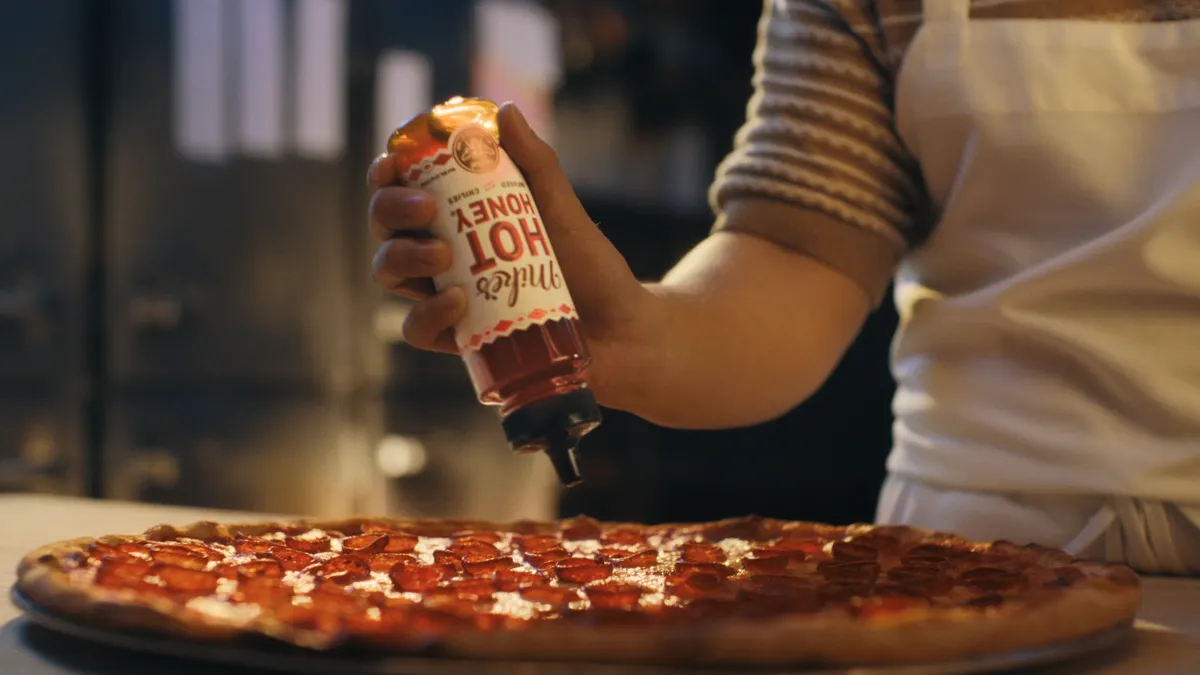
Table of contents
Jump to each section:
- Why hot honey keeps showing up in Gen Z food culture
- What Mike’s Hot Honey is doing in this soccer-infused push
- How the media plan uses AI to match creative to cultural moments
- What this means for marketers
Why hot honey keeps showing up in Gen Z food culture
Hot honey sits in the “swicy” lane: sweet plus spicy, easy to understand, and easy to show on camera. It works because the product’s value is visual. A drizzle reads instantly in short-form video, and the payoff feels personal because people can test it on whatever they are already eating.
That “try it on everything” behavior is the real story. When a condiment becomes a flexible add-on, it stops being a one-dish novelty and starts competing for pantry permanence. Mike’s Hot Honey has been pushing that direction through partnerships that extend beyond pizza, including hot honey flavors tied to Bush’s Grillin’ Beans and Utz chips, plus a successful limited-time offering with KFC.
 ContentGrip
What Mike’s Hot Honey is doing in this soccer-infused push
The campaign launched July 1 and is built around encouraging experimentation, starting with a short-form video set at a Brooklyn pizzeria. The story follows a young adult chasing the role of “The Drizzler,” guided by musician and actor Tariq “Black Thought” Trotter, with music by James Poyser (also of The Roots). The creative was developed by Another Thing, produced by Two One Five, and directed by Anthony Jamari Thomas.
To scale the idea beyond Brooklyn, the brand is leaning into Chicago, pairing pizza identity with a Chicago Fire FC partnership. That includes in-stadium moments like a “Drizzle Cam,” custom content with players filmed at Pizz’Amici, and on-premise signage at Soldier Field across LED boards, video signage, and concourse placements. The partnership also includes a concession tie-in via a “Cocktail of the Match.”
On the distribution side, Mike’s Hot Honey is putting messaging and samples into Chicago pizza boxes during peak ordering windows and summer pizza occasions, then reinforcing the behavior on platforms like TikTok, Meta, and YouTube. It is also leaning on Instacart, DoorDash, search, and TikTok Shop integrations to measure engagement and sales alongside awareness.
How the media plan uses AI to match creative to cultural moments
A key part of the buy is that CTV and online video placement will be supported by Seedtag’s AI to help place creative during “key cultural moments” across food, sports, and entertainment.
In practice, this kind of approach is a bet that context will do some of the persuasion work. If the same creative appears when a viewer is already in a food mindset (or watching soccer content), the message “drizzle this on your next order” can feel less like an ad and more like a relevant suggestion.
It also signals how brands are blending broad reach formats (CTV, online video) with the measurement expectations of commerce media. The campaign’s distribution choices suggest the goal is not only to be seen, but to connect that attention to ordering behavior through retail and delivery integrations.
What this means for marketers
Condiments rarely become culture on their own. They become culture when people can easily remix them, film them, and argue about the “right” way to use them.
- Sell the behavior, not the product description
“Chili-infused honey” is a descriptor. “Drizzle it on everything” is a behavior. The campaign keeps returning to usage moments (pizza, gelato, drinks), which is how you expand occasions without changing the SKU. - Use sports partnerships to create rituals, not just impressions
A “Drizzle Cam” and concession integrations are ritual-shaped ideas: they give fans something to look for on matchday. That is different from a logo that blends into the boards. - Treat cities as content settings, not just media markets
Brooklyn and Chicago are not just geographic targets here. They are pizza story worlds. The locations help the brand feel rooted in real food communities, which matters when you are trying to turn a trend into a staple. - Connect entertainment-grade video to shoppable measurement paths
A short-form film can create meaning and vibe. Instacart, DoorDash, search, and TikTok Shop can capture intent. The pairing is the point: the brand is trying to prove the creative works without reducing the creative to a coupon. - Contextual AI buying is rising because attention is fragmented
Seedtag’s contextual AI support reflects a shift away from assuming one placement fits all. If audiences move between food, sports, and entertainment content in the same session, context-based placement becomes a practical way to stay relevant without over-targeting.
Stepping back, the cultural signal is that “swicy” is not only a flavor trend, it is an identity shorthand: adventurous, slightly chaotic, and built for remixing. Brands that want to ride those cycles have to give people a repeatable action they can claim as theirs.
Mike’s Hot Honey is essentially trying to turn “drizzling” into a personal ritual that travels from fandom spaces (soccer) to everyday routines (ordering pizza). For marketers, that is a useful reminder: the fastest path from trend to habit is usually a behavior people can repeat and show.