55% of businesses are consolidating software tools to adopt AI
Businesses are replacing working software, consolidating vendors, and reshaping procurement strategies as AI adoption accelerates across enterprise tech stacks.

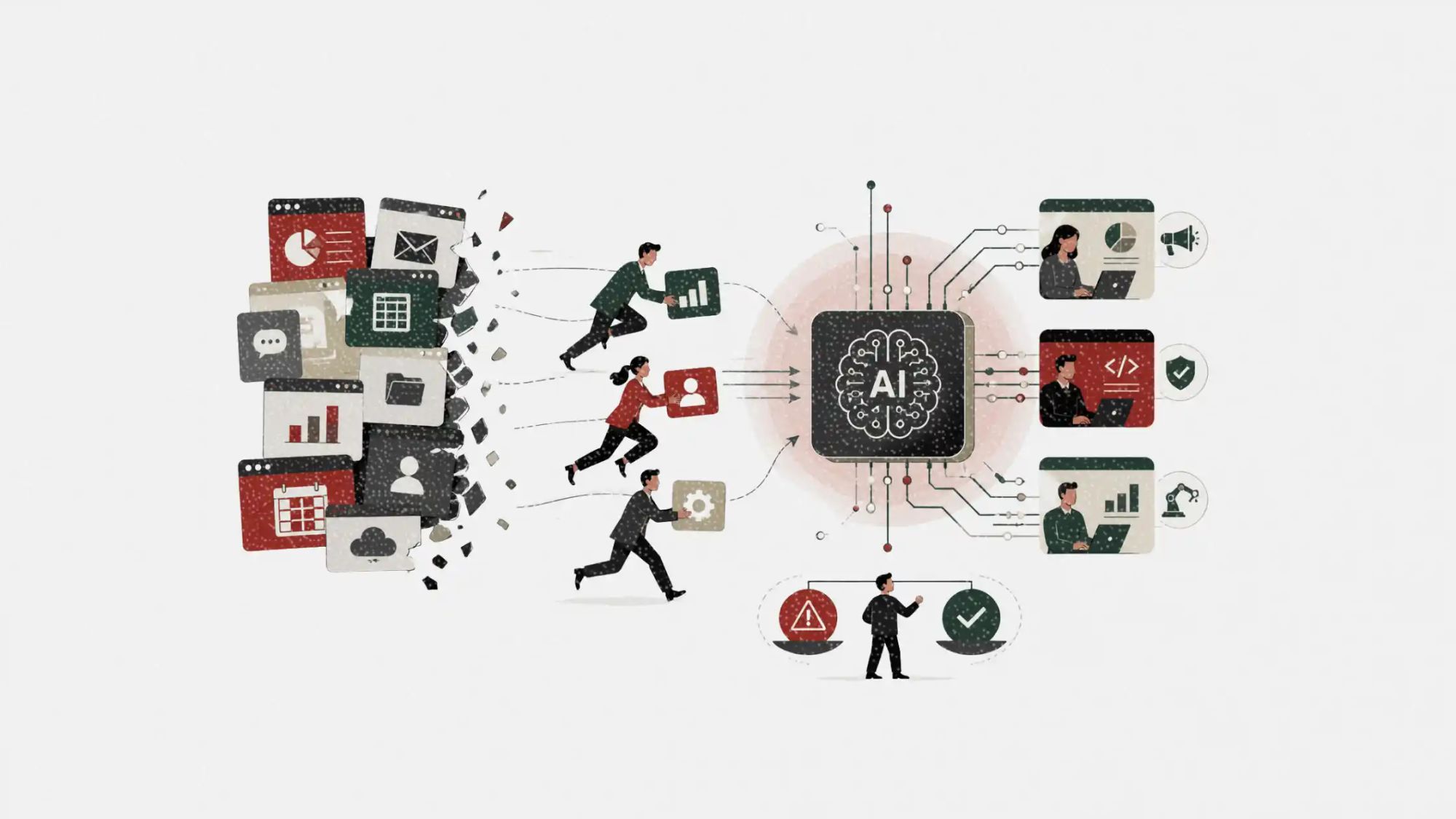
Businesses are rapidly rethinking the software tools they rely on as AI adoption accelerates across departments. A new Software Finder study shows that companies are not just experimenting with AI-powered platforms. Many are actively replacing existing software, consolidating vendors, and reshaping procurement strategies to make room for automation.
The findings highlight a growing tension for marketers, operations leaders, and IT teams. Companies want faster workflows and greater efficiency, but many are also making rushed software decisions to keep pace with competitors.
The result is a new phase of AI adoption where businesses are prioritizing flexibility, consolidation, and AI-native tools over legacy software stability.
Table of contents
Jump to each section:
- What the Software Finder study reveals about AI-driven software consolidation
- Why businesses are replacing working software with AI-powered tools
- What marketers should know about the AI software replacement cycle
- How AI adoption is changing software procurement and vendor evaluation
- Why this matters for marketing and operations teams
What the Software Finder study reveals about AI-driven software consolidation
Software Finder surveyed 272 U.S.-based IT decision-makers, department heads, operations leaders, and business owners to understand how AI is influencing software purchasing and platform strategy.
The results show that AI adoption is directly impacting how companies structure their software ecosystems:
- 55% of businesses are consolidating software tools as part of their AI adoption strategy
- 30% replaced software in the past year with AI-powered alternatives
- 53% are considering replacing more tools with AI-powered platforms
- 44% feel pressure to replace working software simply because AI alternatives exist
- 78% said they replaced tools that were still functioning properly in favor of AI-enabled alternatives
The study also found that project management tools face the highest replacement risk at 27%, followed by crm platforms at 15%, HR systems at 13%, collaboration software at 12%, and accounting software at 8%.
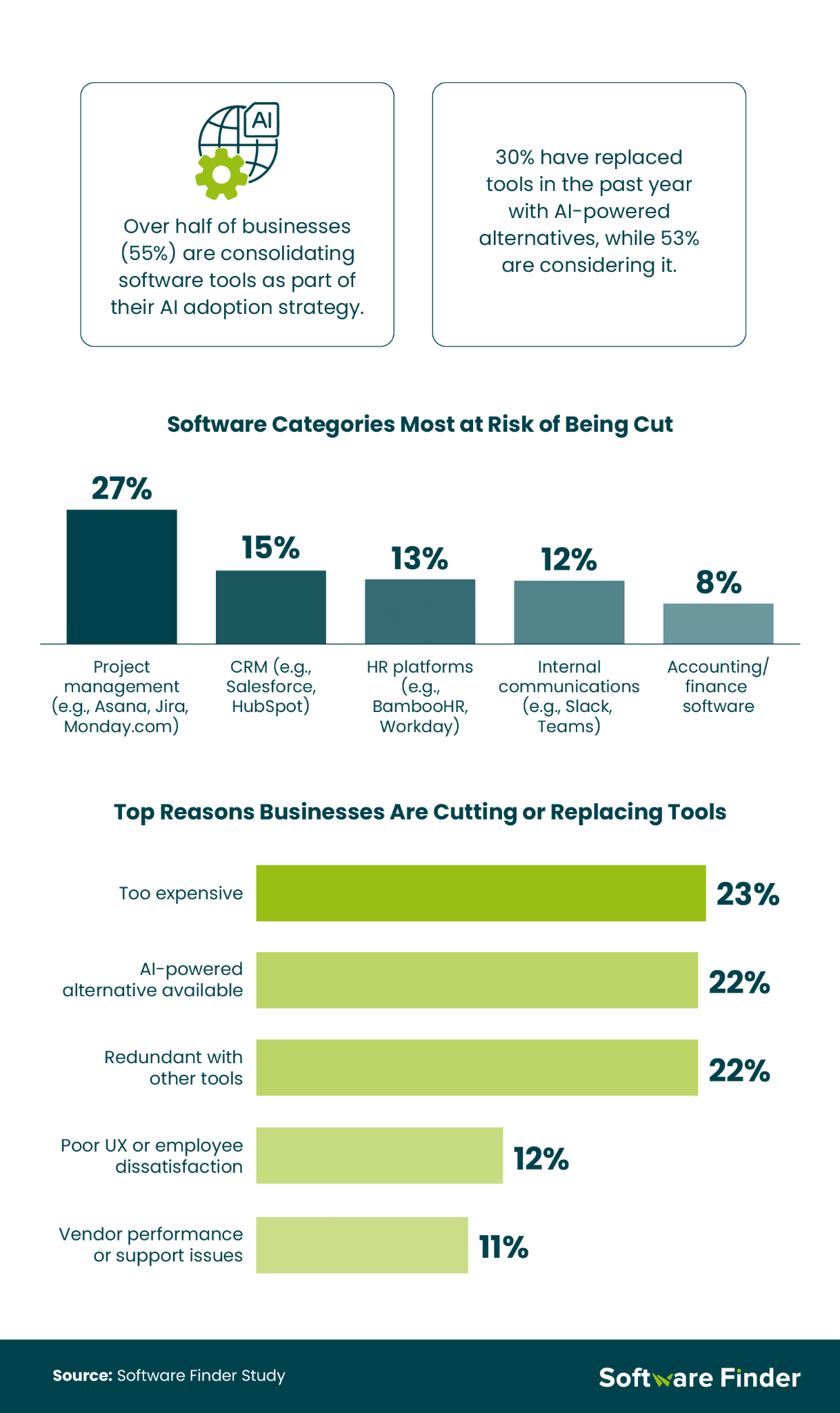
Businesses cited cost, redundancy, and the availability of AI-powered alternatives as the main reasons behind software replacement decisions.
At the same time, companies are significantly reallocating software budgets toward AI. More than half of respondents said between 10% and 24% of their software budget is now allocated to AI platforms.
Why businesses are replacing working software with AI-powered tools
The pressure to adopt AI is no longer limited to experimentation or innovation teams. It is becoming a competitive procurement issue.
Nearly one in four businesses admitted they rushed a software decision simply to stay ahead of competitors adopting AI. That finding reveals how AI hype cycles are increasingly influencing enterprise buying behavior.
Businesses reported that AI-integrated tools are delivering measurable operational benefits:
- 67% said AI tools improve efficiency and save time
- 55% reported improved ease of use
- 54% said AI-supported tools improve employee satisfaction
- 48% reported stronger ROI
Still, the study also exposed growing friction beneath the surface. Companies said they made several tradeoffs while adopting AI-enabled software:
- 28% sacrificed vendor maturity or reputation
- 24% accepted weaker customer support
- 22% paid more than they did for previous solutions
- 19% sacrificed user experience
This suggests that many businesses are prioritizing AI capability over platform stability, customer service, or long-term reliability.
For software vendors and martech providers, that creates both opportunity and risk. Companies with strong AI positioning may gain short-term momentum, but poor onboarding, weak integrations, or immature support structures could quickly damage retention.
What marketers should know about the AI software replacement cycle
Marketing teams are increasingly being pulled into enterprise-wide AI software decisions because campaign execution, analytics, content operations, and customer engagement workflows are becoming tightly connected to AI infrastructure.
Here are the key takeaways marketers should pay attention to:
1. Consolidation is becoming a strategic priority
Businesses are looking to reduce overlapping software subscriptions and simplify fragmented workflows. AI platforms that combine automation, analytics, collaboration, and content generation into unified environments are gaining traction.
For marketers, this means standalone tools with narrow functionality may face increasing scrutiny during procurement reviews.
2. AI positioning now influences vendor survival
The study shows businesses feel pressure to replace software even when existing platforms still work well. Vendors without a clear AI roadmap may increasingly struggle to justify renewals.
Marketers evaluating martech platforms should look beyond AI branding and focus on:
- Integration quality
- Workflow automation depth
- Data governance controls
- Cross-channel orchestration
- Reporting transparency
3. Internal trust matters more than AI claims
Businesses are not blindly trusting vendor messaging. According to the study, 60% validate AI claims through hands-on testing, while 48% rely on team reviews and 32% use third-party benchmarks.
Only 15% said they trust vendor claims directly.
That signals a growing demand for measurable outcomes over AI marketing language.
4. AI procurement friction is still slowing adoption
Despite strong momentum, businesses continue to face adoption barriers:
- 30% cited cost concerns
- 21% raised integration concerns
- 19% worried about privacy or compliance risks
- 12% reported employee resistance
Marketers involved in software selection will likely need to work more closely with IT, legal, and finance teams as AI governance becomes more important.
How AI adoption is changing software procurement and vendor evaluation
The study reveals that AI adoption support varies significantly across departments.
IT teams remain among the strongest advocates for AI adoption, with 46% supporting implementation initiatives. The c-suite also shows strong support at 43%.
Legal teams, however, remain cautious. Only 15% actively advocate for AI adoption, while 31% resist implementation and 45% remain neutral.
That gap matters because AI procurement is increasingly becoming a cross-functional process involving:
- Security reviews
- Compliance evaluations
- Integration testing
- Procurement approvals
- Vendor risk analysis
Businesses also appear to be moving toward more practical AI evaluation frameworks rather than purely innovation-driven purchasing.
Hands-on testing ranked as the top validation method for AI vendor claims, reinforcing the idea that buyers are becoming more skeptical and outcome-focused.
For martech providers, this means AI branding alone is unlikely to sustain long-term growth. Buyers increasingly want proof that AI improves workflows, reduces costs, and integrates cleanly into existing systems.
Why this matters for marketing and operations teams
The Software Finder study reflects a broader shift happening across enterprise technology.
AI is no longer being treated as an isolated productivity feature. It is becoming the organizing layer that influences software procurement, workflow design, and operational planning.
For marketers and operations leaders, that creates several immediate implications:
- AI readiness may become a deciding factor during software renewals
- Procurement cycles may move faster as competitive pressure increases
- Consolidation efforts could reduce tool sprawl but increase vendor dependency
- Teams may need stronger AI governance policies to manage compliance and operational risk
The findings also suggest businesses are entering a more mature phase of AI adoption. Companies are moving beyond experimentation and beginning to redesign their software ecosystems around AI-first workflows.
That transition could dramatically reshape the martech landscape over the next two years, especially for vendors competing in crowded categories like crm, project management, analytics, and collaboration software.
For marketers, the biggest takeaway is clear: AI is no longer just a feature comparison. It is becoming the foundation for how businesses evaluate software ecosystems altogether.