Conair’s AI video ad test points to faster Amazon creative cycles
Conair reports higher detail page views and lower costs from an AI-assisted Amazon video ad, with humans still handling brand-critical

Conair ran an A/B test of Amazon Ads’ Creative Agent and used it to build a 15-second video ad for a Cuisinart food processor. The company said the AI-assisted version delivered 18% higher detail page views and a 14% lower cost per detail page view versus a traditionally produced brand video.
The practical headline is not “AI made a better ad.” It is that Amazon-specific video, once a months-long queue, can now be iterated in weeks, with humans still doing the brand-critical finishing work. Conair also described the details in an Amazon Ads case study.
Table of contents
Jump to each section:
- What Conair tested and what changed
- Why speed matters more than “AI creativity” on Amazon
- The workflow reality: 80% generated, 20% brand-proofed
- What marketers should know about AI-driven Amazon video ads
What Conair tested and what changed
In May, Conair’s e-commerce team tested Amazon’s Creative Agent by producing a video to promote a core Cuisinart food processor on Amazon. The company’s stated goal was to reduce a backlog of video assets that could take months to move through a production queue.
Three numbers signal why this matters for performance marketing teams operating inside retail media:
- The AI-assisted creative drove 18% higher detail page views than the traditional video.
- It lowered cost per detail page view by 14%.
- It was produced in about four weeks, compared with Conair’s stated three to six months for similar videos without the tool.
A useful way to read those results is not “AI is better than humans.” It is “iteration speed is starting to show up in KPI deltas.” On marketplaces, creative wear-out is often a calendar problem before it is an idea problem.
Strategic observation: When production time collapses, testing becomes the strategy, not a tactic.
 ContentGrip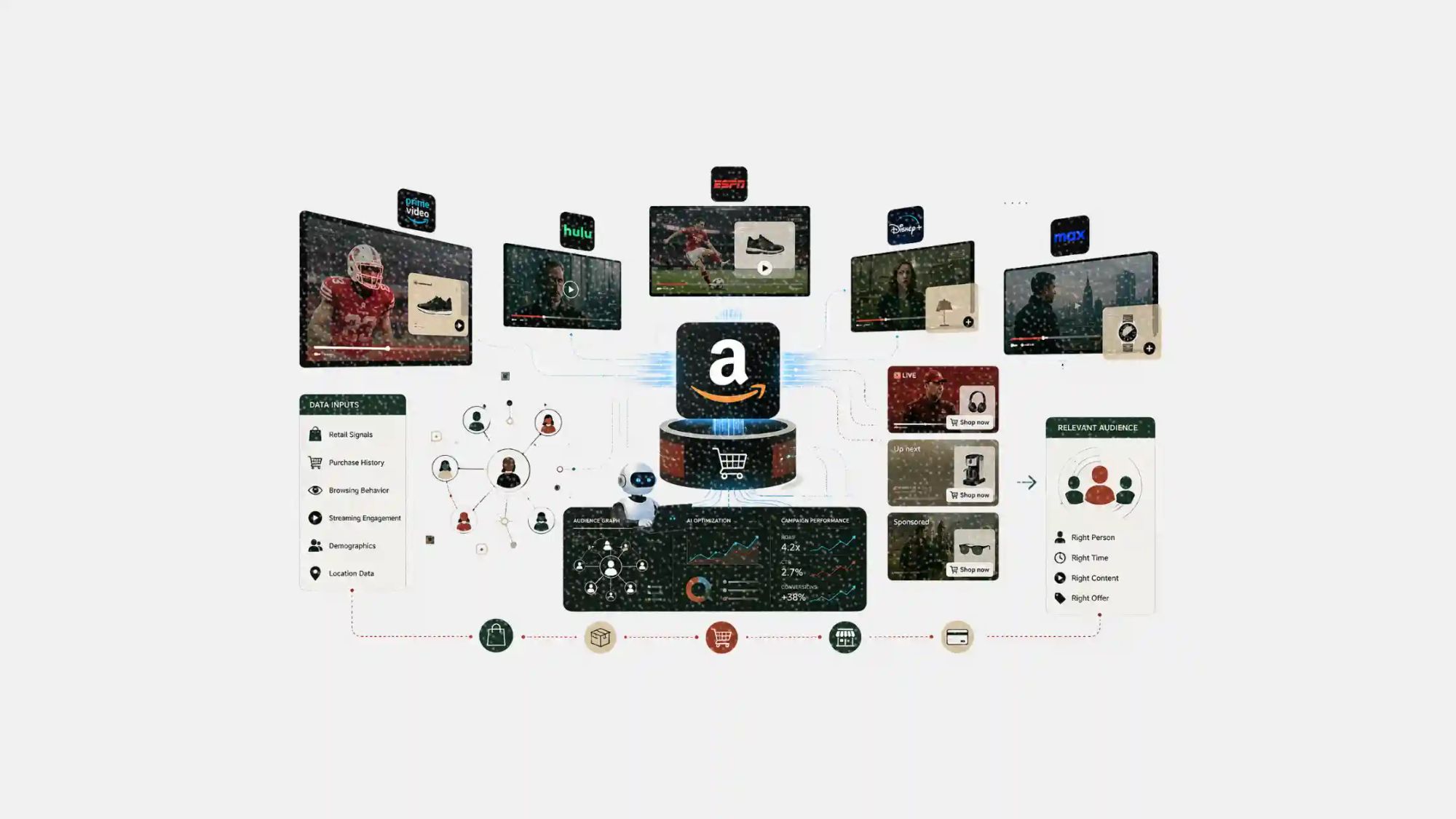
Why speed matters more than “AI creativity” on Amazon
Conair’s internal reasoning points to a common assumption worth challenging.
Common assumption: marketplace ads are mostly about targeting, bids, and placements, with creative as a secondary lever.
Contrasting reality: Conair is treating creative throughput as a constraint on performance, because shoppers are responding to video, and competitors are increasing video investment. When more brands compete in the same placements, the differentiator shifts toward who can refresh, learn, and redeploy faster.
In the Cuisinart example, the ad itself was described as straightforward: an AI-generated family in a kitchen, a “last minute dinner party?” hook, and benefit-led product demonstration (“from pesto to pie crust”), ending with “available on Amazon.” That is not a radical concept. The advantage is that it becomes practical to produce many versions of “straightforward” quickly, then let results decide.
Strategic observation: On retail media, “brand storytelling” often wins by being repeatable, not by being novel.
The workflow reality: 80% generated, 20% brand-proofed
Conair’s test also clarifies what “AI-generated video” means in practice today.
The company said Creative Agent produced roughly 80% of the concept, while the remaining 20% required manual fixes via agency partner Global Overview. Those fixes included brand necessities like logos and color adjustments, and addressing model errors such as altered logos, numbers, or letters.
That split is important because it reframes resourcing decisions. The emerging job is not “replace production teams,” but “move human effort to the parts of the process that protect brand identity.” In Conair’s case, internal marketing pushback was not an issue, because teams worked closely to maintain tone, voice, and “visual DNA.”
Strategic observation: Generative creative does not remove brand standards; it makes them measurable and repeatable.
There is also a reputational edge here. Conair acknowledged wider criticism and backlash toward AI-generated ads, which is a reminder that speed can create new risks: if variation volume increases, review rigor has to keep up, or brand inconsistencies scale just as quickly as output.
What marketers should know about AI-driven Amazon video ads
The deeper shift is that retail media teams are starting to manage creative like a supply chain: throughput, QA, and refresh rates become performance variables.
- Treat time-to-creative as a KPI, not a project detail
Conair’s comparison (four weeks vs. three to six months) suggests the biggest gain is organizational. When video is no longer scarce, teams can align calendars to shopping moments and inventory changes instead of locking creative months in advance. - Separate “idea generation” from “brand finishing” in your process
Conair’s 80/20 split implies a practical operating model: let AI draft, then reserve human time for brand-critical corrections like logo integrity, color consistency, and on-platform compliance. - Use video to show use cases, not just polish
Conair credited performance partly to the video’s ability to demonstrate how the food processor works and frame it as easy for everyday cooks. On Amazon, functional demonstration often does more work than cinematic production values. - Plan for a higher review burden as volume scales
Conair noted the technology can distort logos or characters. If teams expand usage across products, the risk is not one bad asset, but many small inaccuracies that erode brand trust. Scaling AI creative requires scaling review standards and ownership. - Assume competitors will match the tooling, then ask what still differentiates
If Creative Agent (or similar systems) becomes widely used, the advantage shifts to brief quality, testing discipline, and the speed of learning cycles. The scarce asset becomes judgment, not generation.
What makes this moment strategically interesting is that “creative advantage” is moving closer to operations. Not in the sense of checklists, but in the sense that faster creative cycles change what a team can attempt.
If Conair can reliably produce Amazon-ready video variations in weeks, creative stops being a quarterly planning artifact and becomes a continuous optimization loop. That is a meaningful change in how brand building and performance marketing meet inside retail media.