How brands build Gen Z communities that last beyond TikTok
Gen Z is gravitating toward Reddit, Discord, Substack, and other participation-first spaces. This guide explores how marketers can build communities that survive changing algorithms.

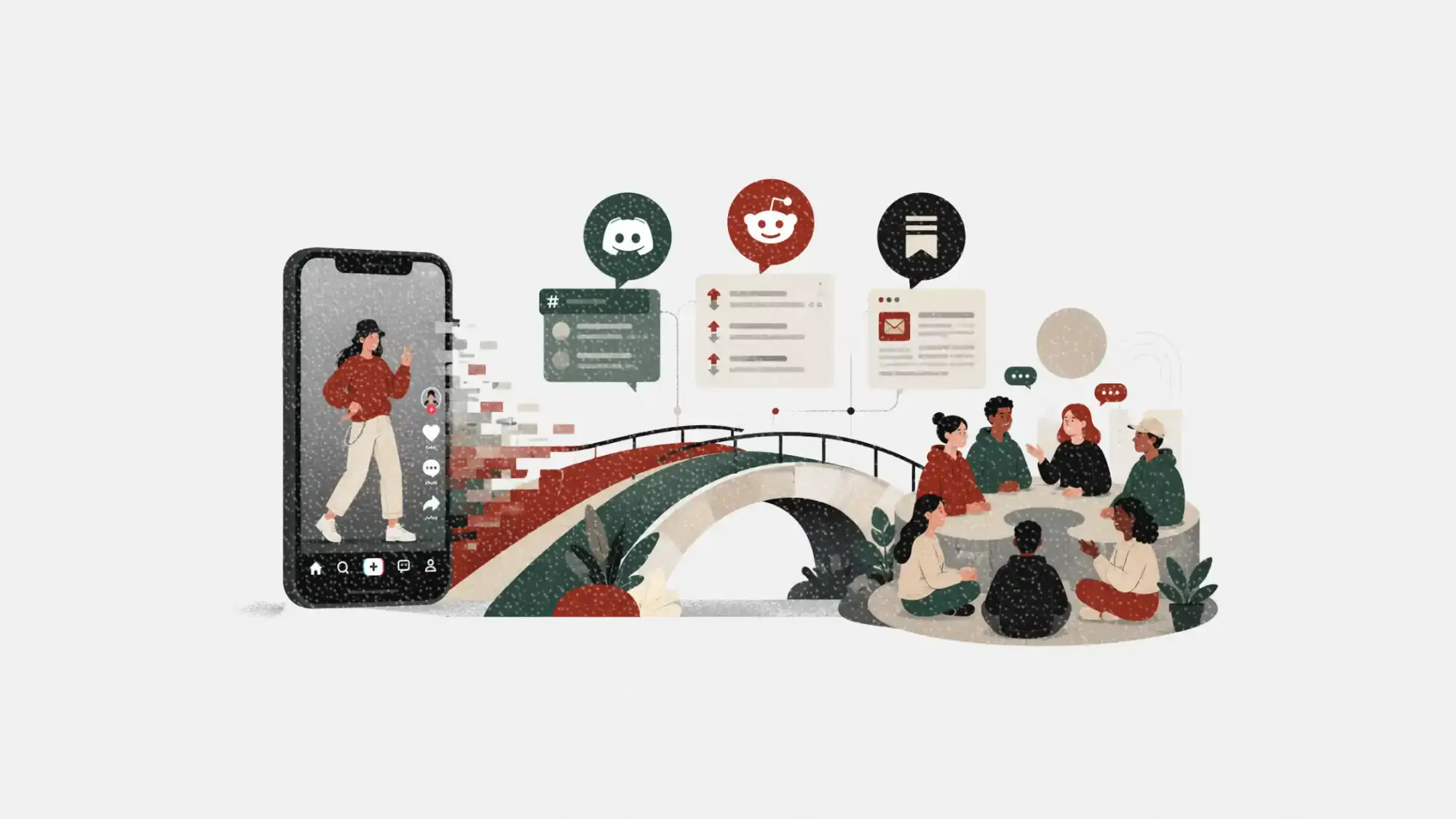
TikTok earns discovery. But discovery is not the same as trust.
Gen Z knows the difference. This generation has grown up inside algorithmic feeds, sponsored content labels, and influencer codes that feel more transactional than genuine. They are fast to spot a brand chasing a trend and even faster to ignore it. What actually moves them is harder to manufacture: a sense of belonging in a space that does not feel like an ad.
That is the core tension in Gen Z community marketing. The platforms that deliver the widest reach are often the ones where trust is hardest to build. Brands that understand this are quietly shifting investment from broadcast-first platforms toward something more deliberate: community-first spaces where participation matters more than impressions.
Table of contents
Jump to each section:
- Why reach alone does not build trust with Gen Z
- The shift to smaller, higher-trust spaces
- Where Gen Z community trust is forming
- What community-first brand behavior actually looks like
- The owned versus rented community risk
- How to build a Gen Z community strategy that holds
 Patrecia Meliana
Why reach alone does not build trust with Gen Z
Gen Z is not withdrawing from social media. Usage figures remain high across Instagram, YouTube, and TikTok. But the relationship with those platforms is changing.
Gen Z social users now say they prefer to create more content than they consume, a shift that could influence their relationship with networks overall. That means brands operating purely in consumption mode, publishing content at Gen Z rather than with them, are already misaligned with how this audience actually uses social media.
The deeper issue is credibility. Gen Z agrees that the top thing they wish brands would stop doing is posting AI content without clearly labeling it, and 56% say they are more likely to trust brands committed to publishing human-generated content. Transparency about who is actually communicating matters enormously. Polished campaign content from faceless brand accounts is increasingly difficult to trust, no matter which platform it runs on.
This is where the community changes the equation.
The shift to smaller, higher-trust spaces
Sprout Social's research is direct about where consumer expectations are heading. The Q4 2025 Pulse Survey found that one of the top five things global social media users say brands should prioritize in 2026 is interacting with audiences in smaller digital spaces.
That is not a niche finding. It reflects a broader migration that marketers are already observing: Gen Z moving more deliberate attention toward Discord servers, subreddits, Substack newsletters, and interest-based group chats. These are not platforms built for mass reach. They are built for belonging.
The key distinction is structure. Smaller, interest-first communities set different norms than algorithmic feeds. Members show up with intent. Conversations carry context over time. Lurkers become regulars. Regulars become advocates. The compounding effect is harder to measure than impressions, but it produces something no media buy can replicate: familiarity that feels earned.
Where Gen Z community trust is forming
Reddit has become one of the clearest indicators of where Gen Z goes for product truth. According to platform data, 82% of Gen Z users trust Reddit for product research and recommendations, while 61% of Reddit users say brands that comment directly in threads feel more human.
That second figure matters as much as the first. Showing up in community discussions is not enough. The manner of showing up determines whether a brand registers as a participant or an intruder. Brands that engage on Reddit with transparent identities, answer criticism honestly, and contribute to conversations without hijacking them tend to earn what the platform calls the "Reddit stamp of approval." That validation travels far beyond the thread where it happens.
Discord has followed a similar trajectory, well past its gaming origins. With 656 million registered users, 259 million monthly active users, and 94 minutes of daily engagement per user, Discord represents the highest-engagement messaging platform in the world, with 73% of users aged 16 to 34. For brands targeting Gen Z and younger millennials, that engagement depth has no direct parallel on any other platform.
The structural advantage is channel flexibility. Discord servers allow brands to create layered spaces: open rooms for broad community, focused channels for product feedback, gated sections for loyal members, and voice channels for live interaction. The format rewards brands that genuinely want ongoing relationships, not one-way announcements.
Substack is a newer addition to the community conversation but growing fast. Sprout Social's CMO noted that platforms like Reddit, Substack, and Discord are powering private groups and micro-communities that build loyalty and spark movements. For content-forward brands, Substack offers a direct ownership advantage: a list of intentional subscribers who opted in specifically for what the brand produces.
What community-first brand behavior actually looks like
The brands doing this well are not treating community as a distribution channel. They are treating it as the product itself.
Rare Beauty built a mental health community infrastructure before it had campaign budgets to match larger beauty competitors. The brand's Rare Impact Fund and ongoing mental health conversations created community identity that TikTok presence reinforced rather than created. Members of that community are not passive followers. They are participants in something they helped shape.
Duolingo approached TikTok the same way it would approach a community server: with participation logic rather than publishing logic. It responded to comments, chased memes its audience was already making, and turned the brand account into a character that could be called out, quoted, and remixed. The result was not just virality. It was a community of people who felt like insiders in a joke that happened to also promote a product.
What these examples share is a common orientation: the brand is not the center of attention. The community is.
The owned versus rented community risk
Most of the trust-building activity on Reddit, Discord, and TikTok happens on infrastructure brands do not own. That is a real constraint. Platform policies change. Algorithms shift. A thriving Discord server can be deprioritized by a platform update. A subreddit can turn hostile.
That is why the smartest community strategies treat rented platforms as acquisition channels and owned platforms as retention infrastructure. A Discord server converts to an email list. A Reddit presence converts to a direct newsletter subscriber. An active TikTok community becomes a Substack reader base.
The question marketers should ask is not which platform to build on, but what community asset they own that does not disappear if a platform changes its rules.
 Patrecia Meliana
How to build a Gen Z community strategy that holds
- Start with a specific identity, not a broad audience
Community cohesion requires a shared thing: a value, an aesthetic, a problem, a culture. "Marketers who like our product" is not a community. "Marketers trying to build authentic brands in noisy markets" is a start.
- Choose platforms where your niche already gathers
Do not build a Discord server if your audience lives on Reddit. Do not start a Substack if your audience does not read long-form. Meet people where the community behavior already exists.
- Contribute before you promote
The ratio matters in community spaces in a way it does not on broadcast channels. Members notice when a brand only shows up to announce something. The brands that earn authority are the ones that add value between launches, not just at them.
- Build feedback loops
Gen Z is highly attuned to whether brands actually act on community input. A community channel where nothing the members say changes anything is not a community. It is a comment section. The distinction is whether participation shapes the brand, not just its content.
- Measure retention, not just reach
Return visit rate, conversation participation, member tenure, and referral behavior are more relevant community health signals than follower count or impression volume. They reflect whether people actually want to be there.
Community marketing for Gen Z is not a replacement for TikTok or any other platform. It is what turns short attention into lasting preference. Discovery happens in feeds. Trust is built in rooms where the brand is willing to stay.