Influencer marketing attribution: connecting creator posts to B2B pipeline
B2B influencer attribution: the UTM, CRM, and dark funnel playbook

Most B2B marketing teams can tell you how many impressions their influencer campaign earned. Far fewer can tell you how many deals it influenced. That gap is not a data problem. It is a framing problem.
The tools exist. The CRM integrations are available. The attribution models are built for exactly the kind of multi-stakeholder, long-cycle buying behaviour that B2B marketers deal with every day. What is missing, in most cases, is the decision to treat influencer activity as a pipeline channel from day one rather than an awareness channel with a vague ROI story attached at the end.
This guide builds the attribution infrastructure from the ground up: UTM taxonomy, attribution model selection, CRM wiring, dark funnel measurement, and the reporting format that earns executive buy-in.
Table of contents
Jump to each section:
- Why influencer attribution fails B2B marketers
- The UTM foundation: tagging every creator touchpoint
- Choosing the right attribution model for a B2B sales cycle
- CRM setup: connecting creator posts to Salesforce and HubSpot
- Measuring the dark funnel: capturing what UTMs miss
- Tools built for influencer attribution in B2B
- Building the attribution report your leadership will trust
Why influencer attribution fails B2B marketers
The standard measure of influencer success, reach and engagement, was designed for consumer campaigns with 48-hour purchase windows. A B2B SaaS buyer with a 90-day sales cycle and a six-person buying committee does not convert on a Friday afternoon because they liked a LinkedIn post. The touchpoints stack up over months, across multiple stakeholders, and the final form submission gets all the credit.
According to the Influencer Marketing Hub 2026 Benchmark Report, measuring ROI and attribution complexity together account for 15.84% of the top challenges marketers report, making it the second-largest pain point cluster in the industry. And a 2025 Demand Gen Report survey found that only 21% of B2B marketers say they can measure marketing ROI with confidence. The remaining 79% are guessing.
The structural cause is a mismatch between attribution tools built for last-click and buyer journeys that bear no resemblance to last-click. Per the Dreamdata and LinkedIn 2025 B2Believe Benchmarks, the average B2B path to purchase spans 211 days across 76 tracked touchpoints. Last-touch attribution credits exactly one of those touchpoints. The other 75 disappear.
The fix is not to demand a simpler answer. It is to build measurement infrastructure that reflects how B2B buying actually works.
The UTM foundation: tagging every creator touchpoint
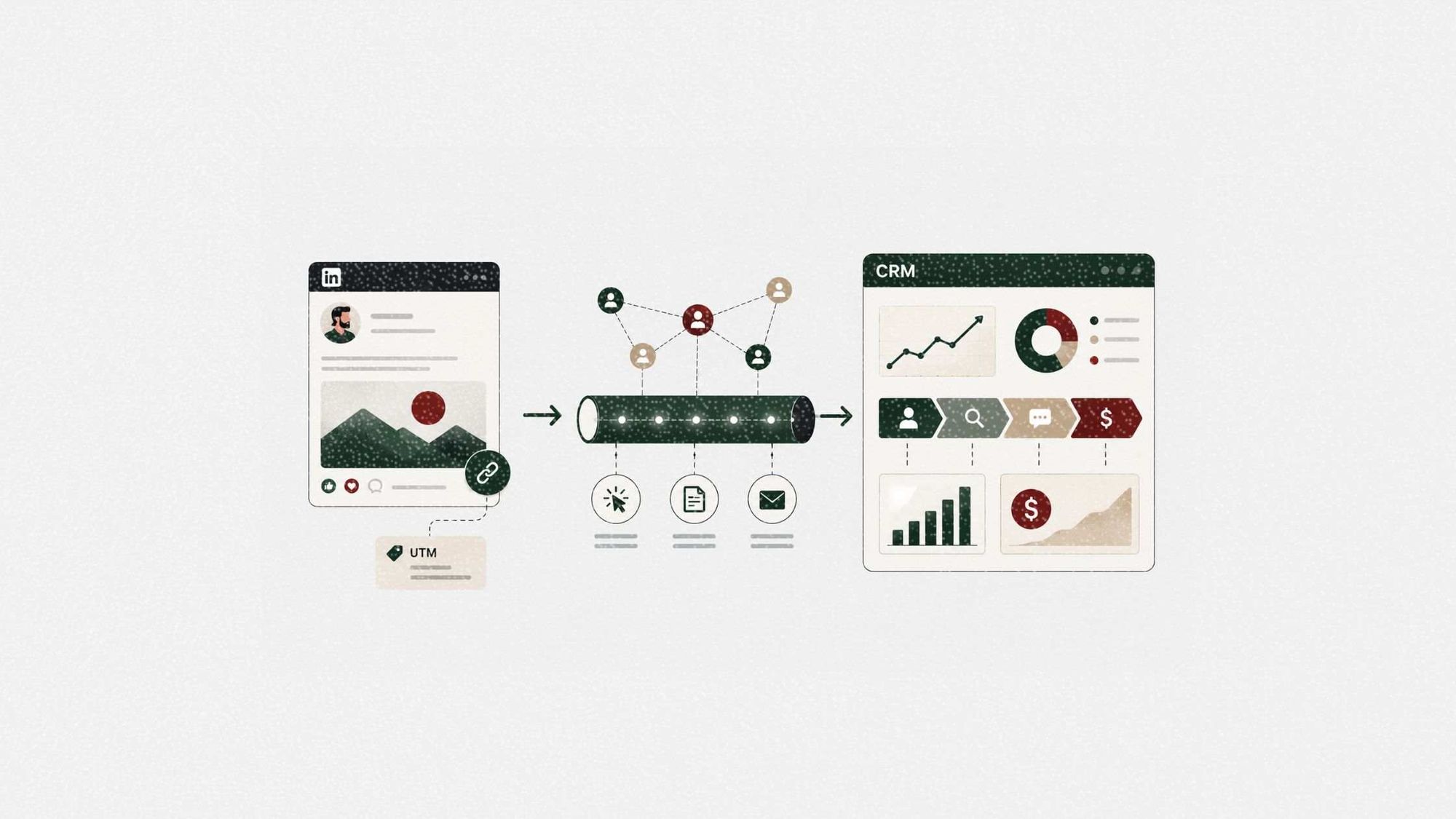
UTM parameters are the entry point for any influencer attribution system. They are the mechanism that connects a creator post to a contact record in your CRM, and they need to be built before the first brief goes out, not after the campaign wraps.
A consistent UTM taxonomy for influencer campaigns should follow this structure:
utm_source = the creator's handle (e.g. sarahjones_linkedin) utm_medium = the channel (e.g. linkedin, newsletter, youtube) utm_campaign = the campaign name (e.g. q3-abm-launch) utm_content = the content format (e.g. carousel, video, text-post)
Every trackable link in a creator's post, bio, or Linktree should carry these parameters. Unique UTM-tagged URLs per creator mean you can isolate which creator drove traffic, which format performed, and which platform converted. Without per-creator tagging, you know that influencer traffic came in. You do not know from where, or from whom.
HubSpot captures UTM parameters automatically when visitors arrive at pages carrying the HubSpot tracking code. To ensure UTM data survives through form submission, hidden fields mapped to custom UTM properties need to be set up, preserving first-touch attribution even when a lead submits a form weeks after clicking a creator link for the first time.
For Salesforce users, UTM data must be passed explicitly from web forms into lead and contact records. Without this step, UTM data gets captured by analytics tools but never makes it into the CRM where deals are managed, creating a permanent gap between traffic data and pipeline data.
Dinda Anandita, Account Director at Content Collision puts it plainly: "The brands that struggle to prove influencer ROI almost always have the same issue: they launched the campaign before they built the tracking. UTM discipline and CRM integration are not post-campaign clean-up tasks, they are pre-campaign prerequisites. Without them, you are measuring activity, not impact."
Choosing the right attribution model for a B2B sales cycle
Not all attribution models are built for B2B. The choice of model determines what your programme looks like to leadership, which channels get budget, and whether influencer activity gets any credit at all.
Last-touch attribution, which 67% of B2B marketing teams still use as of 2026, credits 100% of the conversion to the final trackable touchpoint before a form fill or demo request. For a deal that took 211 days and touched 76 tracked points, last-touch attribution awards a single interaction and discards the rest. Influencer content, which tends to operate in the awareness and consideration layers, almost never holds the last-touch position. It simply disappears from the model.
Multi-touch attribution distributes credit across all meaningful interactions in the buyer journey. Adoption has grown to 47% of B2B marketing teams in 2026, up from 31% in 2023, reflecting the maturation of revenue attribution as a discipline. For influencer-heavy programmes, three models are worth evaluating:
W-shaped attribution assigns 30% credit to first touch, 30% to the lead creation event (the moment a prospect becomes an identified contact), and 30% to the deal creation event, spreading the remaining 10% across all other touchpoints.
Per Improvado's multi-touch attribution guide, this model aligns well with B2B SaaS and enterprise sales teams whose CRMs carry defined funnel stages, such as Salesforce Opportunity stages or HubSpot lifecycle stages. A creator post that first brought a prospect to your content earns the first-touch credit it deserves.
Full-path attribution (available in HubSpot Marketing Hub Enterprise) assigns 22.5% credit each to four major milestones: first interaction, lead creation, deal creation, and closed-won, distributing the remaining 10% proportionally. This model is the most complete representation of a long B2B buying cycle and the one most likely to show influencer content earning sustained credit across the journey.
For teams that cannot yet deploy multi-touch attribution, U-shaped attribution (40% first touch, 40% last touch, 20% spread across the middle) is a practical intermediate step. It at least preserves first-touch credit, which is where creator content most commonly lives.
CRM setup: connecting creator posts to Salesforce and HubSpot
UTM data is only useful when it reaches the CRM. The specific setup differs between platforms.
In HubSpot, the attribution workflow requires hidden form fields mapped to custom UTM contact properties, first-touch preservation workflows so original UTM data is not overwritten by subsequent visits, and attribution reports that pull from contact properties to map source data to deal and revenue outcomes. HubSpot's built-in attribution reporting supports nine models, from linear to full path, all available under Reports within the Attribution section. For B2B teams, W-shaped or full-path models are the correct starting point.
In Salesforce, the setup is more manual but offers greater flexibility. Web-to-lead forms can be extended with hidden UTM fields that populate lead records directly. The gap most teams hit is that UTM data captured in forms does not automatically update throughout the deal lifecycle. The contact record shows first-touch source; the opportunity record often shows nothing. Connecting these requires either a custom Apex workflow or a dedicated attribution tool like Heeet, which is built natively inside Salesforce and HubSpot and connects every touchpoint, including LinkedIn, paid search, and content, to pipeline and revenue.
The consistent recommendation from B2B attribution practitioners: build the UTM taxonomy and CRM field mapping before a single creator brief is sent out. A 2025 attribution report from RevSure found that the foundation of any functioning attribution system is a unified dataset where every interaction is logged, time-stamped, and mapped to the appropriate contact or account record. Influencer campaigns that skip this step leave a permanent gap in the pipeline story.
Measuring the dark funnel: capturing what UTMs miss
Even a perfectly constructed UTM taxonomy cannot track everything. Gartner's 2026 research confirms that 70% of the B2B buying journey now happens before any vendor contact form is filled, in Slack conversations, LinkedIn DMs, peer forums, community discussions, and podcast mentions. A creator post shared inside a Slack channel shows up in analytics as direct traffic with no referrer. The influence is real; the attribution signal is invisible.
Survey data from Improvado indicates that 30 to 40% of B2B buyer touchpoints occur in these untracked channels, including LinkedIn DMs, analyst calls, peer referrals, and review sites visited without UTM parameters. For influencer that rely heavily on LinkedIn content, the dark funnel share is likely higher, not lower.
Three practical methods to address the gap:
First, add a "How did you hear about us?" field to your demo request and contact forms. The free-text answers that come back from closed-won customers are often the most honest attribution data you will collect. When a head of marketing types "I've been following [creator name] for months," that is a pipeline influence signal that no UTM will ever capture.
Second, correlate intent data with creator activity windows. Tools like 6sense and G2 Buyer Intent track which target accounts are researching your category anonymously. Running a 30-to-90-day correlation between creator campaign peaks and spikes in intent signals from target accounts gives you a statistically grounded argument for influence, even without direct attribution.
Third, build creator influence into closed-won reviews as a standing question. Sales teams that ask "what content or people influenced this deal?" regularly surface creator mentions that attribution dashboards miss entirely. The Smarketers' dark funnel attribution guide recommends logging these signals as influence fields in the CRM, separate from standard attribution, to build a qualitative layer that complements the quantitative model.
Tools built for influencer attribution in B2B
Several platforms now connect creator activity to pipeline data directly, reducing the manual plumbing required between influencer management tools and CRM systems.
IMAI offers revenue and conversion attribution per creator, not just at campaign level, with a B2B influencer workspace that supports LinkedIn creator activation and ABM-aligned workflows. IMAI also includes creator-level Shopify and WooCommerce attribution for brands with an ecommerce component alongside their B2B programme.
Dreamdata is built specifically for B2B revenue attribution and aggregates individual contact touches into account-level buying journey timelines. Its data-driven attribution modelling uses your own deal data to weight touchpoints, meaning the model reflects your actual buyer behaviour rather than a predetermined percentage split.
HockeyStack connects marketing touchpoints across ads, email, content, and events to CRM opportunities and revenue, with support for self-reported attribution that catches the LinkedIn and podcast influence that standard tracking misses.
For teams already inside the HubSpot or Salesforce ecosystem, dedicated attribution layers like Heeet (Salesforce-native, cookieless tracking, connects every digital channel to closed revenue) or Factors.ai (account-level engagement mapping across Salesforce, HubSpot, Google, and LinkedIn) provide a more defensible attribution foundation than either CRM's native reporting alone.
The tool choice matters less than the decision to connect influencer activity to pipeline data before the first campaign launches. Retroactive attribution is always incomplete.
Building the attribution report your leadership will trust
A B2B influencer attribution report that earns executive buy-in answers three questions: where did creator-influenced contacts come from, how many became pipeline opportunities, and what was the creator-influenced pipeline value against programme cost.
The reporting structure that works in practice:
At the top, show creator-influenced pipeline value for the period, calculated as the sum of opportunity values where an influencer-tagged UTM appears at any point in the contact's journey. This is the headline number that frames the rest of the report in business terms, not marketing terms.
Below that, break down first-touch attribution by creator, showing which creators introduced the highest-value contacts to the programme for the first time. This tells you which creator relationships to deepen and which to re-evaluate.
Add a touchpoint contribution layer using your chosen multi-touch model, showing how influencer content contributed across the full journey, not just at entry. For W-shaped or full-path attribution, this reveals how creator content participates in lead creation and deal creation moments, not just awareness.
Close with the dark funnel signal layer: self-reported mentions from closed-won interviews, intent data correlations for target accounts during campaign windows, and any CRM influence fields populated from sales team feedback.
TopRank Marketing's 2025 B2B Influencer Marketing research found that teams using always-on influencer programmes rated their programmes as effective 99% of the time, and were 17 times less likely to report programme ineffectiveness compared to campaign-based teams. Part of what drives that differential is measurement discipline: always-on programmes produce consistent data over time, making attribution arguments more defensible and compounding.
The attribution case for influencer marketing in B2B is not built in a single QBR slide. It is built over three to six months of clean data, consistent UTM hygiene, and a reporting structure that maps creator activity to the metrics your CFO already tracks.
That is the bridge from "we got reach" to "we sourced pipeline."