Influencer marketing fraud in 2026: how to detect fake followers, bots, and engagement pods
81% of marketers encountered influencer fraud in 2026. Learn how to detect fake followers, bots, and engagement pods with a 12-point checklist and the AI tools that automate it.

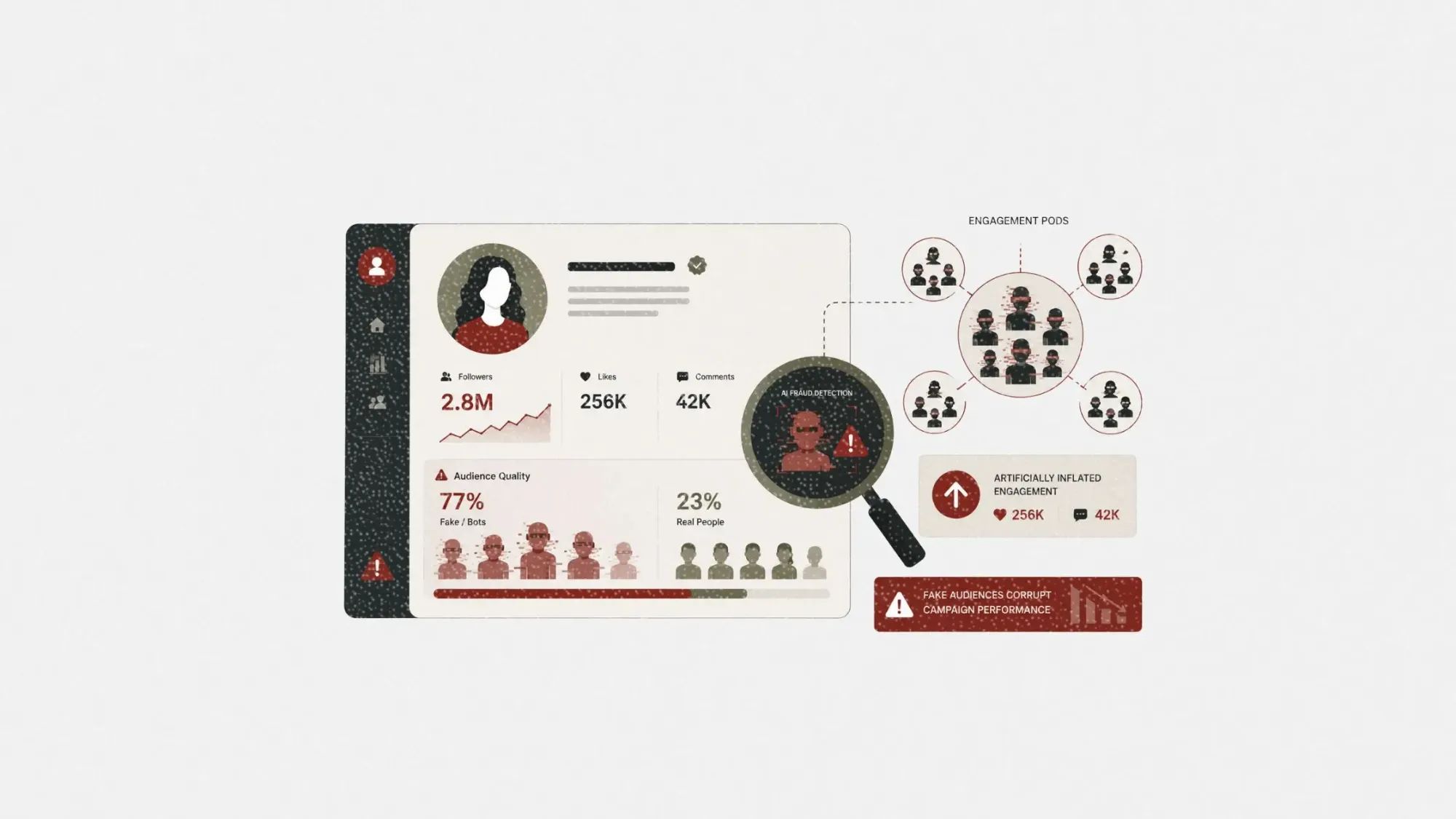
Influencer marketing fraud is not a niche concern for cautious procurement teams. It is a mainstream operational risk. According to a cross-market study by the World Federation of Advertisers spanning 1,400 senior marketing professionals across 28 countries, 81% had encountered influencer fraud within the past 12 months. The same study found that affected campaigns reported a median budget waste of US$128,000 per mid-scale program.
That figure compounds quickly when you consider the scale of the problem at the audience level. SociaVault Labs' analysis of 100,000 accounts across Instagram and TikTok found that 37.2% of influencer followers show signs of being fake, purchased, or inauthentic. More than a third of the audience reach brands are paying for may not exist.
For B2B marketers, where deal cycles are long and every qualified lead matters, the calculus is unforgiving. A campaign that reaches 200,000 inauthentic followers does not just waste the budget. It corrupts your attribution data, skews your benchmark reporting, and delivers zero pipeline.
This guide covers what fraud actually looks like in 2026, the red flags you can catch without any software, the AI tools that automate detection at scale, and a 12-point checklist you can run before any creator contract is signed.
Table of contents
Jump to each section:
- Why influencer fraud costs more than you think
- The three main types of fraud B2B marketers encounter
- Red flags any marketer can spot without tools
- AI tools that automate influencer fraud detection
- A 12-point pre-campaign fraud checklist
- Post-campaign validation: catching fraud after content goes live
Why influencer fraud costs more than you think
The headline loss figure is significant. SociaVault calculates that 19.2% of total influencer marketing spend reaches audiences that do not actually exist, translating to an estimated US$4.6 billion in annual waste on a US$24 billion industry. That is not an outlier result. It is a structural leak embedded in how influencer pricing has historically worked, rewarding follower counts and surface engagement rather than verified reach.
The fraud burden is not evenly distributed across creator tiers. The same SociaVault Labs study places the macro tier, defined as influencers with 100,000 to 500,000 followers, at the highest fraud rate: 48.3%. This is the tier most B2B brands target for credibility and reach, making it exactly where fraud risk concentrates.
The Influencer Marketing Hub 2026 Benchmark Report adds a more granular layer. In its survey of how programs fail, fake or bot followers account for 56.5% of all reported fraud and quality issues. The next cluster, inauthentic or templated comments plus fake or purchased engagement, adds another 20.8%. In other words, nearly 80% of the fraud problem traces back to two things: the audience not being real, and the engagement being manufactured.
For B2B teams specifically, the IMH report flags an additional tension. Fraud detection sits at just 7.22% of tasks that marketers feel comfortable delegating to AI, despite it being one of the highest-stakes vetting activities. Most fraud checking is still manual, incomplete, or skipped under time pressure.
The three main types of fraud B2B marketers encounter
Understanding the fraud landscape starts with separating three distinct problems, each requiring different detection approaches.
The first is fake followers. These are accounts, typically bots or dormant profiles, purchased to inflate a creator's follower count. They do not engage with content, do not belong to any meaningful demographic, and will never convert. HypeAuditor's machine learning model, trained on over 53 behavioral patterns, identifies this type of account as part of its "suspicious accounts" category: bots or users who rely on automation to artificially increase likes, comments, or follower counts.
The second is bot engagement. This goes beyond inflated follower counts to include automated likes, views, and comments that simulate real activity. The result is an influencer whose engagement rate looks healthy until you examine the quality of each signal.
Generic comments ("Nice!") or emoji-only responses from accounts with no profile photos or posts are strong indicators. Modash flags a consistent red flag in this category: if an influencer has bought fake followers, follower growth charts typically show a clear spike followed by a flat or declining period with no sustained organic activity.
The third is engagement pods. These are coordinated groups of creators who agree to like and comment on each other's content in order to game platform algorithms and inflate engagement metrics. HypeAuditor describes them as a specific pattern its platform detects: irregular mutual engagement behavior that does not match the natural variability of organic audience interaction.
Pods are harder to detect manually because the accounts involved are typically real people, not bots, but the engagement they generate is still non-commercial and worthless to a brand campaign.
Red flags any marketer can spot without tools
Even without access to a paid vetting platform, a structured manual review catches the most obvious fraud cases. The following patterns are observable from any public profile.
A follower-to-engagement ratio that does not match the creator's tier is one of the clearest signals. A creator with 200,000 followers receiving only 200 to 400 likes per post is operating at a 0.1 to 0.2% engagement rate, well below the 1 to 3% range Modash benchmarks as typical for genuine accounts. Conversely, an unusually high engagement rate on a small account can signal pod activity.
Comment quality is a second manual check. Scroll through the comments on three to five recent posts. Pods and bots produce recognizable patterns: strings of generic affirmations ("Great content!"), repeated emojis, comments in mismatched languages for an account claiming a specific regional audience, or short phrases that appear identical across multiple posts from different accounts.
Follower growth charts are publicly visible on tools like Social Blade. A sharp vertical spike followed by a long plateau or decline is a purchase pattern. Genuine organic growth tends to be gradual, with occasional acceleration tied to viral content or press coverage, not sudden jumps from 40,000 to 85,000 followers over three days.
Audience geography mismatches are particularly relevant for B2B campaigns. An influencer claiming a US or Singapore professional audience but showing majority followers from regions with no correlation to their content niche (certain markets are well-known as follower-farm sources) should trigger deeper scrutiny.
Finally, check the profile itself. Fake follower accounts that follow an influencer tend to have incomplete profiles: no profile photo, no posts, a username that appears computer-generated, and a following-to-follower ratio of 1,000:5 or worse.
AI tools that automate influencer fraud detection
Manual checks catch the obvious cases. For scale, especially when vetting 20 or more creators per quarter, AI-powered platforms turn a multi-hour audit into a five-minute review.
HypeAuditor is the most comprehensive option for deep audience vetting. Its core output is the Audience Quality Score (AQS), a proprietary metric from 1 to 100 that aggregates audience credibility, engagement authenticity, and growth patterns into a single reviewable number.
The platform categorizes every follower into real people, other influencers, mass followers (accounts that follow more than 1,500 accounts and rarely see any individual post), and suspicious accounts. For B2B campaigns, the mass follower category is particularly important: a creator can have a technically "real" but commercially unreachable audience simply because their followers follow too many accounts for any content to register.
Modash offers a more accessible entry point, including a free fake follower checker that reports suspicious follower percentage, engagement rate, and top audience countries for any public Instagram profile. According to Modash's own documentation, it uses network graph analysis to score billions of accounts and determine normal behaviour patterns, flagging those that fall too far outside those patterns as fake. Its benchmark for concern: anything above 25% suspicious followers warrants a closer look, though that threshold should be read in the context of absolute audience size and the proportion still representing your target ICP.
For teams using GRIN as their influencer management platform, the built-in authenticity checks are integrated into the creator discovery workflow, allowing fraud signals to surface during sourcing rather than as a separate audit step. GRIN's AI assistant Gia adds an agentic layer to this, capable of flagging patterns across large creator pools without requiring manual review of each profile.
Dinda Anandita, Account Director at Content Collision, a content-led comms agency, argues that the real value of these tools is not catching fraud after a campaign fails. "The brands we see getting burned are usually the ones who treat vetting as a one-time checklist during onboarding," she says. "Fraud risk is ongoing. An account that passed an authenticity check six months ago could have purchased a follower package since. Building quarterly re-audits into your creator roster management is the behaviour change that actually protects budget."
A 12-point pre-campaign fraud checklist
This checklist is designed for in-house teams operating without enterprise influencer platforms. Each item combines free or low-cost tools with manual checks that take less than 20 minutes per creator profile.
- Run a fake follower percentage check via Modash's free tool or HypeAuditor's free Instagram checker. Flag any profile showing more than 25% suspicious followers.
- Check the Audience Quality Score if your platform provides one. An AQS below 60 on HypeAuditor's scale warrants a detailed review before proceeding.
- Pull the follower growth chart on Social Blade. Flag any spike of more than 15% growth within a 7-day window that is not tied to a viral post or notable press event.
- Review the like-to-comment ratio against the creator's tier. A micro-influencer receiving 3,000 likes and 4 comments on a typical post has an unusual ratio, suggesting like-buying or pod engagement.
- Read through comments on 5 recent posts. Flag profiles where more than 15% of visible comments are single words, emoji-only, or appear to be copy-paste from the same small set of phrases.
- Check audience geography. Compare the claimed audience location in any media kit the creator provides against the platform-reported breakdown from your vetting tool. A discrepancy of more than 20 percentage points for a key market is a red flag.
- Request a screenshot of the creator's recent story views and direct reach metrics from the platform's native analytics. Authentic stories on an account with 80,000 followers typically reach 3 to 8% of their audience. Consistently below 1% suggests a largely inactive following.
- Cross-reference the creator's engagement rate against tier benchmarks. Influencer Marketing Hub benchmarks provide a reference point by platform and tier.
- Google "[creator name] + fake followers" and "[creator name] + fraud." Publicly flagged fraud cases from other brand partners occasionally surface in community discussions on Reddit, LinkedIn, or creator marketing forums.
- Verify the creator's professional claims. For B2B creators on LinkedIn, cross-check stated job titles, employer history, and professional connections against what they claim in their pitch materials.
- Ask for campaign case studies with verifiable metrics. A credible creator can share past campaign results: reach, clicks, or conversion data tied to a real brand partner you can contact.
- Review FTC disclosure compliance on recent sponsored posts. A creator who does not disclose paid partnerships correctly is already a compliance liability. Check that recent sponsored posts include clear disclosures such as #ad or #sponsored in a prominent position, not buried in a caption or hidden in a hashtag cluster.
Completing all 12 checks on a shortlist of five to ten creators is achievable in a half-day review. For larger rosters, platforms like HypeAuditor, Modash, and Upfluence allow bulk audits that reduce per-creator time significantly. If you are still building your vetting workflow from scratch, the guide on how to vet influencers covers the broader authenticity review process beyond fraud detection alone.
Post-campaign validation: catching fraud after content goes live
Pre-campaign vetting removes the most obvious bad actors. It does not eliminate all risk. Some fraud patterns, specifically pod engagement and coordinated comment activity, only become visible once content is live and performance data starts accumulating.
The first signal to watch is the conversion gap. If a creator's content delivers strong reported reach and engagement but produces near-zero clicks, redemptions, or trackable actions, the disconnect points to low-quality audience activity. Set up UTM-tagged links or unique promo codes for every creator before launch so you have direct traffic data to compare against the platform's reported reach.
The second is the engagement velocity pattern. Genuine engagement on a post builds gradually over the first 24 to 48 hours, with a decay curve that follows natural platform distribution. Pod-driven engagement tends to spike within the first two hours of publication, taper sharply, and produce a final engagement total that looks healthy but arrived in an unnatural burst. Screenshot and timestamp engagement data for high-value posts to preserve a record of this pattern.
The third is comment volume at specific posting times. Engagement pods often operate within time zones or through scheduled automation. A creator based in Southeast Asia whose comments arrive predominantly between 3 and 5 AM local time, and whose engagement drops sharply outside that window, is worth flagging for a deeper audit.
If fraud is confirmed post-campaign, document everything before approaching the creator or their management: follower growth screenshots, engagement rate data, UTM performance versus platform-reported reach. GRIN's platform and others allow you to export campaign performance records. These records matter for any refund or contract dispute.
For the next campaign cycle, integrate the findings into your creator brief and contract. AI-detection clauses, performance warranties, and audience authenticity representations are increasingly standard in influencer agreements. Platforms like HypeAuditor and Modash both offer ongoing roster monitoring features designed for post-campaign validation, not just one-off pre-campaign audits.
Fraud detection is not a one-time gate. It is a recurring quality control function. The teams that protect their budgets consistently are the ones that build it into their workflow at every stage, from discovery through to post-campaign reporting, rather than treating it as an optional pre-flight check.