Instagram influencer marketing in 2026: how the Reels algorithm affects brand campaigns
How Mosseri's three ranking signals should change every Instagram influencer brief you write

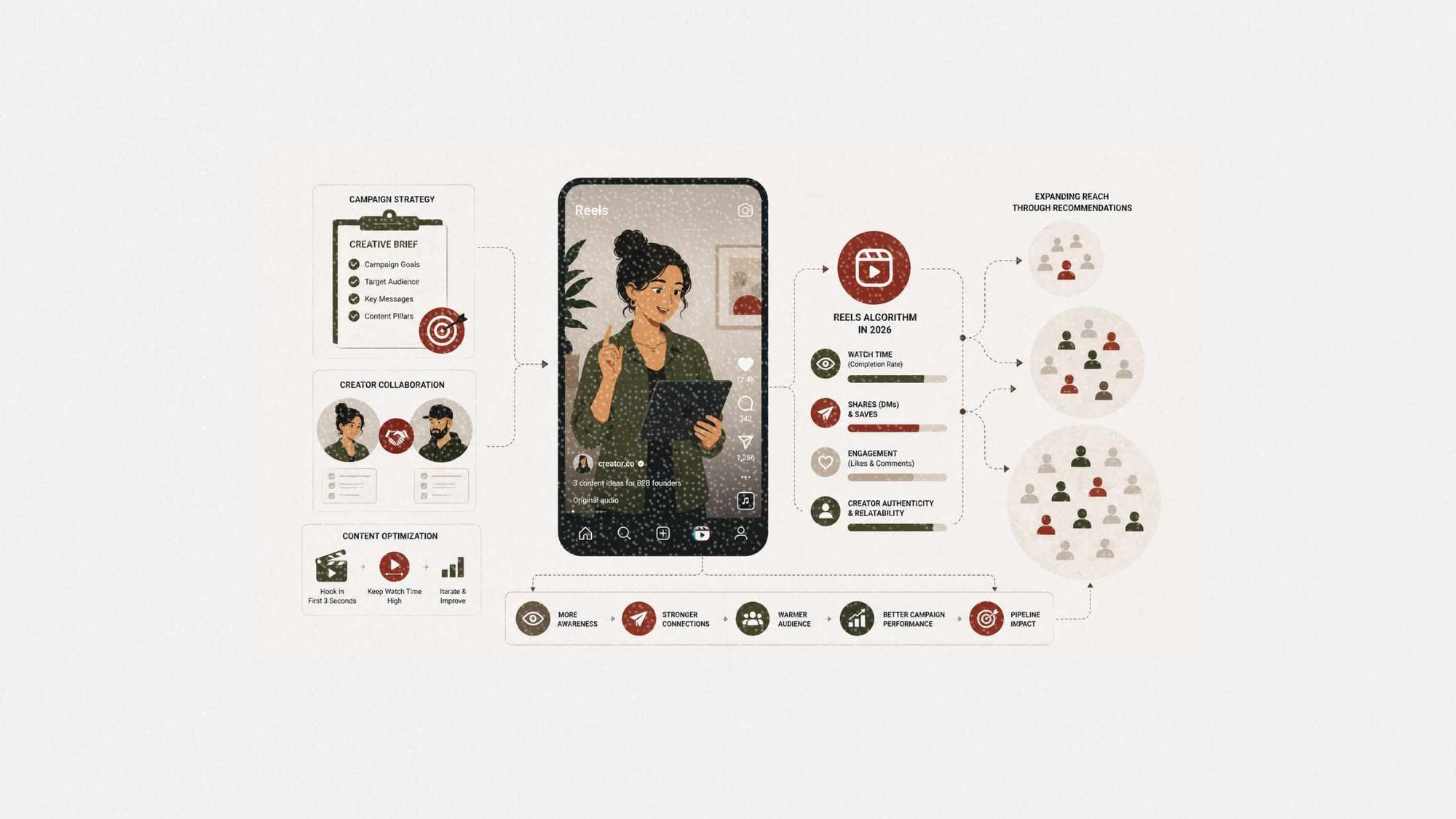
Instagram has crossed 3 billion monthly active users, and Reels now account for more than half the time people spend on the platform. For brands running influencer campaigns, those two facts should reframe how every brief gets written. The platform is no longer a passive display channel where reach is purchased and content is shipped. The Reels algorithm distributes content actively, and it rewards specific behaviors over others. Brands that brief against those behaviors see compounding reach. Those that brief around brand safety checklists and hashtag lists see diminishing returns.
This guide breaks down exactly what Instagram's algorithm is doing in 2026, what it means for the way you design sponsored Reels, and how to turn a creator partnership into a campaign that earns distribution rather than just buys it.
Table of contents
Jump to each section:
- Why Instagram still leads for brand campaigns in 2026
- The three ranking signals Mosseri confirmed for Reels
- What sends per reach really means for sponsored content
- How to brief creators for watch-time performance
- The "Your Algorithm" update and what it changes for targeting
- Compliance inside sponsored Reels: what brands must get right
- A practical checklist for Instagram influencer campaigns in 2026
Why Instagram still leads for brand campaigns in 2026
Despite competition from TikTok and the steady rise of LinkedIn among B2B buyers, Instagram remains the dominant platform for influencer-led brand campaigns by volume. The 2025 Instagram Content Playbook, a joint study by Metricool and HypeAuditor analyzing 700 million posts across 28 million influencer accounts, found that Reels lead in reach across all follower tiers and consistently outperform images and carousels as the most effective path to new audiences. Reels achieve a 2.46% average engagement rate across the platform, the highest of any format, according to Sprout Social's 2026 data.
The purchase connection is just as strong. Sprout Social's 2026 Social Media Content Strategy Report found that over a quarter of social users from every generation turn to Instagram to find their next purchase, making it the platform where discovery and buying intent overlap most directly. That conversion pathway is what keeps brand budgets pointed at Instagram even as newer platforms compete for attention.
The challenge for brands is that Instagram's distribution logic has changed substantially. The platform no longer operates on a single feed algorithm. As Instagram head Adam Mosseri has confirmed, the app runs separate ranking systems for Feed, Reels, Stories, and Explore, each weighing signals differently. Optimizing a sponsored post for the Feed is not the same exercise as optimising a Reel for recommendation reach. Most brand briefs still treat them as interchangeable, which is where campaign performance quietly disappears.
The three ranking signals Mosseri confirmed for Reels
In January 2025, Mosseri confirmed three ranking factors that matter most across all Instagram surfaces, with specific weight given to Reels: watch time, likes per reach, and sends per reach (DM shares).
Watch time is the single most important signal. The algorithm tracks whether viewers continue watching past the first three seconds, and completion rate is the most powerful individual metric for earning recommendation placement. A Reel that holds 60% or more of its viewers to the end signals genuine interest to the algorithm and triggers broader distribution to unconnected audiences.
Likes per reach matters more for connected audiences, meaning existing followers. It reflects how well the content performs with people who already know the brand or creator. Sends per reach, by contrast, is the signal that drives reach to new audiences. When someone forwards a Reel to a contact via DM, Instagram interprets that as a strong endorsement and amplifies distribution accordingly. According to data from CreatorFlow, sends per reach carry 3 to 5 times the weight of likes when the algorithm is deciding whether to recommend content outside an existing follower base.
One additional signal worth noting: in December 2025, Mosseri published a year-end memo stating that Instagram would prioritize raw, real human content over AI-generated material throughout 2026. Original, platform-native content now earns 40 to 60% more distribution than reposts or recycled assets from other platforms.
What sends per reach really means for sponsored content
The sends signal has direct implications for how brands should think about sponsored Reels, and most campaign briefs are not accounting for it.
A single sponsored Reel that generates several hundred DM shares can trigger recommendation placement that reaches audiences a paid distribution budget would never efficiently access, and it does so with the social proof attached to a peer recommendation. That is a qualitatively different kind of reach from a paid impression.
The operational problem is that brands do not have direct visibility into DM share counts. Instagram does not expose this metric to third-party analytics tools, and the API does not surface it. What brands can monitor as proxy indicators includes disproportionate reach-to-follower ratio on sponsored posts, which signals recommendation placement was triggered, and saves, which the algorithm also interprets as a signal of durable value.
For campaign briefs, the practical implication is that the question "would someone DM this to a friend?" needs to be built into creative direction, not left to creator instinct. Content formats that consistently generate DM shares include relatable observations that feel true to a specific audience, surprising or counterintuitive information framed around something the audience already cares about, and humour that lands for a defined niche rather than broad appeal.
Promotional content, by contrast, rarely earns shares. Advertising language is the fastest way to remove the social proof that makes sends algorithmically valuable in the first place.
"Instagram campaigns that earn organic sharing require a fundamental shift in how brands brief creators. The brief should define the audience insight the Reel is built around, not just the product message. When the content earns a share because it resonates deeply with a specific reader, it does the distribution work for you." says Dinda Anandita, Account Director at Content Collision.
How to brief creators for watch-time performance
Watch time optimization starts before production, at the brief stage. Brands that leave hook construction to creator discretion are outsourcing the most algorithmically consequential decision in the content process.
The first three seconds of a Reel determine whether the algorithm classifies it as content worth distributing. Human eye contact in the opening frame consistently triggers retention. Pattern interrupts, which means anything that breaks the viewer's scrolling reflex, hold attention past the critical three-second threshold.
Stated paradoxes ("the thing most brands get wrong about X") and specific audience call-outs ("if you manage a team of five or more") both work as hook architectures because they immediately signal relevance to a defined viewer.
Beyond the hook, pacing matters throughout the full runtime. Instagram now supports Reels up to three minutes in recommendation feeds, which gives creators room for genuine storytelling and educational depth. But the algorithm continues to reward completion rate, so longer Reels need to sustain attention through the full duration, not just past the opening. Quick cuts, captions at eye level, and audio cues at key moments all reduce drop-off.
For brands running multiple creator partnerships, hook variants should be treated as mandatory brief deliverables. Testing two or three distinct hooks on Reels consistently surfaces larger performance differences than any other creative variable, including creator identity. If you are not briefing hook variants, you are leaving optimization leverage on the table.
The "Your Algorithm" update and what it changes for targeting
In December 2025, Instagram launched "Your Algorithm," a personal dashboard visible in Settings under Content Preferences. The feature lets users explicitly add topic categories they want more of and remove categories they are no longer interested in. By early 2026, it was available globally.
For brands running influencer campaigns, this changes the targeting context in two ways.
First, audiences that have opted into your category are more receptive than they have ever been to relevant sponsored content. A fitness brand whose target audience has actively curated their feed toward health and training content is entering a higher-intent environment than the undifferentiated feed of two years ago.
Second, audiences that have explicitly removed a category will not see Reels in that space, regardless of how well the content performs on other signals. This makes creator selection even more important. Creators whose audience is already opted into a relevant interest category provide access to an audience that is predisposed to receive the content. Audience category alignment is now a vetting variable, not just a follower count check.
The practical step for brands is to ask creator partners to share audience insight data and to assess how that audience's stated interests overlap with the campaign category. Platforms such as Modash, Favikon, and IMAI surface audience-level interest breakdowns at the creator vetting stage, which is where this check should happen rather than after a brief has already been signed off.
Compliance inside sponsored Reels: what brands must get right
Instagram's branded content policies require that paid partnerships be disclosed using the built-in Paid Partnership label, which applies a visible tag to posts, Stories, Reels, and live content. However, FTC guidance makes clear that the platform label alone is insufficient for video content. Brands running Instagram campaigns should have disclosure requirements written explicitly into creator contracts. ContentGrip's influencer contract template guide covers the specific clauses that handle FTC indemnification, usage rights, and disclosure obligations.
For sponsored Reels, a layered disclosure approach is required:
The creator must include a verbal disclosure of the brand partnership within the first three seconds of audio. Waiting until mid-video or placing a disclosure at the end, after the promotional message has already been delivered, does not meet FTC standards.
An on-screen text overlay, visible as a lower-third or similar prominent placement, must appear at the beginning of the Reel. The text must be in a contrasting colour and at a readable size. Overlays buried in corners or over visually complex backgrounds do not satisfy the requirement.
Caption disclosure should appear in the first line of the caption text, before Instagram's "more" truncation point on mobile. The FTC has confirmed that acceptable language is narrow: "Ad," "Sponsored," and "Paid partnership with [brand]" are compliant. Terms such as "collab," "partner," "thanks to," or "#gifted" used alone are high-risk and may be considered insufficient.
The tension for brands is that the first three seconds of a Reel are also the hook, the most performance-critical moment in the entire asset. Building a verbal disclosure into that opening without destroying the hook requires deliberate creative direction in the brief.
One workable approach is to integrate the disclosure as part of the hook itself: "I got early access to [product] and need to share what I found" names the brand relationship while functioning as a curiosity-gap hook.
For brands running whitelisting or boosting alongside organic Reels, the creator must also enable the "Allow business partner to boost" toggle in the branded content tool. Forgetting this step prevents the brand from running partnership ads against the content and is a common workflow failure that should be caught at the content submission stage.
A practical checklist for Instagram influencer campaigns in 2026
Before any sponsored Reel goes live, run through the following:
Brief quality
- Hook construction is specified in the brief, with at least two variants required as deliverables
- The audience insight the Reel is built around is articulated explicitly, not implied
- A verbal disclosure is required within the first three seconds of audio
- On-screen text disclosure is required as a brief deliverable, with format specifications included
Creator vetting
- Audience interest category data reviewed against campaign category
- Completion rate on recent organic Reels checked as a proxy for watch-time performance
- DM share-rate proxies (sends visible in creator Insights) discussed with the creator before agreement
Content review
- Hook variant performance tested before full campaign distribution
- 9:16 aspect ratio confirmed (non-native formats reduce reach by 30 to 40%)
- Original audio or trending audio included (no watermarks from other platforms)
- Paid Partnership label enabled with boost permission toggled on
Measurement
- Reach-to-follower ratio tracked as a proxy indicator of recommendation placement
- Saves tracked alongside likes and comments in post-campaign reporting
- Creator Insights screenshot for sends requested as part of campaign reporting deliverable
For benchmarks on what to expect to pay for Instagram creator partnerships at each tier, see ContentGrip's influencer marketing cost breakdown for 2026.