Media training: a practical guide for PR teams and spokespeople
A practical media training guide for PR teams, founders, and executives preparing for journalist interviews, podcasts, live video, and crises.

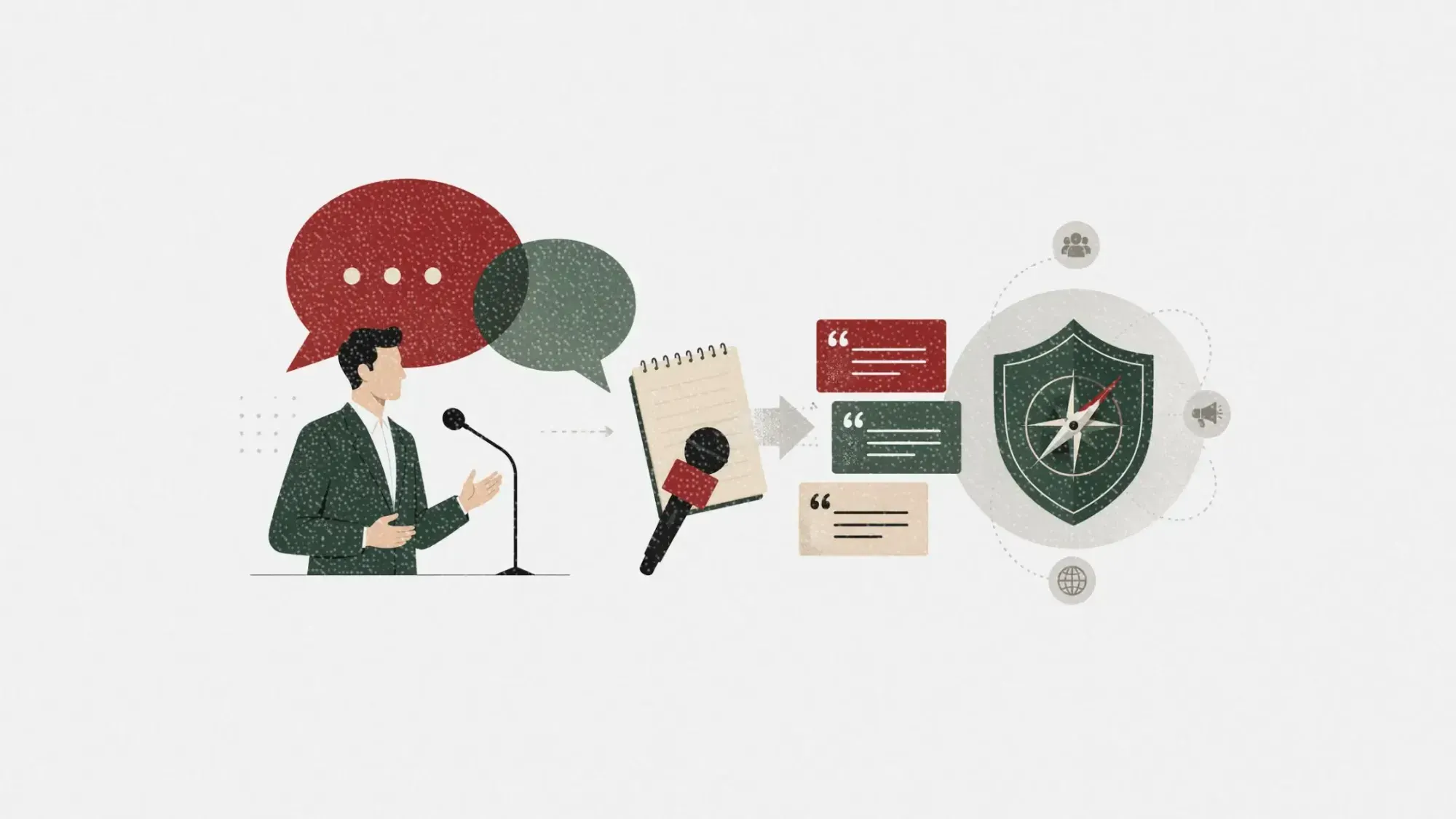
Media training is no longer just about looking composed on camera. For B2B marketers, founders, and PR teams, it is the discipline of preparing a spokesperson to say something accurate, quotable, and useful when a journalist, podcast host, analyst, or conference moderator asks a question under pressure.
Table of contents
Jump to each section:
- What media training actually prepares you to do
- Why media training matters more in the zero-click era
- What to prepare before any media interview
- How to build message points journalists can actually quote
- How to handle difficult questions without sounding evasive
- How PR teams should coach different interview formats
- How to measure whether media training worked
What media training actually prepares you to do
Media training is communication coaching that prepares a spokesperson to interact with reporters, represent an organization clearly, and handle live or recorded interview pressure. Indeed defines media training as preparation for media interactions that helps people practice interview formats, craft key messages, handle challenging questions, and improve communication skills.
For PR teams, that definition is useful but incomplete. The real job is not simply to make someone sound polished. It is to help them become a reliable source.
If your team is actively pitching journalists, start by aligning media training with the story angle, not a generic list of talking points. This pairs naturally with stronger outreach discipline, especially if your team already uses media pitch email templates to tighten the hook before asking a spokesperson to go on the record.
Good media training should help a spokesperson do five things:
- Understand the journalist's likely angle before agreeing to the interview.
- Explain the company position in plain language.
- Use specific proof without overclaiming.
- Answer uncomfortable questions without freezing or rambling.
- Leave the reporter with quotable language that still holds up in context.
That last point matters. A spokesperson can be technically correct and still be unusable as a source if every answer is overloaded with qualifiers, acronyms, and internal framing. The goal is not to win the interview. The goal is to make the eventual coverage more accurate, more useful, and less vulnerable to misinterpretation.
Why media training matters more in the zero-click era
Media interviews used to be judged mainly by placement. Did the quote make it into the article? Did the executive look calm on broadcast? Did the company avoid a reputational stumble?
Those questions still matter, but they no longer capture the full visibility impact. A quote can now travel across search snippets, social screenshots, AI answers, newsletters, podcasts, and internal sales decks. The interview is only the first surface where the message appears.
That changes the job of media training. A spokesperson needs to make the company's position easy to understand when separated from the full interview. They also need to avoid phrases that sound clever in conversation but become misleading when extracted into a headline, summary, or AI-generated answer.
The most useful media training today teaches source discipline. That means being precise enough for journalists, clear enough for buyers, and consistent enough for search and AI systems to associate the brand with the right topic.
This is where PR teams have an advantage over generic presentation coaches. PR people know how stories get framed. They know what journalists need by deadline, how quotes are trimmed, and why one vague answer can turn a balanced interview into a missed opportunity.
Tommy Prayoga, Head of Agency at digital PR service provider Content Collision: "The strongest spokespeople are not the ones with the smoothest delivery. They are the ones who know which sentence should survive the edit. Media training should help a founder or executive identify that sentence before the interview starts."
What to prepare before any media interview
The first media training mistake is starting with performance. Tone, posture, and pace matter, but they come after the PR team has clarified whether the interview should happen and what role the spokesperson should play.
The University of Houston's media training guide says a media relations representative can help anticipate reporter questions, communicate the message, understand a reporter's style and background, and coordinate consistency across institutional responses. That same logic applies to companies. PR should be a preparation partner, not a calendar-forwarding function.
Before a spokesperson says yes, the PR lead should gather:
- The journalist's name, outlet, beat, and recent coverage.
- The story angle and deadline.
- The interview format, such as phone, video, written Q&A, live broadcast, or podcast.
- Whether the interview is on background, on the record, or for attribution.
- The likely audience and why they care.
- Any sensitive topics the journalist may raise.
- The proof points the company can safely share.
The University of California, Santa Cruz media training page recommends asking what the story is about, what angle the reporter is pursuing, what the deadline is, what medium will be used, and whether the interview is live, taped, in person, by phone, or by email. Those are not admin details. They determine the training plan.
For example, a live broadcast segment needs short answers and calm pivots. A written Q&A needs sharper wording because the response may be copied almost verbatim. A podcast needs narrative pacing, examples, and enough range to sustain a longer conversation.
PR teams should also brief the spokesperson on what not to do. That includes speculating beyond known facts, correcting the journalist aggressively, giving confidential context casually, or assuming a friendly pre-interview conversation is harmless.
How to build message points journalists can actually quote
Most message documents are too bloated. They read like internal strategy slides, not source material for a journalist. Media training should force the team to compress the message until it becomes usable in the real world.
Start with three layers:
- The core point: the one sentence the spokesperson must land.
- The proof: the data, customer pattern, operational detail, or market observation that makes the point credible.
- The example: the concrete scenario that helps the audience understand why it matters.
For a B2B startup launching a cybersecurity product, the core point might be: "Security teams do not need another alert queue. They need fewer false positives and faster escalation." The proof might be internal testing, customer interviews, or a named technical capability. The example might show how an overloaded analyst handles a real incident.
That structure is stronger than a generic claim like "we are transforming cybersecurity with AI." It gives the journalist a line to quote, a fact to verify, and a story to build around.
Media training should also pressure-test language. Ask the spokesperson:
- Would this sentence make sense to someone outside the company?
- Can a journalist quote this without adding a paragraph of explanation?
- Does this claim require evidence we are not ready to provide?
- Could this sound defensive, inflated, or dismissive if clipped?
- Does this create a promise the company cannot keep?
The best message points sound natural because they are built from real judgment. They should not sound like legal copy, investor relations boilerplate, or LinkedIn thought leadership with a microphone attached.
How to handle difficult questions without sounding evasive
Hard questions are not a media training edge case. They are the reason training exists.
A spokesperson should not be trained to dodge. They should be trained to answer within the limits of what they know, what they can disclose, and what the audience needs. Evasion damages trust. Over-answering creates risk. The middle path is controlled candor.
Use a three-part response:
- Acknowledge the question directly.
- Give the safest accurate answer available.
- Bridge to the relevant message without pretending the question was never asked.
If a reporter asks why a product launch was delayed, a weak answer is: "We are always focused on quality and innovation." A stronger answer is: "We extended testing because enterprise customers asked for more controls before deployment. The important point is that the delay changed the rollout sequence, not the product direction."
That response does not reveal confidential details. It also does not insult the journalist with fog. It gives a clear reason, frames the business implication, and protects the broader narrative.
For crisis-sensitive interviews, media training should connect with the crisis plan. A spokesperson needs to know what is confirmed, what is still being investigated, who has authority to approve updates, and which audiences need priority communication. A strong crisis communication plan makes media training less improvisational because the decision rules are already clear.
The same principle applies to personal or off-angle questions. David Beckham's handling of family-related questions in Davos became a useful PR case study because he did not escalate the story. According to Sky News, he declined to answer direct questions about his son while attending the World Economic Forum. Whether a brand is dealing with celebrity scrutiny, founder controversy, or customer complaints, restraint can be a strategy when the setting does not support a fuller answer.
How PR teams should coach different interview formats
Media training should match the format. A spokesperson who performs well in a written Q&A may struggle on live audio. A founder who is compelling on a podcast may ramble during a three-minute TV slot.
For written interviews, focus on precision. Answers should be complete, but not padded. The PR team should review whether the response includes facts, context, and quotable phrasing. Written answers are easier to control, but they also remove tone, so clarity matters more.
For phone interviews, coach pacing and signposting. The spokesperson should speak in short sections, pause after important points, and check whether the journalist needs clarification. Without visual cues, long answers can become hard to follow.
For video calls, treat the setup as part of the message. Camera height, lighting, background, and sound quality affect perceived authority. This is especially true for B2B leaders speaking about complex topics, where distraction can make expertise feel less confident.
For live broadcast, train for compression. The spokesperson needs two or three short answers ready before the interview begins. They should expect interruptions, time pressure, and abrupt topic changes.
For podcasts, train for story rhythm. A podcast guest needs enough depth to sustain a conversation, but should still avoid turning every answer into a keynote. Prepare three examples, two strong opinions, and one concise company description.
For press conferences, train for consistency across multiple questioners. The risk is not one hard question. The risk is giving slightly different answers until the story becomes the inconsistency.
This is also where companies should connect media training to announcement assets. If an executive is speaking about a launch, the press release, press kit, and spokesperson answers should reinforce one another.
 Enricko Lukman
How to measure whether media training worked
Media training is often evaluated too casually. The executive felt good. The PR team felt relieved. The interview did not create a crisis. That is not enough.
A better measurement pass should happen after the coverage lands, or after the interview if no article is published. Review the transcript, recording, or final placement against the goals set before the interview.
Look at:
- Message pull-through: did the core point appear in the coverage?
- Quote quality: were the quotes clear, accurate, and representative?
- Context control: did the article frame the issue fairly?
- Correction risk: did anything require follow-up clarification?
- Relationship value: did the journalist get useful material by deadline?
- Search and AI visibility: is the brand now associated with the right topic, entity, or expertise?
This last measure is still emerging, but it belongs in the discussion. If the interview contributes to a broader topic cluster, the PR team should track how earned mentions, search snippets, and AI answers describe the company over time. Media training cannot control every downstream summary, but it can improve the source material those summaries draw from.
The practical test is simple: if a journalist had to write the story from only your spokesperson's interview, would the story be accurate, interesting, and defensible?
If the answer is no, the issue is rarely charisma. It is usually preparation. The message was too vague, the proof was too thin, the example was missing, or the spokesperson had not practiced the difficult question.
Media training works best when it becomes part of the PR operating system. Use it before launches, funding announcements, crisis preparation, executive visibility campaigns, and thought leadership pushes. The goal is not to manufacture a perfect spokesperson. The goal is to make sure your best people can speak clearly when the moment matters.