
Heinz’s World Cup “Penalty Packets” turn a fan gripe into social content
Heinz’s Penalty Packets use red/yellow card visuals, creators, and UGC to tie a common condiment gripe to World Cup conversation.

If you have ever opened a tiny condiment packet mid-meal, you know the feeling: you are already hungry, the food is right there, and the sauce runs out before the first bite is even properly covered. During the World Cup, that small annoyance becomes a bigger, more shareable moment because fans are already primed to think in the language of “fouls,” “cards,” and referees.
Heinz is leaning into that behavior with a social-first World Cup idea it described in an official announcement: “Penalty Packets,” extra-large ketchup and mustard packets styled like soccer’s yellow and red cards, built for people who want to call out “no flavor” in real time and fix it immediately.
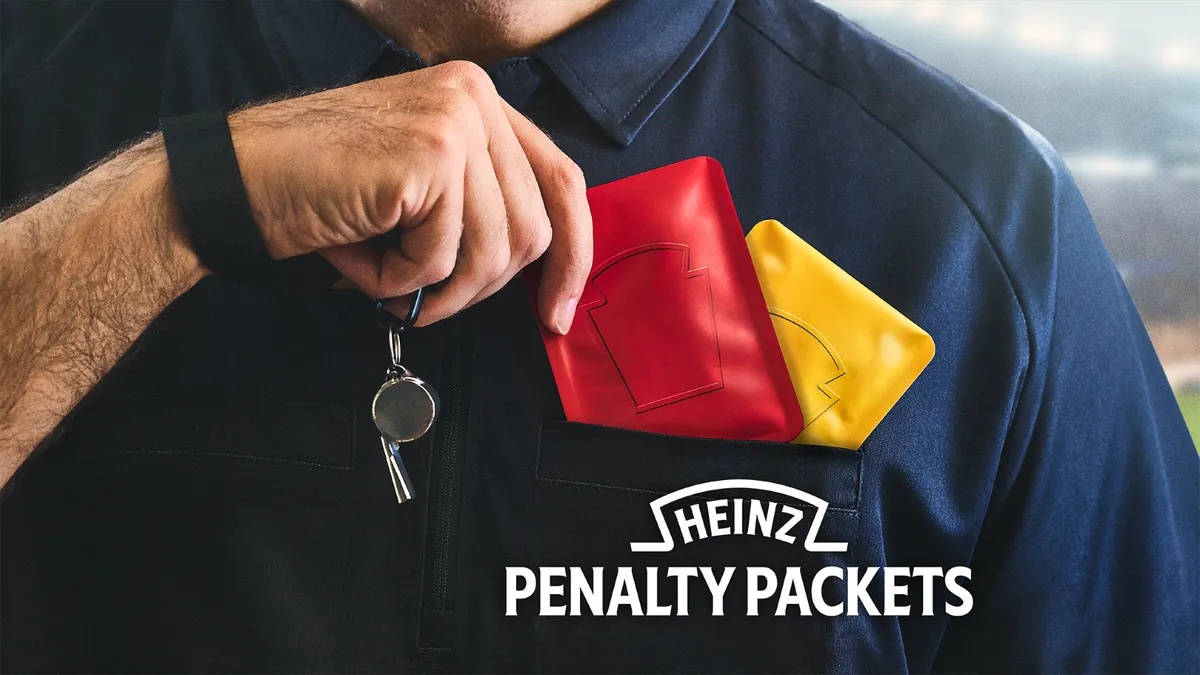
Table of contents
Jump to each section:
- What Heinz is doing with Penalty Packets
- Why the “card” concept works in World Cup culture
- How the campaign is designed for creators and UGC
- What this means for marketers
What Heinz is doing with Penalty Packets
The campaign centers on oversized packets that hold twice the amount of ketchup or mustard compared to standard packets. The packets are designed to resemble yellow and red penalty cards, matching both the visual language of soccer and the brand colors of Heinz condiments.
Heinz is also selling the packets in a limited-time box through a microsite. The $1.57 price point references the “57” associated with Heinz, and each box includes one red packet and one yellow packet, plus normal-sized packets positioned as “substitutions,” borrowing another familiar soccer term.
Creatively, this sits under Heinz’s “Irrational Love” brand platform, which it launched in 2023 to unify global creative strategy.
 Editorial Team
Why the “card” concept works in World Cup culture
The hook is not just that the packets are bigger. It is that they turn a universal “small packet” complaint into a gesture that feels native to the moment people are already watching.
This World Cup has seen a record number of red cards, with 13 issued as of July 5, compared with four total across the last two tournaments (2018 and 2022). That statistic matters because it makes the card imagery feel even more present in highlight clips, comment sections, and match debates. When fans are already talking about refereeing decisions, “pulling a card” is an easy reference to borrow.
Heinz also has a built-in storyline around not being an official sponsor. FIFA’s clean-stadium policy requires venues to cover or rename brands that are not tournament partners, which has led to viral visuals like Heinz bottles taped over. Heinz Canada leaned into that attention by calling itself the “unofficial stadium ketchup,” turning the restriction into part of the brand narrative instead of avoiding it.
How the campaign is designed for creators and UGC
The kickoff creative is a social video built around a simple, repeatable action: show an unsauced food a red or yellow Heinz packet like a referee would, then cover the meal with ketchup or mustard and post with #PenaltyPackets.
That format is doing a few things that tend to travel well on social:
- It gives people a clear visual prop (the “card”) and a one-step performance (the ref gesture).
- It creates a before-and-after moment that is easy to understand without sound.
- It turns “more sauce” into something people can demonstrate on camera, not just claim.
The campaign also includes creator content and user-generated content, and it was developed by Heinz’s in-house agency, The Kitchen. In terms of brand strategy, it builds on the same idea that has made Heinz’s broader creative effective in recent years: treating condiment preference like identity, not utility.
What this means for marketers
World Cup marketing is often a fight for attention against official sponsorships, highlight reels, and nonstop discourse. This idea works because it uses the tournament’s most recognizable symbol to make a product truth feel like a shared joke.
- Make the prop do the storytelling, not the caption
A red/yellow card is instantly legible. When the packaging itself communicates the reference, the content becomes easier to remix and harder to misunderstand. - Start from an everyday annoyance people already narrate online
“Not enough sauce” is a familiar complaint, but the smart move is framing it as something you can “call out” publicly, then fix on camera. - Design UGC around a repeatable gesture
The referee motion is a built-in template. That matters because people do not just share opinions during sports events, they reenact moments and perform their fandom. - Use cultural rules as creative fuel when you cannot be official
Clean-stadium coverups could have been a dead end. Treating it as part of the story (“unofficial stadium ketchup”) turns limitation into content.
Underneath the gimmick, the broader signal is that sports fandom is increasingly participatory: fans do not just watch, they comment, parody, reenact, and collect. Packaging that doubles as a memeable object gives brands a way to show up in that loop without feeling like they are interrupting it. For marketers, the lesson is less about “timing the tournament” and more about building a simple, culturally fluent behavior that people want to perform while the conversation is already loud.