The PLG-influencer flywheel: how Notion, Figma, and Canva turn users into growth engines
The PLG-influencer flywheel: how Notion, Figma, and Canva turn users into growth engines

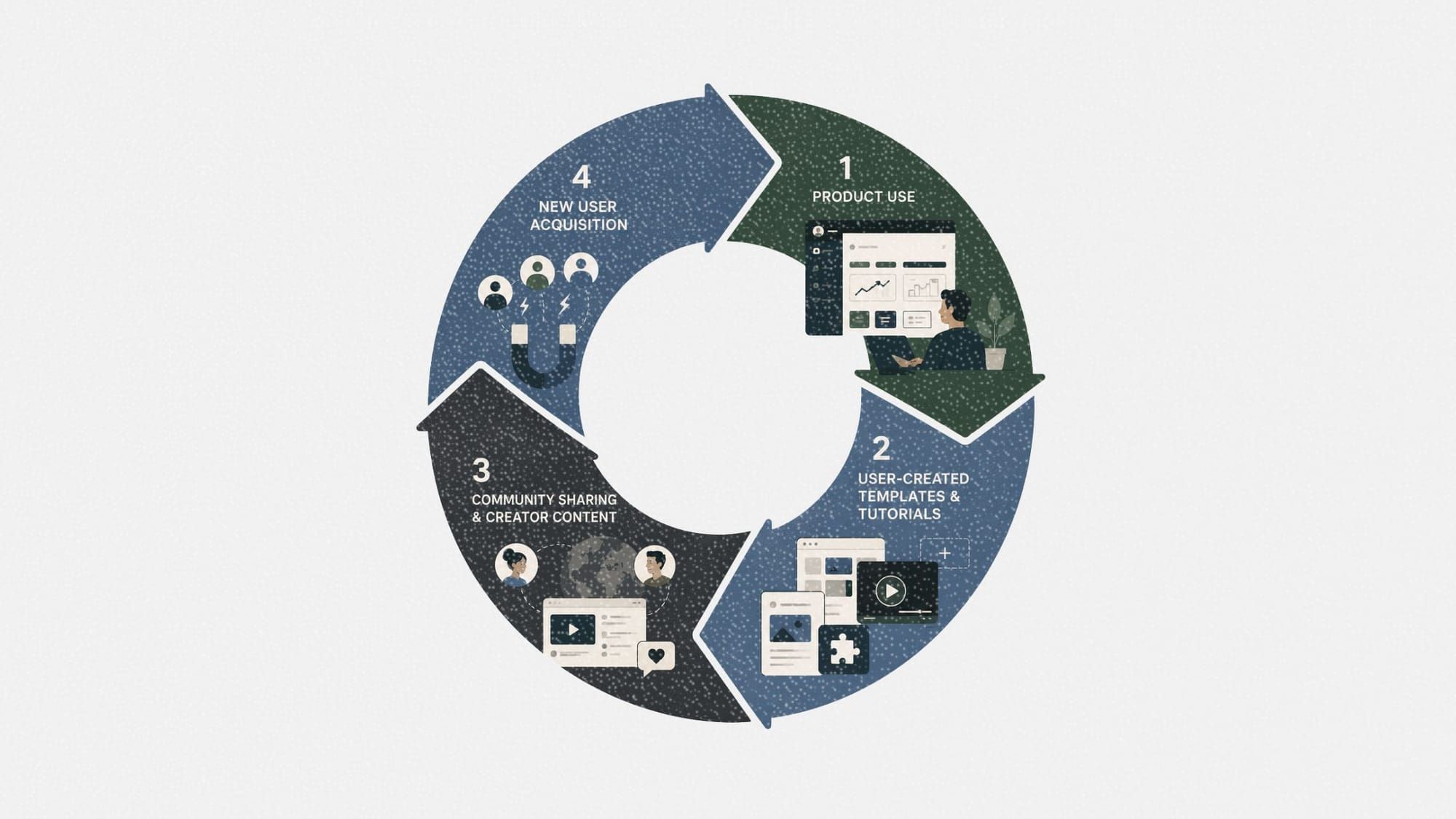
Notion, Figma, and Canva did not buy their way into hundreds of millions of users. They built a loop where the product itself produces the creators, and the creators bring in the next wave of users. Here is how that loop actually works, and what a B2B SaaS marketer without a household name can copy from it.
Table of contents
Jump to each section:
- What is the PLG-influencer flywheel
- How Notion built the flywheel from ambassadors to TikTok
- How Figma turned community templates into an acquisition loop
- How Canva scaled creators into a distribution moat
- How b2b saas marketers can build their own flywheel
- Where the plg-influencer flywheel breaks down
Most B2B SaaS marketers treat product-led growth and influencer marketing as separate budgets run by separate teams. Notion, Figma, and Canva built something different: a flywheel where users become creators, creators become acquisition channels, and acquisition brings in the next generation of users who repeat the cycle. None of it happened by accident, and none of it looked like a typical influencer program.
 Enricko Lukman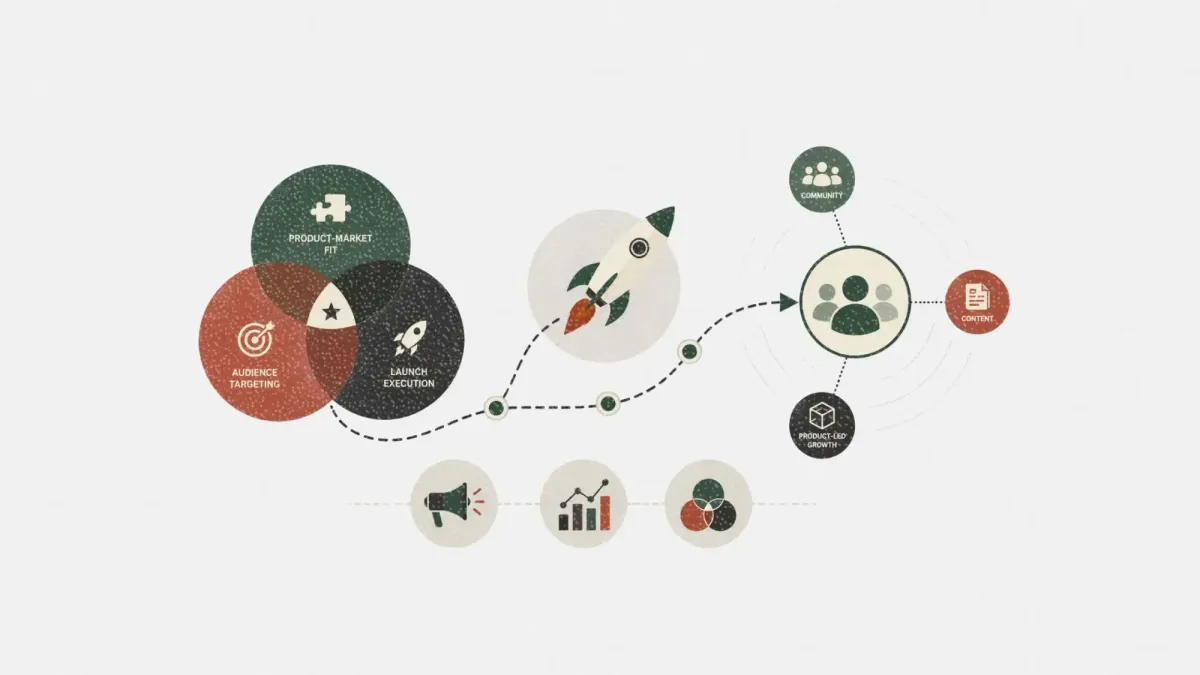
This matters most for B2B SaaS brands because the standard playbook of paying a creator to talk about a product for one campaign cycle runs into the same wall over and over: reach without retention. A single sponsored post can move signups for a week, but it rarely produces the compounding, self-reinforcing loop that turns a marketing line item into a durable growth channel. The three companies profiled here solved that problem in three different ways, and each solution maps to a different starting condition a B2B SaaS marketer might find themselves in.
What is the PLG-influencer flywheel
A PLG-influencer flywheel is a growth loop where the product itself generates the content and the creators, not a media budget. A user discovers real value, builds something shareable inside the product (a template, a file, a workspace), shares it natively with their audience, and that share becomes the acquisition asset. The company's job is to notice which users are doing this well, then give them tools, funding, or recognition to do more of it.
This is different from a standard B2B influencer program in one key way. A typical program pays a creator to talk about a product they may or may not use daily. A PLG-influencer flywheel starts from the opposite direction: the company finds people already obsessed with the product and builds infrastructure around their existing behavior. The content feels native because it is native. Nobody is reading from a brief.
How Notion built the flywheel from ambassadors to TikTok
Notion's flywheel started with one person: Ben Lang, an early user who bought Notion-related domains and built a template-sharing site purely because he loved the product. According to Ben Lang's own account on Medium, Notion hired him, and his first project became the Ambassador program, a global network that now spans more than 300 enthusiasts who run local Notion communities, from "Notion Korea" on Facebook to "Notion for Solopreneurs" on Twitter. Notion intentionally kept a light touch here, offering grants, early feature access, and swag rather than top-down control.
The second layer came from Notion's template gallery, which grew from a handful of internally built examples into tens of thousands of community-submitted templates. Each template functions as a mini onboarding tool: a new user does not face Notion's blank-page problem because someone else already built the workflow they need. The gallery also compounds as an SEO asset, since every template gets its own indexed page.
The third layer is where influencer marketing formally entered. Notion hired Lexie Barnhorn, previously the influencer marketing lead at skincare brand Curology, specifically because B2B companies were ignoring the channel. According to Rachel Karten's interview with Notion's Head of Influencer, the hashtag #Notion passed 1 billion views on TikTok, largely through creator partnerships rather than paid ads. One of her highest-converting placements was not a video creator at all. It was a single mention inside a founder-focused newsletter, which out-converted more than 150 other influencer partnerships combined.
Notion's most recent proof point is the Notion Faces campaign, launched in January 2026. The company took portraits that had been an internal employee perk for years and opened them to the public, working with more than 50 LinkedIn creators to launch on the same day. Creator Match's behind-the-scenes account puts the result at over 900 organic, unpaid LinkedIn posts from people who wanted in on the trend, run by a two-person influencer marketing team. Notion's community team also learned early on that full-length videos featuring a creator who genuinely used the product outperformed short paid ad reads, even at a higher production cost.
Figma's own go-to-market team chose community trust over feature competition when it launched against Adobe in 2015, betting that if designers adopted Figma and shared files with colleagues, the product would spread horizontally through organizations without needing enterprise sales. That single decision is the same mechanic Figma later formalized into its community program.
How Figma turned community templates into an acquisition loop
Figma's flywheel begins with the product's core mechanic: because Figma is browser-based, sharing a file is as simple as sharing a link. According to Community Inc's deep-dive on Figma's growth, a large share of Figma's inbound signups come from people who were invited into a file by a colleague, never having searched for a design tool themselves.
Figma layered a formal creator economy on top of that native sharing behavior. Its affiliate program, run through PartnerStack, pays creators and advocates a flat fee for each new qualifying signup plus a share of the first payment on a paid plan. The Figma Community marketplace lets designers publish and sell templates, plugins, and widgets directly, with Figma handling payment processing and taking a 15 percent transaction fee. Designer Advocates support this ecosystem regionally, and the Creator Fund, launched in March 2023, grants funding to developers building high-quality plugins and assets.
The templates serve a dual purpose that B2B SaaS marketers often miss. A user who arrives through a specific template already has higher intent than someone landing on a generic homepage, which lowers cost per acquisition. At the same time, every published template is its own indexed web page, feeding organic search traffic back into the same loop that produces the next wave of creators.
Figma also built a dedicated education arm, providing free plans, classroom templates, and community access to students and instructors, then funding student hackathons to keep the pipeline of future advocates full. The lesson for B2B teams is that a creator flywheel does not require an influencer budget at all. It requires product mechanics that make sharing the path of least resistance, then formal programs that reward the people already sharing.
How Canva scaled creators into a distribution moat
According to TechCrunch, Canva ended 2025 with more than 265 million monthly active users and over 31 million paid users, pushing its annual recurring revenue to US$4 billion. The company's B2B segment, covering organizations with more than 25 seats, grew 100 percent year over year to reach US$500 million in ARR. That B2B acceleration matters for SaaS marketers specifically, because it shows the flywheel converting well beyond the consumer users who first made Canva popular.
Canva runs two distinct creator tracks that most B2B marketers conflate. The Canva Creators program lets skilled designers, photographers, and illustrators publish and sell templates and elements directly to Canva's user base, earning royalties on every use. Separately, the Canvassador Program (Canva's rebranded affiliate structure) is reserved for individual content creators who make tutorials, courses, and workshops that teach others how to use Canva, and only Canvassadors are eligible for affiliate commissions.
That distinction is deliberate. Canva is not simply paying people to mention the product. It is investing in the specific behavior, teaching content, that lowers the barrier for the next cohort of free users to become power users, and eventually paying customers. The company also runs a non-monetary Empower Canvassador track aimed at educators and nonprofit leaders, extending the same flywheel logic into communities where a direct affiliate payout would be the wrong incentive.
For B2B SaaS brands watching Canva's enterprise growth, the operative insight is that a two-sided creator economy (people who build inside the product and people who teach the product) can run in parallel without competing for the same budget line.
"The reason the PLG-influencer flywheel works for Notion, Figma, and Canva is that the creators were never treated as a media placement," says Dinda Anandita, Account Director at Content Collision, a content-led comms agency. "Each company found people who were already building their identity around the product, then removed the friction between that enthusiasm and reaching a bigger audience. A B2B SaaS brand chasing this playbook needs to ask who is already doing that unpaid, not who they can pay to start."
How b2b saas marketers can build their own flywheel
Most B2B SaaS companies do not have Notion's TikTok reach or Canva's 265 million users, but the underlying mechanics scale down. The starting point is not a media budget. It is identifying the handful of users already creating unprompted content about the product.
- Audit before you recruit. Search your own product name alongside "template," "workflow," or "tutorial" across YouTube, LinkedIn, and TikTok before building any formal program. Notion's ambassador program began because Ben Lang was already doing the work for free.
- Separate the two creator types. Treat the people who build inside your product (templates, plugins, integrations) differently from the people who teach your product externally. Figma and Canva both run parallel tracks rather than one generic influencer roster, which keeps incentives clean on both sides.
- Make the shareable artifact the acquisition asset. A template, a public workspace link, or a duplicated file converts better than a generic ad because the person who receives it already sees the product in use. Build the product feature that makes sharing effortless before investing in the influencer layer.
- Fund the low end before the high end. Notion's creator strategy started with grants, swag, and early access rather than large sponsorship checks, and only added a dedicated head of influencer marketing once the organic signal was already strong.
- Track the earliest leading indicator, not signups. A B2B PLG company should watch behaviors correlated with paid conversion (a second invited user, a second file created within a day) rather than raw signup volume, which can rise while paid conversion quietly falls.
- Give the program a home before it needs one. Notion deliberately kept its community and influencer functions inside a brand organization rather than folding them into a revenue-focused marketing team, precisely because the two functions need different levels of control. A B2B SaaS marketer building this from scratch should decide early who owns the relationship with unpaid advocates versus paid creators, rather than letting one team default into both.
The connective tissue across all three examples is that the creator economy infrastructure came after product-market fit was already visible in organic user behavior, not before it. A B2B SaaS marketer trying to reverse-engineer this playbook without that organic signal is buying reach without the trust that made the original flywheel work.
That does not mean a smaller SaaS company should wait indefinitely. It means the first channel to build is not the ambassador program or the affiliate structure. It is a habit of watching where users are already talking about the product without being asked, and treating that surface as the source material for everything that follows.
 Ariana Sorensen
Where the plg-influencer flywheel breaks down
The flywheel model has real limits that B2B marketers should weigh before committing budget to it. It depends on a product with a genuinely shareable artifact, something a B2C content tool or a collaborative workspace produces naturally but a narrow, single-user piece of software may not. Forcing a template gallery or ambassador program onto a product without that native shareability tends to produce thin, low-quality content rather than an organic loop.
The model also takes years to compound, which sits uneasily with quarterly marketing targets. Notion's community and template efforts predate its influencer hires by years, and Figma's Creator Fund only formalized in 2023, long after the underlying sharing behavior existed. Teams under pressure to show quarter-one results from a creator program are often measuring the wrong stage of a loop that was never designed to move that fast.
Finally, a flywheel built on unpaid enthusiasm can create disclosure and compliance gaps that a paid influencer contract would have caught automatically. Ambassadors, superusers, and template creators frequently mention a brand without a clear commercial relationship, which sits in a grayer zone under FTC endorsement rules than a standard sponsored post. B2B SaaS legal and marketing teams should agree on disclosure guidance for community-driven promotion before scaling a program, not after a creator's post draws regulatory attention.
For a B2B SaaS marketer without Notion or Canva's user base, the flywheel is still worth building in miniature: find the handful of people already building around the product, and remove the friction between their enthusiasm and a bigger audience, before spending a dollar on reach that has not been earned yet.