
Skyword survey reveals AI trust gap as consumers turn to third-party validation
Skyword's latest survey reveals why visibility in AI search is no longer enough to earn consumer trust.

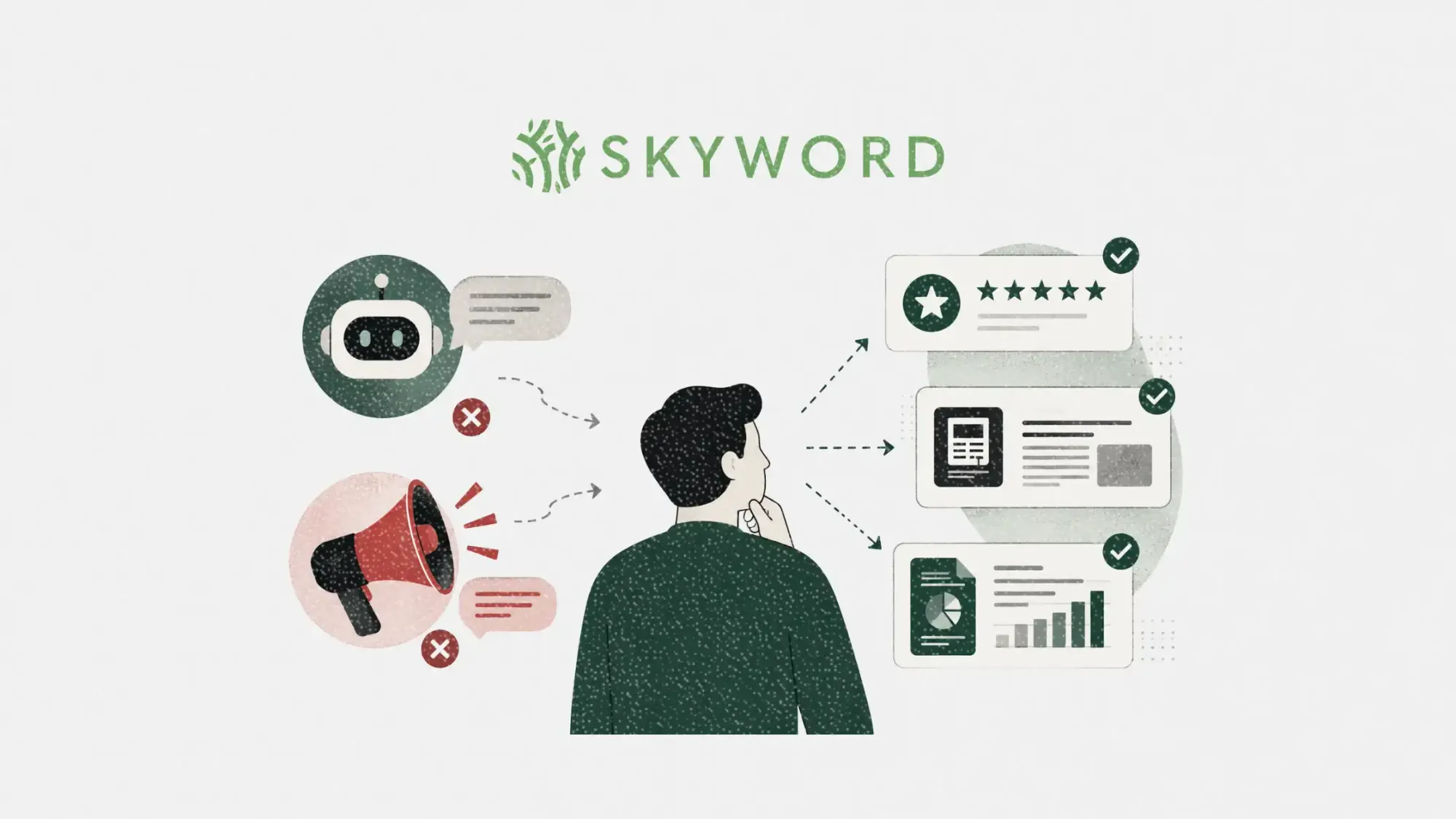
As AI becomes a primary research tool for consumers, new survey data from Skyword suggests brands are facing an emerging credibility challenge. When AI-generated information conflicts with a brand's own messaging, consumers are increasingly unwilling to accept either source at face value.
The survey of 1,000 U.S. consumers found that only 29% trust the brand when AI and brand messaging disagree, while just 12% trust the AI-generated answer. Instead, the majority of respondents, 54%, seek validation from third-party sources.
The findings highlight a growing shift in how authority is established in the AI search era and why marketers may need to rethink how they build trust beyond owned channels.
Table of contents
Jump to each section:
- What did Skyword's survey reveal about AI and brand trust?
- Why consumers are looking beyond brands for validation
- What marketers should know about authority in the AI search era
- The bigger challenge with AI-generated content and trust
- What this means for marketers moving forward
 Enricko Lukman
What did Skyword's survey reveal about AI and brand trust?
Skyword's latest research paints a complicated picture of consumer trust in an AI-driven information environment.
According to the survey, when AI-generated information conflicts with a brand's own messaging:
- 54% of consumers seek third-party validation
- 29% trust the brand's information
- 12% trust the AI-generated answer
The findings suggest that neither brands nor AI systems automatically hold authority when conflicting information appears. Instead, consumers increasingly rely on external sources to determine which version is accurate.
The survey also found that AI-generated information is already influencing purchasing decisions:
- 17% of consumers have switched brands because of AI-generated information
- 19% have avoided a purchase based on AI-generated information
- 47% have taken at least one significant action based on information provided by an AI tool
- 46% of full-time employed Americans have made a major purchase or important decision primarily based on AI-generated recommendations
According to Skyword ceo Andrew Wheeler, the issue extends beyond visibility in AI search results.
"AI search is often framed as a visibility issue, but the larger challenge is authority," Wheeler said.
Why consumers are looking beyond brands for validation
For years, brand-owned channels served as the primary source of information about products, services, and company positioning. The survey suggests that dynamic is changing. Consumers now encounter information about brands across AI assistants, search engines, review platforms, publishers, analyst reports, and social conversations. As a result, authority is becoming increasingly distributed.
The data indicates that consumers do not automatically trust AI-generated answers. In fact, 55% cited inaccurate information as their biggest concern regarding AI-generated brand and product information.
This creates a new reality for marketers. Even if a company publishes accurate information, consumers may verify those claims elsewhere before making a decision.
The findings align with broader industry discussions around AI discoverability and authority, where being visible is no longer enough. Brands increasingly need to be cited, referenced, and validated across multiple trusted sources rather than relying solely on their own channels.
 Patrecia Meliana
What marketers should know about authority in the AI search era
The survey offers several practical lessons for marketing and communications teams.
1. Authority matters more than visibility
Appearing in AI-generated answers is valuable, but it does not guarantee credibility. Brands need consistent narratives across earned media, analyst coverage, review platforms, and expert content.
2. PR becomes part of AI strategy
As consumers seek external validation, third-party coverage may play a larger role in shaping how brands are perceived. Industry publications, analysts, and expert commentary become important credibility signals both for consumers and AI systems.
3. Monitor AI-generated brand narratives
Marketers should regularly evaluate how AI systems describe their company, products, and competitors. Inaccurate summaries can influence purchasing behavior long before prospects visit a company website.
4. Invest in citation-worthy content
Brands should focus on publishing original research, expert insights, customer evidence, and thought leadership that can be referenced by both journalists and AI systems. Content that demonstrates expertise is more likely to become part of authoritative industry conversations.
The bigger challenge with AI-generated content and trust
The survey also highlights a potential downside to the growing use of AI-generated content.
Thirty percent of respondents said they would be less likely to engage with or purchase from a company if they believed its content was AI-generated. Meanwhile, 86% believe companies should disclose when content is AI-generated.
For marketers, this creates a balancing act.
AI can improve efficiency and scale content production, but overreliance on generic AI-generated material may undermine credibility if audiences perceive it as low quality, inaccurate, or lacking expertise.
The findings reinforce a broader industry trend: as AI-generated content becomes more common, human expertise, original thinking, and transparency may become stronger differentiators.
What this means for marketers moving forward
Skyword's survey highlights a significant shift in how trust is formed in the AI era.
Consumers are increasingly using AI to research products and evaluate brands, but they are not blindly accepting what AI systems tell them. Instead, they are cross-checking information across multiple sources before making decisions.
For marketers, that means authority can no longer be built exclusively through owned media. Trust now depends on how consistently a brand appears across AI systems, media coverage, analyst commentary, review platforms, and other third-party sources.
As AI becomes a larger part of the customer journey, the brands that win may not be the ones that generate the most content. They may be the ones that build the strongest ecosystem of credibility around their content.