
What content works in AI search today (and what doesn’t)
Search has shifted from clicks to citations, and content strategy needs to follow

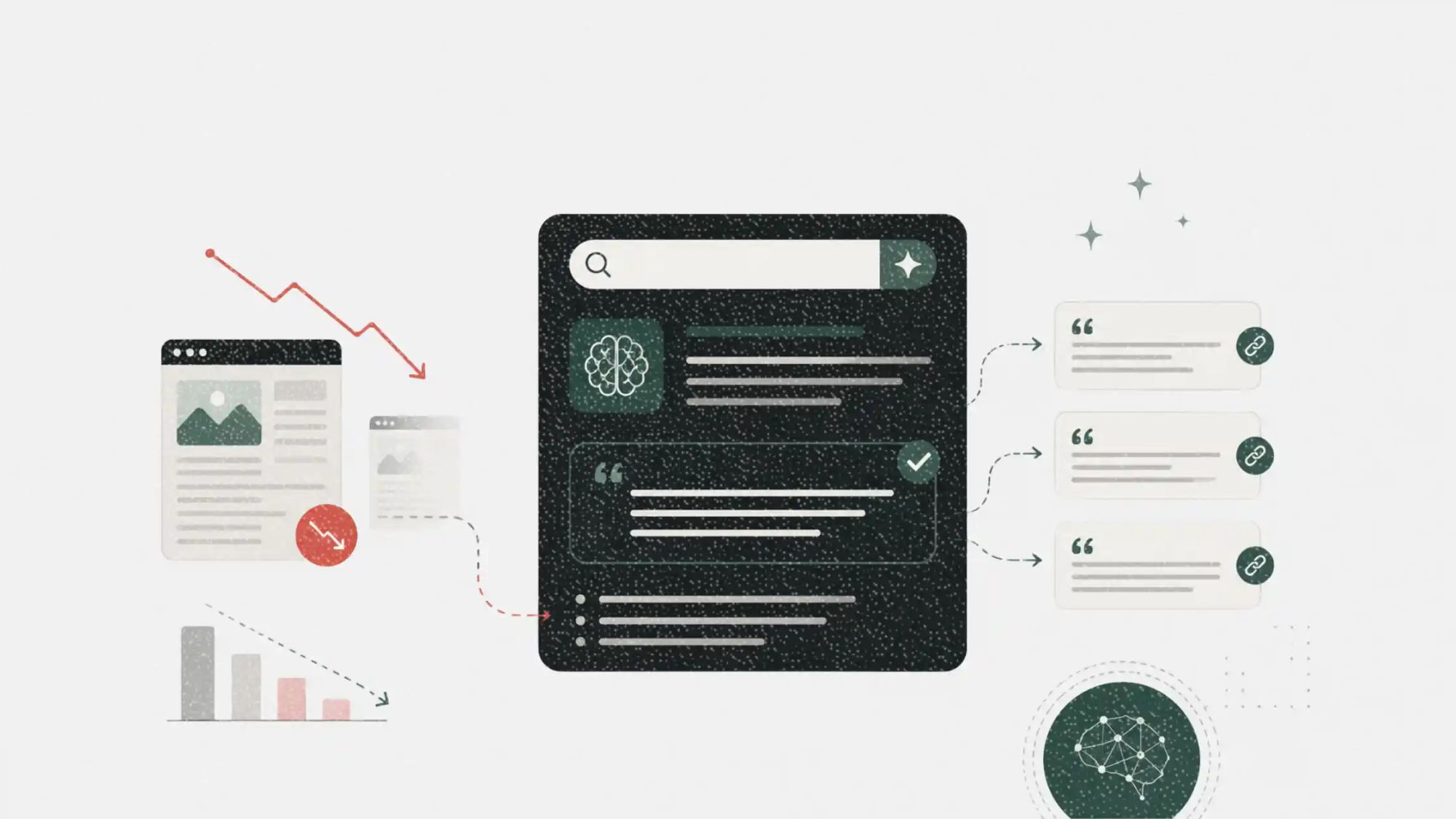
Traffic is dropping across the board, and not because teams stopped doing SEO “right.”
Rankings can hold steady while clicks quietly disappear. AI Overviews and answer engines are reshaping how users interact with search, and the impact is already measurable.
This article explores what content still works in the age of AI search, and more importantly, what marketers should stop doing. Because content is not dead, but the rules that determine its value have fundamentally changed.
Table of contents
Jump to each section:
- Why informational blog posts are losing leverage
- Why you need citation-worthy content, not just rankable content
- What content should you still create in the age of AI search?
- Formats that perform best in AI search
- What marketers should know
 Patrecia Meliana
Why informational blog posts are losing leverage
Traditional SEO content is being quietly absorbed into AI answers. “What is,” “how to,” and basic explainers are no longer guaranteed traffic drivers, even if they rank well.
AI Overviews appear heavily on informational queries, with some estimates suggesting up to 91% of triggers come from this intent type. The result is simple. Users get answers directly on the results page without clicking through.
This changes the role of informational content. It is no longer a destination. It is a source.
For marketers, this means basic educational content is increasingly becoming training data rather than traffic generators. Publishing more of it does not translate into more visibility.
What marketers should do:
- Reduce production of generic informational articles
- Keep only content that adds original insight, perspective, or framing
- Treat informational pages as support assets, not primary growth drivers
Why you need citation-worthy content, not just rankable content
Ranking number one no longer guarantees visibility. AI systems do not simply pick the top result. They synthesize answers from multiple sources.
Search has shifted from a linear model to a layered one. Instead of “rank, click, convert,” it now operates as “retrieve, summarize, mention.”
That last step matters most. Being cited inside an AI-generated answer can drive visibility even without a click.
Data shows that brands cited in AI answers can see a 35% higher organic clicks compared to those that are not included. Visibility is no longer about position. It is about inclusion.
What marketers should do:
- Add statistics that can be easily extracted and quoted
- Include expert quotes and strong definitions
- Use structured formats like FAQs, lists, and frameworks
- Write in a way that is easy for AI systems to parse and reuse
Patrecia Meliana
What content should you still create in the age of AI search?
Not all content is losing value. It is being redistributed.
AI is filtering out generic information and amplifying content that is structured, experience-driven, and entity-rich. The shift is not about producing less content. It is about producing the right types.
Here are the formats that still work and why they matter now.
1. Experience-led content
AI can summarize knowledge, but it cannot replicate execution.
That makes firsthand experience one of the most defensible content advantages today. Platforms are increasingly prioritizing signals tied to real-world expertise, aligning with the broader shift toward experience-driven credibility.
What this looks like:
- Case studies with real metrics
- Campaign breakdowns with context
- Honest insights on what worked and what failed
Why it works: It introduces original information into the ecosystem, something AI cannot easily generate or replace.
2. Structured listicles with perspective
Listicles are not dead. They are becoming inputs for AI-generated answers.
AI systems rely heavily on structured formats to compile recommendations. Many “best tools” or “top examples” queries are now answered directly using list-based content.
What this looks like:
- “Best campaigns in B2B SaaS with breakdowns”
- “Top AI tools for PR teams ranked by use case”
- Opinionated lists with clear selection criteria
Why it works: Structured content is easier for AI to extract, summarize, and cite. The more specific and opinionated the list, the harder it is to replicate.
3. Entity-driven content
Search is shifting from keywords to entities.
AI retrieval systems prioritize relationships between brands, topics, and concepts. Visibility depends on whether your brand is recognized within a category, not just whether a page ranks.
What this looks like:
- Content clusters around a core topic
- Deep dives into specific brands, tools, or strategies
- Internal linking that reinforces relationships
Why it works: It helps AI systems understand where your brand fits, increasing the likelihood of being retrieved and cited.
4. Multi-platform content
Your website is no longer the only source of truth.
AI systems pull from a wide range of platforms, including LinkedIn, YouTube, and Reddit. Content that exists only on your blog is less likely to dominate visibility.
What this looks like:
- Repurposed blog posts into LinkedIn insights
- Short-form videos explaining key ideas
- Participation in community discussions
Why it works: It increases your surface area across the sources AI systems use for retrieval and synthesis.
5. High-intent, decision-stage content
While informational traffic is declining, high-intent content still drives action.
Users searching with clear intent are more likely to click, compare, and convert. These queries are less affected by zero-click behavior.
What this looks like:
- Comparison pages
- Pricing breakdowns
- “Best for X” or “X vs Y” content
Why it works: It aligns with decision-making, not just information gathering, making it harder for AI to fully replace the need to click.
Formats that perform best in AI search
Some formats are naturally aligned with how AI systems retrieve and present information.
Winning formats:
- FAQs
- Definitions paired with statistics
- Structured listicles
- Case studies
- Opinionated analysis
Losing formats:
- Generic blog posts
- Thin informational pages
- Keyword-stuffed articles
The difference is not subtle. It reflects a shift from volume-based content strategies to value-based ones.
What marketers should know
AI search is not removing content. It is filtering it. The content that gets surfaced now follows a different set of rules, where usefulness, structure, and originality matter more than volume.
- Publishing more content is no longer a competitive advantage
AI systems are designed to compress and summarize information, which reduces the visibility of repetitive or generic content. Producing more articles does not increase reach if they do not add new value.
- Visibility depends on being cited, not just ranked
Even high-ranking pages can lose traffic if they are not included in AI-generated answers. Visibility now depends on whether your content is selected, extracted, and referenced within those summaries.
- Experience and originality are now defensible assets
AI can replicate common knowledge, but it cannot easily reproduce firsthand insights. Content built on real campaigns, data, and unique perspectives stands out and is more likely to be surfaced.
- Distribution across platforms is part of SEO strategy
AI pulls information from multiple sources, including social platforms and communities. Limiting content to your website reduces your chances of being discovered and cited.
- Winning content gets used, not just published
The goal is no longer just to rank or attract clicks. Content needs to be structured and valuable enough to be reused by AI systems and remembered by audiences. If it is not being used, it is being ignored.