TikTok influencer marketing strategy: The 2026 B2B operator's guide
Why B2B brands can't afford to ignore TikTok in 2026 (and how to use it right)

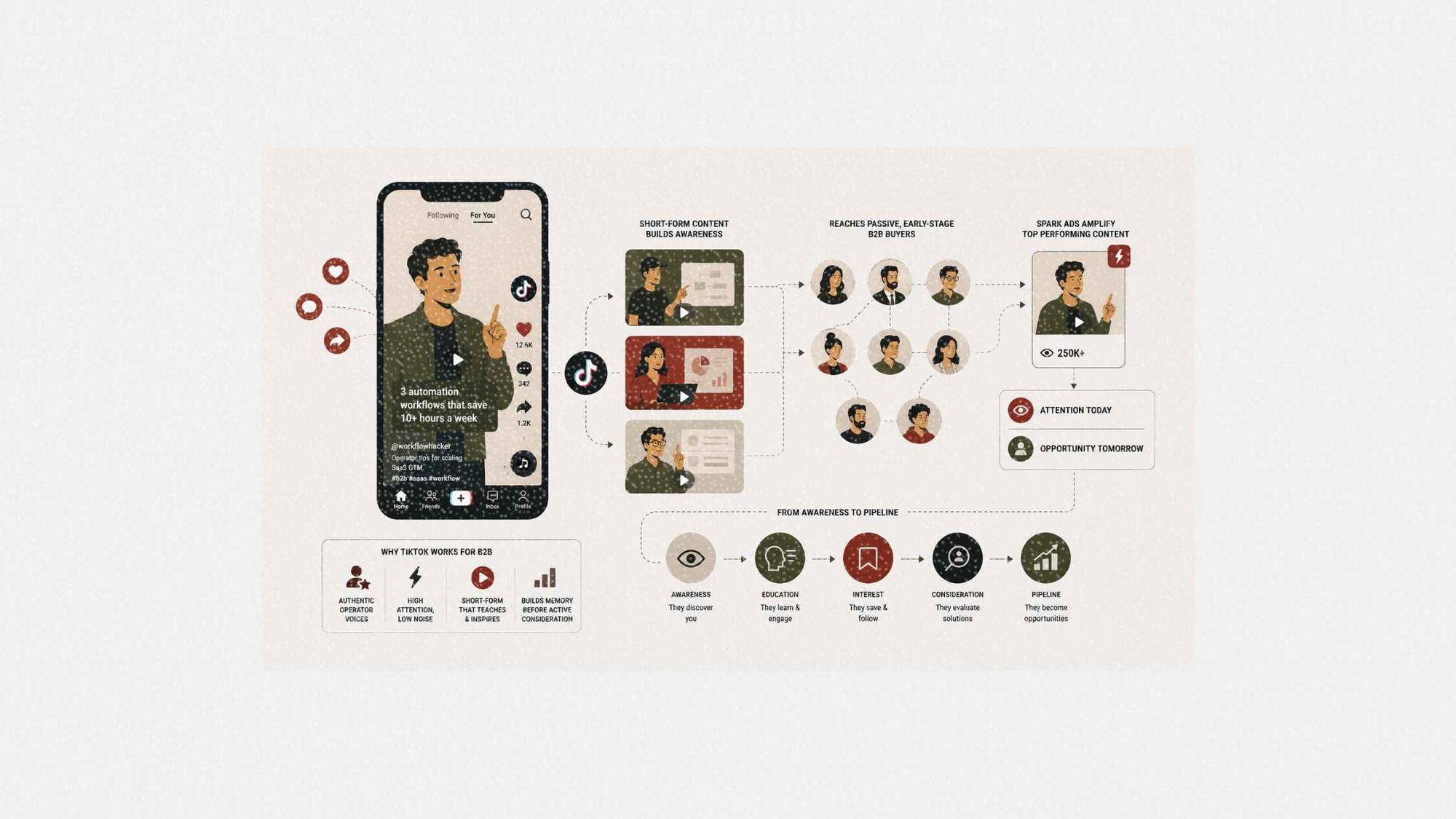
Most B2B marketers still treat TikTok as someone else's problem. A platform for Gen Z dances, beauty hauls, and consumer flash sales. Safe to ignore if you sell software, professional services, or complex enterprise solutions. That assumption is costing brands real pipeline.
According to HubSpot's State of Marketing 2025, only 8% of B2B marketers planned to invest in TikTok in 2025, even as the platform recorded 644 million downloads that same year and surpassed every major social network for average daily time spent per user. While B2B budgets concentrate on LinkedIn, the decision-makers worth reaching are spending hours on TikTok every week, watching sales strategy explainers, SaaS workflow teardowns, and "day in the life" content from operators they trust. A small but growing group of B2B marketers has figured out how to show up there, and the results are hard to ignore.
This guide is for the marketers who want to act before the platform gets crowded.
Table of contents
Jump to each section:
- Why most B2B brands are skipping TikTok (and why the calculus is shifting)
- TikTok platform mechanics B2B marketers need to understand
- Content formats that work for B2B influencer campaigns on TikTok
- How to find and vet B2B-relevant creators on TikTok
- Three B2B brands proving TikTok works
- Measuring TikTok influencer ROI for B2B campaigns
- Where TikTok fits in your B2B influencer stack
Why most B2B brands are skipping TikTok (and why the calculus is shifting)
The objection is reasonable on its face. TikTok skews younger, B2B buyers are professionals, and the platform's creative demands feel disconnected from how B2B brands traditionally communicate. The conclusion that follows from this, that TikTok is irrelevant for B2B marketing, keeps proving itself wrong.
The decision-makers who authorize six-figure software contracts do not exist only on LinkedIn. They are on TikTok with their guard down, consuming content they chose, from people they like. The context is different from a professional network, and for brand-building purposes, that difference is actually useful. Audiences on TikTok are not in defensive scroll mode the way they often are on a platform full of job alerts and vendor pitches. A well-placed creator video can introduce a brand to a VP of Sales or a Head of Operations in a moment of genuine attention.
The generational shift in buyer demographics amplifies this. The cohort of buyers who grew up as digital natives is now moving into senior decision-making roles. These are not executives who need to be introduced to TikTok. They already use it.
"B2B brands that write off TikTok as a consumer channel are making the same mistake they made with LinkedIn ten years ago. The platform is changing, and the buyers are already there. The question is whether you want to be the brand that figured it out early or the one that arrives late," says Dinda Anandita, Account Director at Content Collision.
The other driver is creative efficiency. TikTok's CPM rates remain among the most competitive in social media, and the creator ecosystem for B2B content, while smaller than Instagram's, is less saturated and less expensive to work with. A micro-creator in the sales tech or HR software space with 30,000 followers on TikTok costs a fraction of an equivalent LinkedIn creator and delivers engagement rates that are genuinely hard to match on any other platform.
According to Socialinsider data published by Sprout Social, TikTok has the highest average engagement rate of any major social network at 3.73%, putting it well ahead of platforms where most B2B budgets currently sit.
The brands that move now will benefit from building creator relationships, platform data, and audience familiarity before their competitors realize the opportunity is real.
TikTok platform mechanics B2B marketers need to understand
TikTok's algorithm is distribution-first in a way that no other major platform fully replicates. Content is served based on signals of watch behavior, not follower graphs. A video from a creator with 5,000 followers can reach 500,000 people if early engagement signals are strong enough. The inverse is also true: a brand with millions of followers will get minimal reach if the content does not hold attention.
For B2B marketers, this has two practical implications. First, the creator's audience size matters less than their content's ability to hold watch time on a given topic. A creator who consistently posts about CRM workflow tips and earns strong completion rates on those videos has a distribution advantage in that niche regardless of their follower count. Second, follower-based metrics are a poor proxy for platform influence on TikTok. Focus on average views per post and completion rate when evaluating B2B creators.
One structural change from 2025 is worth flagging. TikTok replaced its Creator Marketplace with TikTok One, its unified creative platform, shutting down the Marketplace for new campaigns as of April 2025. TikTok One consolidates brand-creator collaboration tools, creative inspiration resources, trend research, and content guidance into a single interface. B2B marketers who used the Creator Marketplace need to migrate their workflows to TikTok One for any new campaigns.
The platform's ad infrastructure for B2B campaigns centers on two formats worth understanding. Spark Ads allow brands to boost organic creator content natively within the feed, preserving the authentic look of a creator post while adding targeting and budget control. This is the primary paid amplification format for influencer campaigns. TopView and In-Feed Ads are relevant for brand-owned content but are less commonly used in creator partnership campaigns.
TikTok's targeting for B2B is weaker on job title and company firmographics compared to LinkedIn. The practical workaround is using first-party audience lists for retargeting, layering interest and behavioral signals for cold audiences, and treating TikTok as a demand creation and familiarity-building channel rather than a precision account-based marketing tool.
Content formats that work for B2B influencer campaigns on TikTok
B2B content on TikTok does not look like a B2B webinar. The formats that consistently earn watch time are native to the platform's culture: short, specific, useful or entertaining, and filmed in a way that feels personal rather than produced.
Problem-framing videos. A creator names a specific, painful problem their audience faces ("Why your sales team isn't following up on MQL leads") and delivers a 45 to 60 second explanation of what causes it and what a better approach looks like. These work because the problem hook earns immediate scroll-stopping attention from anyone who recognizes themselves in it. For B2B brands, the brief is to seed a problem the brand solves without scripting an ad.
Workflow teardowns. The creator shares their actual setup or process for something their audience wants to do. "How I built our content calendar in Notion" or "The three Salesforce reports I check every Monday" are typical examples. These are platform-native and genuinely useful, which drives shares among professional communities.
Expectations vs. reality. The split-screen or dialogue format showing the gap between how something is supposed to work and how it actually does is a reliable engagement format for B2B. It lets brands build relatability without being overtly promotional.
Trend-jacking with a professional lens. Creators who can apply a viral audio or format to a B2B scenario, where the punchline is relevant to the audience's professional life, earn outsized reach because TikTok's algorithm rewards participation in trending formats.
For all of these, the brief from the brand should specify the problem to seed or the outcome to associate with the brand, the single message to land, and reference examples of the creator's own best-performing content. Scripts kill TikTok performance. The more the creator is permitted to translate the brief into their own voice, the better the content performs.
How to find and vet B2B-relevant creators on TikTok
TikTok's creator discovery for B2B requires more manual legwork than LinkedIn because the platform does not organize creators by professional identity. The most reliable approaches combine platform-native search with third-party tools.
Keyword and hashtag search within TikTok. Use the platform's search bar with job-function or industry terms ("sales ops," "B2B marketing," "SaaS founder," "RevOps") and filter by creators. Sort by engagement and watch time signals by looking at individual video performance, not just follower counts. The creators worth finding are producing content your ICP is already watching.
TikTok One search. The TikTok One platform (the successor to Creator Marketplace) includes creator search with filters for category, audience demographics, average views, and engagement rates. For B2B niches, category filters are broad, so keyword-based search within the platform will still be the main lever.
Discovery platforms with TikTok coverage. Tools including Modash, IMAI, and Upfluence index TikTok creators and allow filtering by audience demographics and engagement benchmarks. These are especially useful for vetting creators identified through manual search, particularly when TikTok One's category filters prove too broad for B2B niches.
Cross-platform identification. Many of the operators and practitioners who post on LinkedIn also maintain TikTok accounts. Checking whether LinkedIn creators you already follow are active on TikTok is one of the most efficient discovery methods for B2B.
When vetting creators for B2B campaigns, the checklist should include: average views per post (not total followers), audience geography and age demographic match to your ICP, comment quality (are the commenters professionals engaging with the content or generic reactions), and content consistency in the relevant topic area. Audience authenticity verification using a tool such as HypeAuditor or GRIN before contracting is standard practice.
A note on rate expectations. B2B TikTok creators are not yet priced at LinkedIn creator rates, which creates favorable economics for early movers. Micro-creators (10,000 to 100,000 followers) posting in B2B niches typically sit in the US$200 to US$1,500 range per sponsored video, a range that reflects both smaller audience sizes and the relative newness of B2B TikTok as a category.
As with any creator engagement, rate negotiation should factor in content usage rights and Spark Ad authorization, both of which carry additive value for paid amplification.
Three B2B brands proving TikTok works
Adobe. Adobe's TikTok presence combines short creative tutorials, product feature explainers, and behind-the-scenes clips from their design community. The approach is creator-informed rather than creator-led, with the brand posting content built around the same formats that drive engagement among Adobe's creative professional audience.
As documented by Sotrender, Adobe accumulated over three million likes on TikTok through this consistent, tutorial-forward strategy. The lesson for B2B operators: usefulness at a micro level (a 30-second Photoshop trick, a color theory explainer) builds brand affinity at a macro level faster than awareness campaigns do.
Zapier. Automation tools live or die by whether their community understands what the product actually does, and Zapier has turned TikTok into one of its most effective education channels. As documented by We Are Sculpt, Zapier's short-form content focuses entirely on workflows: existing processes made easier with Zapier, and new possibilities the tool unlocks.
The approach works because each video is a standalone demonstration of product value for a professional audience that already experiences the problem being solved. For B2B brands with a product that can be shown rather than described, this format is replicable across almost any SaaS category.
Gong. The revenue intelligence platform found a TikTok formula that translates directly to its ICP. Gong uses the "expectations vs. reality" format to highlight the gap between how sales reps think calls will go and how they actually unfold. As noted by Viacon's analysis of B2B TikTok, the humor is subtle and highly relatable to anyone who has spent time in a sales organization.
It seeds Gong's product value proposition (capturing and analyzing what actually happens in sales conversations) without stating it explicitly. For B2B brands selling to practitioners, this format is replicable across almost any industry.
The pattern across all three: the content solves or reflects something real for a professional audience, is delivered in a platform-native format rather than repurposed from another channel, and is consistent enough to build accumulative familiarity over time.
Measuring TikTok influencer ROI for B2B campaigns
TikTok attribution for B2B is genuinely harder than for B2C because the platform sits primarily at the top of a long sales funnel. The metrics that matter for B2B TikTok campaigns fall into three layers.
Awareness and reach metrics. Views, unique reach, and completion rate are the baseline. For B2B campaigns, average view duration is more revealing than raw view counts because it indicates whether the content is actually landing with the audience or being skipped. A 60-second video with a 45-second average view duration is outperforming a 60-second video with 15 seconds in almost every meaningful way, even if the total view counts are identical.
Engagement and signal quality. Comments are the most valuable engagement signal for B2B TikTok. A video earning professional-context comments ("This is exactly what we're dealing with in our sales process") is generating warm brand association with the right audience. Saves and shares are secondary signals worth tracking; they indicate utility value.
Pipeline-connected measurement. The honest challenge with TikTok B2B attribution is that the platform does not connect naturally to CRM pipelines the way an email campaign or a LinkedIn Lead Gen Form does. The standard approach is UTM-tagged links in creator bios and video descriptions, combined with traffic and conversion monitoring in Google Analytics or the CRM platform.
For campaigns using Spark Ads, TikTok's ad reporting provides more granular data including click-through rates and cost-per-click. Mid-funnel connection between TikTok exposure and eventual pipeline touches should be tracked in the CRM using a time-windowed last-touch or multi-touch model.
Setting honest benchmarks matters here. B2B brands should treat TikTok as a demand creation investment, not a demand capture channel. The measurement question is not "did TikTok close a deal" but "are the accounts engaging with our TikTok content showing up later in the pipeline," and the lag between those two events can be three to six months in enterprise B2B.
Where TikTok fits in your B2B influencer stack
TikTok is not a replacement for LinkedIn in a B2B influencer program. It plays a different role at a different funnel stage.
LinkedIn creator partnerships build credibility, support consideration, and reach active buyers. The professional context, verified identities, and high-intent audience make it the highest-priority platform for most B2B influencer budgets. TikTok, by contrast, builds familiarity at scale, reaches buyers who are not in active consideration mode, and creates brand associations that warm later LinkedIn and sales touchpoints.
The most effective B2B TikTok strategies are always-on rather than campaign-by-campaign. A consistent presence through two or three micro-creators posting regularly in relevant professional niches compounds over time in the same way that LinkedIn thought leadership content does, but in a different emotional register and with a different segment of the attention economy.
TikTok influencer marketing strategy: The 2026 B2B operator's guide
Most B2B marketers still treat TikTok as someone else's problem. A platform for Gen Z dances, beauty hauls, and consumer flash sales. Safe to ignore if you sell software, professional services, or complex enterprise solutions.
That assumption is costing brands real pipeline.
According to HubSpot's State of Marketing 2025, only 8% of B2B marketers planned to invest in TikTok in 2025, even as the platform recorded 644 million downloads that same year and surpassed every major social network for average daily time spent per user. While B2B budgets concentrate on LinkedIn, the decision-makers worth reaching are spending hours on TikTok every week, watching sales strategy explainers, SaaS workflow teardowns, and "day in the life" content from operators they trust. A small but growing group of B2B marketers has figured out how to show up there, and the results are hard to ignore.
This guide is for the marketers who want to act before the platform gets crowded.
Table of contents
Jump to each section:
- Why most B2B brands are skipping TikTok (and why the calculus is shifting)
- TikTok platform mechanics B2B marketers need to understand
- Content formats that work for B2B influencer campaigns on TikTok
- How to find and vet B2B-relevant creators on TikTok
- Three B2B brands proving TikTok works
- Measuring TikTok influencer ROI for B2B campaigns
- Where TikTok fits in your B2B influencer stack
Why most B2B brands are skipping TikTok (and why the calculus is shifting)
The objection is reasonable on its face. TikTok skews younger, B2B buyers are professionals, and the platform's creative demands feel disconnected from how B2B brands traditionally communicate. The conclusion that follows from this, that TikTok is irrelevant for B2B marketing, keeps proving itself wrong.
The decision-makers who authorize six-figure software contracts do not exist only on LinkedIn. They are on TikTok with their guard down, consuming content they chose, from people they like. The context is different from a professional network, and for brand-building purposes, that difference is actually useful.
Audiences on TikTok are not in defensive scroll mode the way they often are on a platform full of job alerts and vendor pitches. A well-placed creator video can introduce a brand to a VP of Sales or a Head of Operations in a moment of genuine attention.
The generational shift in buyer demographics amplifies this. The cohort of buyers who grew up as digital natives is now moving into senior decision-making roles. These are not executives who need to be introduced to TikTok. They already use it.
"B2B brands that write off TikTok as a consumer channel are making the same mistake they made with LinkedIn ten years ago. The platform is changing, and the buyers are already there. The question is whether you want to be the brand that figured it out early or the one that arrives late," says Dinda Anandita, Account Director at Content Collision.
The other driver is creative efficiency. TikTok's CPM rates remain among the most competitive in social media, and the creator ecosystem for B2B content, while smaller than Instagram's, is less saturated and less expensive to work with. A micro-creator in the sales tech or HR software space with 30,000 followers on TikTok costs a fraction of an equivalent LinkedIn creator and delivers engagement rates that are genuinely hard to match on any other platform. According to Socialinsider data published by Sprout Social, TikTok has the highest average engagement rate of any major social network at 3.73%, putting it well ahead of platforms where most B2B budgets currently sit.
The brands that move now will benefit from building creator relationships, platform data, and audience familiarity before their competitors realize the opportunity is real.
TikTok platform mechanics B2B marketers need to understand
TikTok's algorithm is distribution-first in a way that no other major platform fully replicates. Content is served based on signals of watch behavior, not follower graphs. A video from a creator with 5,000 followers can reach 500,000 people if early engagement signals are strong enough. The inverse is also true: a brand with millions of followers will get minimal reach if the content does not hold attention.
For B2B marketers, this has two practical implications. First, the creator's audience size matters less than their content's ability to hold watch time on a given topic. A creator who consistently posts about CRM workflow tips and earns strong completion rates on those videos has a distribution advantage in that niche regardless of their follower count. Second, follower-based metrics are a poor proxy for platform influence on TikTok. Focus on average views per post and completion rate when evaluating B2B creators.
One structural change from 2025 is worth flagging. TikTok replaced its Creator Marketplace with TikTok One, its unified creative platform, shutting down the Marketplace for new campaigns as of April 2025. TikTok One consolidates brand-creator collaboration tools, creative inspiration resources, trend research, and content guidance into a single interface. B2B marketers who used the Creator Marketplace need to migrate their workflows to TikTok One for any new campaigns.
The platform's ad infrastructure for B2B campaigns centers on two formats worth understanding. Spark Ads allow brands to boost organic creator content natively within the feed, preserving the authentic look of a creator post while adding targeting and budget control. This is the primary paid amplification format for influencer campaigns. TopView and In-Feed Ads are relevant for brand-owned content but are less commonly used in creator partnership campaigns.
TikTok's targeting for B2B is weaker on job title and company firmographics compared to LinkedIn. The practical workaround is using first-party audience lists for retargeting, layering interest and behavioral signals for cold audiences, and treating TikTok as a demand creation and familiarity-building channel rather than a precision account-based marketing tool.
Content formats that work for B2B influencer campaigns on TikTok
B2B content on TikTok does not look like a B2B webinar. The formats that consistently earn watch time are native to the platform's culture: short, specific, useful or entertaining, and filmed in a way that feels personal rather than produced.
Problem-framing videos. A creator names a specific, painful problem their audience faces ("Why your sales team isn't following up on MQL leads") and delivers a 45 to 60 second explanation of what causes it and what a better approach looks like. These work because the problem hook earns immediate scroll-stopping attention from anyone who recognizes themselves in it. For B2B brands, the brief is to seed a problem the brand solves without scripting an ad.
Workflow teardowns. The creator shares their actual setup or process for something their audience wants to do. "How I built our content calendar in Notion" or "The three Salesforce reports I check every Monday" are typical examples. These are platform-native and genuinely useful, which drives shares among professional communities.
Expectations vs. reality. The split-screen or dialogue format showing the gap between how something is supposed to work and how it actually does is a reliable engagement format for B2B. It lets brands build relatability without being overtly promotional.
Trend-jacking with a professional lens. Creators who can apply a viral audio or format to a B2B scenario, where the punchline is relevant to the audience's professional life, earn outsized reach because TikTok's algorithm rewards participation in trending formats.
For all of these, the brief from the brand should specify the problem to seed or the outcome to associate with the brand, the single message to land, and reference examples of the creator's own best-performing content. Scripts kill TikTok performance. The more the creator is permitted to translate the brief into their own voice, the better the content performs.
How to find and vet B2B-relevant creators on TikTok
TikTok's creator discovery for B2B requires more manual legwork than LinkedIn because the platform does not organize creators by professional identity. The most reliable approaches combine platform-native search with third-party tools.
Keyword and hashtag search within TikTok. Use the platform's search bar with job-function or industry terms ("sales ops," "B2B marketing," "SaaS founder," "RevOps") and filter by creators. Sort by engagement and watch time signals by looking at individual video performance, not just follower counts. The creators worth finding are producing content your ICP is already watching.
TikTok One search. The TikTok One platform (the successor to Creator Marketplace) includes creator search with filters for category, audience demographics, average views, and engagement rates. For B2B niches, category filters are broad, so keyword-based search within the platform will still be the main lever.
Discovery platforms with TikTok coverage. Tools including Modash, IMAI, and Upfluence index TikTok creators and allow filtering by audience demographics and engagement benchmarks. These are especially useful for vetting creators identified through manual search, particularly when TikTok One's category filters prove too broad for B2B niches.
Cross-platform identification. Many of the operators and practitioners who post on LinkedIn also maintain TikTok accounts. Checking whether LinkedIn creators you already follow are active on TikTok is one of the most efficient discovery methods for B2B.
When vetting creators for B2B campaigns, the checklist should include: average views per post (not total followers), audience geography and age demographic match to your ICP, comment quality (are the commenters professionals engaging with the content or generic reactions), and content consistency in the relevant topic area. Audience authenticity verification using a tool such as HypeAuditor or GRIN before contracting is standard practice.
A note on rate expectations. B2B TikTok creators are not yet priced at LinkedIn creator rates, which creates favorable economics for early movers. Micro-creators (10,000 to 100,000 followers) posting in B2B niches typically sit in the US$200 to US$1,500 range per sponsored video, a range that reflects both smaller audience sizes and the relative newness of B2B TikTok as a category. As with any creator engagement, rate negotiation should factor in content usage rights and Spark Ad authorization, both of which carry additive value for paid amplification.
Three B2B brands proving TikTok works
Adobe. Adobe's TikTok presence combines short creative tutorials, product feature explainers, and behind-the-scenes clips from their design community. The approach is creator-informed rather than creator-led, with the brand posting content built around the same formats that drive engagement among Adobe's creative professional audience.
As documented by Sotrender, Adobe accumulated over three million likes on TikTok through this consistent, tutorial-forward strategy. The lesson for B2B operators: usefulness at a micro level (a 30-second Photoshop trick, a color theory explainer) builds brand affinity at a macro level faster than awareness campaigns do.
Zapier. Automation tools live or die by whether their community understands what the product actually does, and Zapier has turned TikTok into one of its most effective education channels. As documented by We Are Sculpt, Zapier's short-form content focuses entirely on workflows: existing processes made easier with Zapier, and new possibilities the tool unlocks.
The approach works because each video is a standalone demonstration of product value for a professional audience that already experiences the problem being solved. For B2B brands with a product that can be shown rather than described, this format is replicable across almost any SaaS category.
Gong. The revenue intelligence platform found a TikTok formula that translates directly to its ICP. Gong uses the "expectations vs. reality" format to highlight the gap between how sales reps think calls will go and how they actually unfold. As noted by Viacon's analysis of B2B TikTok, the humor is subtle and highly relatable to anyone who has spent time in a sales organization. It seeds Gong's product value proposition (capturing and analyzing what actually happens in sales conversations) without stating it explicitly. For B2B brands selling to practitioners, this format is replicable across almost any industry.
The pattern across all three: the content solves or reflects something real for a professional audience, is delivered in a platform-native format rather than repurposed from another channel, and is consistent enough to build accumulative familiarity over time.
Measuring TikTok influencer ROI for B2B campaigns
TikTok attribution for B2B is genuinely harder than for B2C because the platform sits primarily at the top of a long sales funnel. The metrics that matter for B2B TikTok campaigns fall into three layers.
Awareness and reach metrics. Views, unique reach, and completion rate are the baseline. For B2B campaigns, average view duration is more revealing than raw view counts because it indicates whether the content is actually landing with the audience or being skipped. A 60-second video with a 45-second average view duration is outperforming a 60-second video with 15 seconds in almost every meaningful way, even if the total view counts are identical.
Engagement and signal quality. Comments are the most valuable engagement signal for B2B TikTok. A video earning professional-context comments ("This is exactly what we're dealing with in our sales process") is generating warm brand association with the right audience. Saves and shares are secondary signals worth tracking; they indicate utility value.
Pipeline-connected measurement. The honest challenge with TikTok B2B attribution is that the platform does not connect naturally to CRM pipelines the way an email campaign or a LinkedIn Lead Gen Form does. The standard approach is UTM-tagged links in creator bios and video descriptions, combined with traffic and conversion monitoring in Google Analytics or the CRM platform.
For campaigns using Spark Ads, TikTok's ad reporting provides more granular data including click-through rates and cost-per-click. Mid-funnel connection between TikTok exposure and eventual pipeline touches should be tracked in the CRM using a time-windowed last-touch or multi-touch model.
Setting honest benchmarks matters here. B2B brands should treat TikTok as a demand creation investment, not a demand capture channel. The measurement question is not "did TikTok close a deal" but "are the accounts engaging with our TikTok content showing up later in the pipeline," and the lag between those two events can be three to six months in enterprise B2B.
Where TikTok fits in your B2B influencer stack
TikTok is not a replacement for LinkedIn in a B2B influencer program. It plays a different role at a different funnel stage.
LinkedIn creator partnerships build credibility, support consideration, and reach active buyers. The professional context, verified identities, and high-intent audience make it the highest-priority platform for most B2B influencer budgets. TikTok, by contrast, builds familiarity at scale, reaches buyers who are not in active consideration mode, and creates brand associations that warm later LinkedIn and sales touchpoints.
The most effective B2B TikTok strategies are always-on rather than campaign-by-campaign. A consistent presence through two or three micro-creators posting regularly in relevant professional niches compounds over time in the same way that LinkedIn thought leadership content does, but in a different emotional register and with a different segment of the attention economy.
The operational case for TikTok is strongest for B2B brands that: already have a LinkedIn creator program running (so TikTok is additive rather than competing for the same budget), are targeting audiences with a significant under-35 demographic, are selling a product with a recognizable practitioner pain point that can be dramatized in short-form video, and have the creative flexibility to brief creators loosely rather than scripting content.
Before committing, it helps to have a clear view of how TikTok fits within your overall influencer marketing budget so creator fees, Spark Ad spend, and content production costs are accounted for from the start.
For brands with limited influencer budgets, the prioritization should still favor LinkedIn first. But for brands with room to extend, TikTok is the most under-priced B2B creator channel available in 2026, and the window for early-mover advantage will not stay open indefinitely.