What is a press release boilerplate? Examples, tips, and common mistakes
A practical guide to writing company boilerplates that provide journalists, customers, and AI systems with clear and accurate business information.

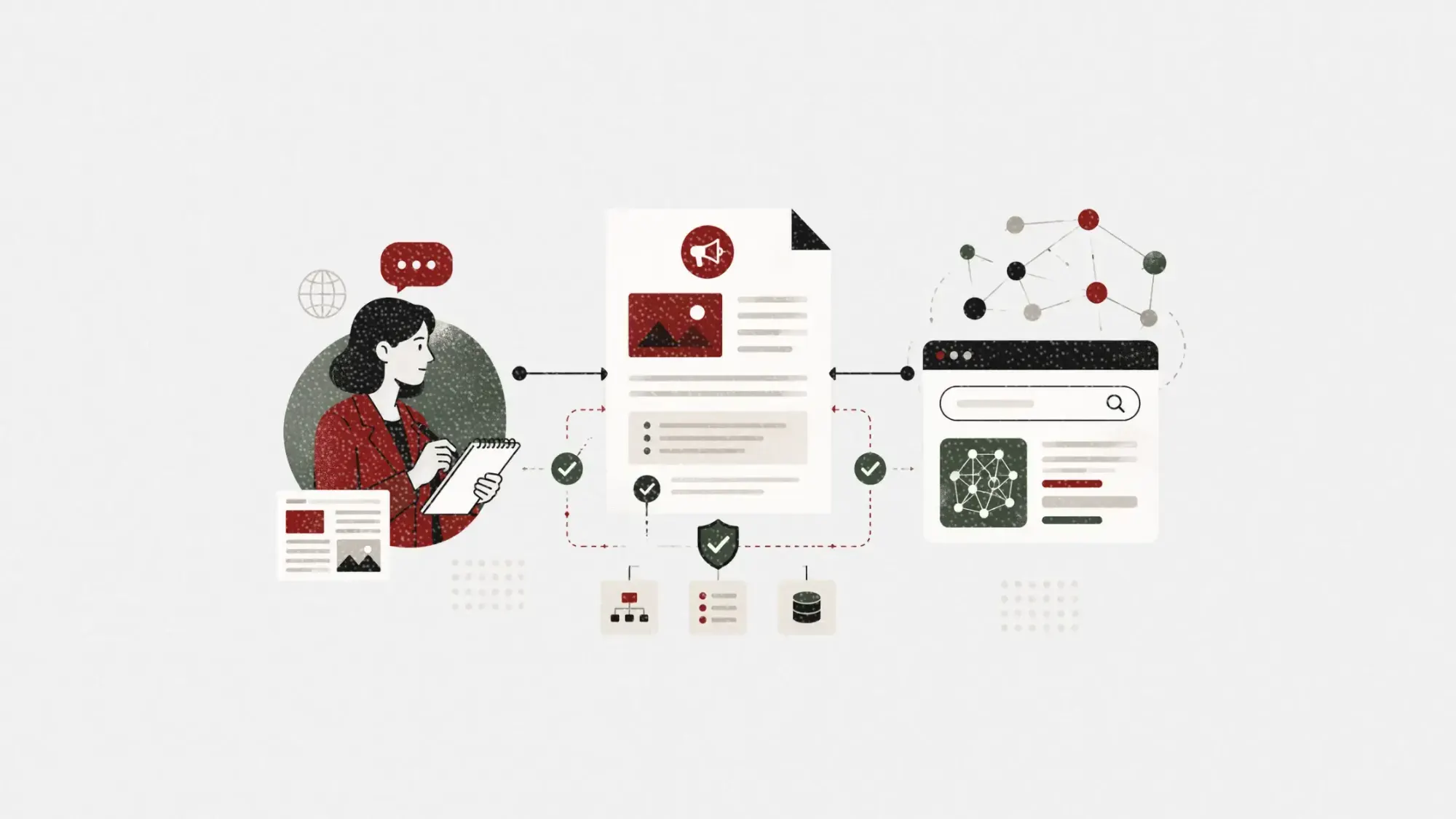
The boilerplate is the most ignored section of a press release. It sits at the bottom, after the news, after the quotes, after the call to action. Most PR teams write it once and forget it for years.
That is a problem, because the boilerplate is now doing two jobs at once: describing your company to a journalist who is deciding whether to cover you, and describing your company to an AI system that is deciding whether to cite you. Neither audience is forgiving of vague, outdated, or fluffy copy.
This guide covers what a strong press release boilerplate actually looks like, why the stakes have changed, and how to write one that works for both humans and machines.
Table of contents
Jump to each section:
- What is a press release boilerplate?
- Why the boilerplate matters more than most PR teams realize
- What AI search actually reads in your boilerplate
- The anatomy of a strong boilerplate
- Boilerplate examples: weak vs. strong
- Common boilerplate mistakes
- A checklist before you publish
 Enricko Lukman
What is a press release boilerplate?
A boilerplate is the short paragraph that appears at the end of a press release under the heading "About [Company Name]." It is a standardized, pre-approved summary of who your company is, what it does, and why it matters.
Think of it as your company's standing answer to the question journalists ask before they write anything: "So who are these people?"
A strong boilerplate typically covers four things in 75 to 100 words: what the company does, who it serves, a specific proof point or credential, and where to learn more. That is not much space, which is exactly the point. Every word has to earn its place.
Why the boilerplate matters more than most PR teams realize
According to Cision's 2024 State of the Media Report, 74% of journalists say receiving news announcements and press releases from PR professionals is valuable to their work. Press releases are still the primary vehicle through which companies get covered. The boilerplate is the part of that vehicle that gives journalists quick context on whether the story is worth pursuing.
But the stakes have grown beyond journalist relations. Since late 2024, generative AI tools including ChatGPT, Perplexity, and Google's AI Overviews have become standard research entry points for B2B buyers, investors, and media. In October 2025, PR Newswire announced an open-access policy explicitly designed to make press release content available for AI indexing, describing press releases as a "foundational source of truth" for the AI era.
The reasoning is straightforward: AI systems learn what a company is and does largely from the content that appears repeatedly and consistently across public sources. Your boilerplate is one of the most frequently repeated pieces of text your company puts into the world.
A weak boilerplate does not just confuse journalists. It trains AI systems to describe your company inaccurately.
What AI search actually reads in your boilerplate
This is where things get specific. According to Meltwater's research on AI press release optimization, generative engines like ChatGPT, Gemini, and Claude rely heavily on the first 75 to 100 words of a press release to determine what it is about, what matters, and whether it should surface in response to a user query. Every entity in that copy, including your company name, market focus, executive title, founding date, and location, helps AI verify your announcement and decide whether to summarize or cite it.
The implication for boilerplate writing is concrete. AI systems do not infer. They extract. If your boilerplate says you are "a leading innovator in next-generation solutions," an AI model cannot do anything useful with that. If your boilerplate says you are "a Singapore-based B2B SaaS company serving mid-market logistics teams across Southeast Asia," the model can place you accurately in response to relevant queries.
Consistency matters too. The same company name format, the same market description, and the same founding details appearing repeatedly across press releases help AI associate the correct facts with your brand. Inconsistency across releases creates conflicting signals, which is how companies end up being described incorrectly in AI-generated summaries.
The anatomy of a strong boilerplate
A well-built boilerplate has a clear internal structure, even if it reads as a single paragraph.
1 .Sentence one: identity and category
Name the company, state when it was founded if the age adds credibility, and name the specific category it operates in. Avoid adjectives that do not carry information. "Leading," "innovative," and "cutting-edge" tell a journalist or an AI nothing they can use.
Weak: Nexara is a leading provider of innovative workforce solutions.
Stronger: Nexara is a workforce management software company founded in 2018, serving mid-size manufacturers across the United States and Canada.
2. Sentence two: what you actually do
Be specific about the product or service and the problem it solves. Name the customer if you can.
Weak: We help companies work smarter.
Stronger: Its platform automates shift scheduling and compliance tracking for factories with 500 to 5,000 hourly workers.
3. Sentence three: a proof point
A real number, a real award, or a real partnership. Not a superlative, not a claim you cannot back up.
Weak: Nexara is trusted by companies worldwide.
Stronger: The company serves more than 300 clients across 18 industries and has been recognized on Deloitte's Technology Fast 500 for two consecutive years.
4. Sentence four: where to go
A clean URL, nothing more. Do not stuff keywords into this line.
Example: For more information, visit nexara.com.
Boilerplate examples: weak vs. strong
Here are side-by-side comparisons across different company types.
1. B2B SaaS
Weak: TechFlow is a dynamic and innovative company committed to transforming the digital landscape with world-class enterprise software solutions. Our passionate team of experts delivers value-driven products that empower businesses to achieve their goals. Learn more at techflow.com.
Strong: TechFlow is an enterprise procurement software company founded in 2016, serving procurement teams at Fortune 1000 manufacturers and distributors. Its platform consolidates purchase order management, supplier onboarding, and spend analytics into a single workflow, reducing procurement cycle time by an average of 40%. TechFlow is headquartered in Chicago and currently serves clients in 14 countries. Learn more at techflow.com.
Why it works: the strong version names a specific buyer persona (procurement teams at Fortune 1000 manufacturers), a specific function (purchase order management, supplier onboarding, spend analytics), and a specific outcome (40% reduction in cycle time). A journalist covering supply chain software can immediately tell whether this is relevant. An AI model can accurately categorize this company in response to procurement-related queries.
2. Healthtech startup
Weak: Medara Health is a next-generation health technology company using artificial intelligence to revolutionize patient care. We are dedicated to improving outcomes and reducing costs for health systems everywhere.
Strong: Medara Health is a clinical decision support company founded in 2021, helping hospitalists at US acute-care facilities reduce diagnostic delays for sepsis and pneumonia. Its AI-assisted triage tool is deployed in 47 hospitals across 12 states and holds FDA 510(k) clearance. Medara Health is based in Boston. For more information, visit medarahealth.com.
Why it works: it names the buyer (hospitalists at acute-care facilities), the specific problem being solved (diagnostic delays for sepsis and pneumonia), deployment scale (47 hospitals), and a significant credential (FDA clearance). Any of those details could become a search query. Each one helps an AI system surface this company accurately.
3. Professional services firm
Weak: Cornerstone Advisory Partners is a premier management consulting firm with a proven track record of delivering transformational results for clients across industries. Our team combines deep expertise with innovative thinking to help organizations reach their full potential.
Strong: Cornerstone Advisory Partners is a Singapore-based management consultancy specializing in post-merger integration and operational turnarounds for private equity-backed companies in Southeast Asia. Since 2015, the firm has advised on more than 80 transactions across manufacturing, logistics, and consumer goods. For more information, visit cornerstoneap.com.
Why it works: specialization (post-merger integration and operational turnarounds), buyer (private equity-backed companies), geography (Southeast Asia), and a track record number (80 transactions) make this easy for both a journalist and an AI to interpret correctly.
Common boilerplate mistakes
- Using superlatives without evidence
Words like "leading," "premier," and "top" are not just vague, they are now actively counterproductive. Journalists see through them immediately, and AI systems cannot index them as meaningful signals.
- Letting it go stale
A boilerplate that references a product you discontinued two years ago or a market position you no longer hold creates credibility problems with journalists and accuracy problems for AI. Treat it like product copy: review it quarterly.
- Optimizing it for impressiveness rather than accuracy
The boilerplate is not a sales pitch. It is a factual summary. The goal is not to make the company sound important. It is to make the company easy to understand and easy to find.
- Writing it once and reusing it verbatim across every release
This is actually fine for consistency, but only if the boilerplate is accurate and specific in the first place. The mistake is reusing a weak boilerplate because updating it feels like low-priority work.
- Cramming in too many claims
A boilerplate that tries to communicate five different value propositions communicates none of them clearly. One category, one buyer, one proof point, one URL.
A checklist before you publish
Before any press release goes out, run your boilerplate through these questions:
- Does it name the company and the specific category it operates in, without adjectives?
- Does it name the customer or market being served?
- Does it include at least one verifiable proof point: a number, a credential, or a named partner?
- Is every claim in it still accurate as of today?
- Is the company name formatted exactly as it appears across your website, LinkedIn, and previous press releases?
- Is the URL clean and direct?
- Is it under 100 words?
If you cannot answer yes to all of these, the boilerplate needs work before the release goes out.
The boilerplate is the one piece of copy that represents your company in almost every formal communication you issue. It travels with your announcements into newsrooms, into journalist inboxes, into AI training data, and into search indexes. It is the paragraph that defines how the world understands your company when no one from your team is in the room.
Most companies write it in twenty minutes and never look at it again. The ones that treat it with the same care they bring to their homepage copy tend to have a much easier time getting accurately covered and accurately cited, by both journalists and the AI tools they increasingly rely on.