The anatomy of a 7-figure B2B influencer marketing program
Inside a 7-figure B2B influencer program: org chart, budget split, and operating rituals

Most B2B influencer programs are built one campaign at a time. A creator is identified, a brief is written, a post goes live, and the team moves on. That model produces data points. It does not produce compounding pipeline influence.
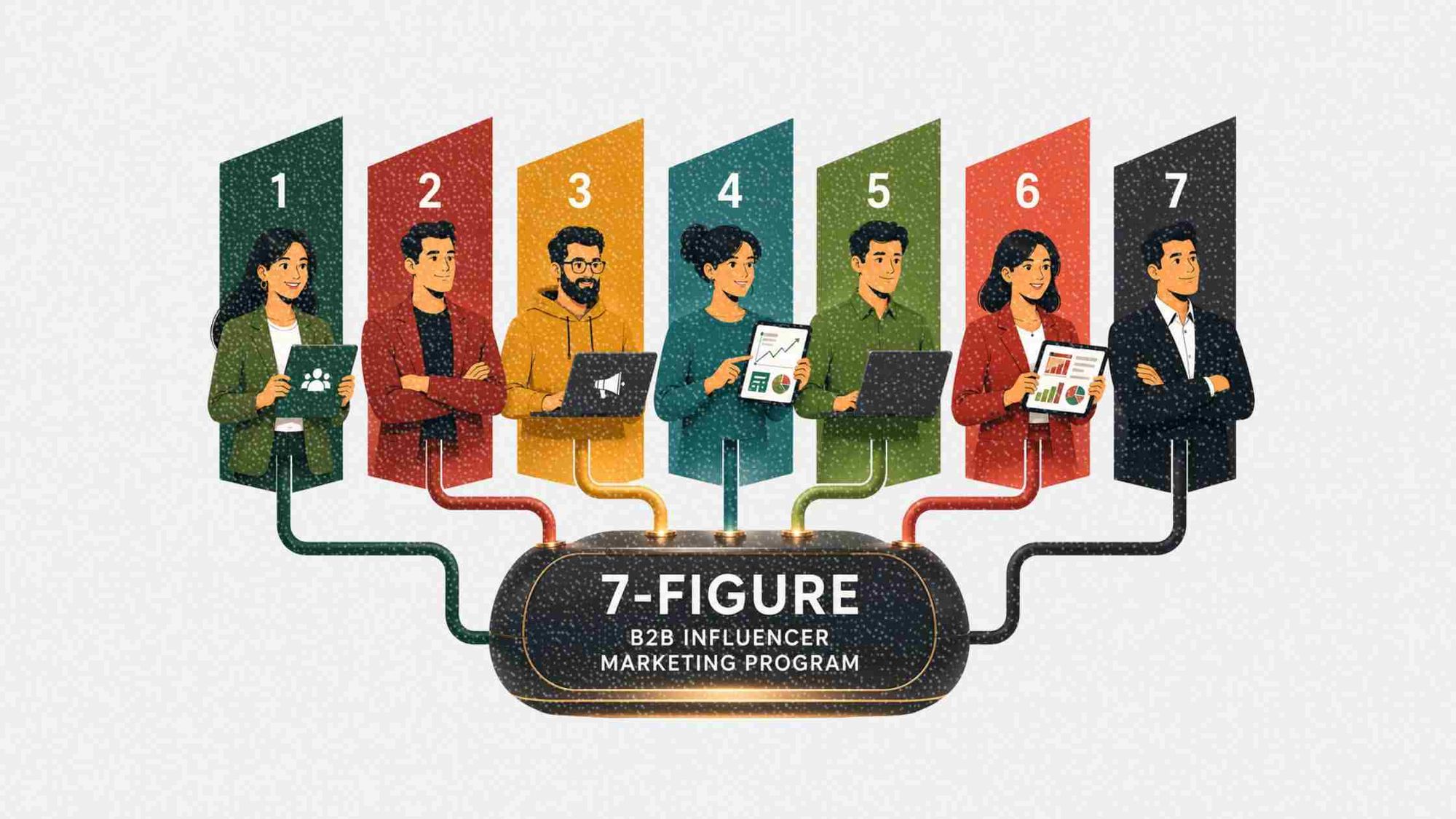
The brands spending seven figures on creator partnerships are doing something structurally different. They have moved past the campaign mindset entirely and built programs with defined org charts, diversified creator rosters, split budgets that fund amplification alongside creator fees, and quarterly rituals that treat influencer marketing like a revenue channel rather than a content experiment.
This piece reverses-engineers that structure: what it looks like in practice, how it is resourced, how advanced brands like Salesforce, Adobe, and Nextiva have built it, and what the path looks like for teams earlier in the journey.
Table of contents
Jump to each section:
- What a 7-figure B2B influencer program actually means
- The org chart: who owns the program
- The creator roster: composition, size, and selection
- The budget split: how advanced programs allocate spend
- The operational rituals that drive consistency
- Attribution and reporting: connecting creator activity to pipeline
- How Salesforce, Adobe, and Nextiva built their programs
- What to build first if you are not there yet
What a 7-figure B2B influencer program actually means
Seven figures is not just a budget threshold. It is a maturity signal. It indicates a program that has moved through the experimental phase, survived a budget review by presenting pipeline data, and earned enough organizational trust to be treated as a recurring investment rather than a discretionary line item.
According to the TopRank Marketing 2025 B2B Influencer Marketing Report, 85% of US B2B marketers now incorporate influencer marketing into their strategy, up from 34% in 2020. But adoption rate does not reveal maturity. The more useful signal is this: 43% of B2B marketers report outstanding results from their influencer programs, a jump of nearly ten percentage points from the prior year. Among companies with mature programs specifically, that number climbs to 79%. Maturity, not spend level alone, drives the performance gap.
What separates a mature, high-budget B2B influencer program from a well-funded experiment is not the number of creators or the size of the posts. It is whether the program functions as an integrated operating layer across demand generation, content, paid media, and sales, or whether it sits in a social media bucket that nobody is quite sure how to measure.
 Ariana Sorensen
The org chart: who owns the program
One of the most reliable indicators of program maturity is where it sits in the organization. Early-stage programs are typically owned by a social media manager or a content specialist. Mature programs have a dedicated function with cross-functional accountability.
In a 7-figure B2B program, the org chart typically looks like this.
A program lead at the senior manager or director level owns strategy, creator relationships, and executive reporting. This person is not a content coordinator. They are a program architect who understands pipeline metrics, can speak to finance in the language of influenced revenue, and has the authority to negotiate long-term creator contracts.
A creator success manager handles day-to-day relationships, brief delivery, content review, and performance tracking across the active roster. At scale, this role is distinct from the program lead because creator relationship management is operationally intensive. A 15-creator roster with four to six deliverables per creator per quarter generates enough workflow to justify dedicated attention.
A paid amplification specialist manages the budget allocated to Thought Leader Ads, Spark Ads, and other paid formats that extend creator content beyond organic reach. This is not a nice-to-have at seven figures. Organic LinkedIn reach has declined significantly, and amplification is the mechanism that makes creator content reach the full relevant audience.
Legal and compliance sits outside the program team but is a regular collaborator, covering FTC disclosure requirements, usage rights language, exclusivity clauses, and AI-content disclosure provisions now appearing in 2025-2026 contracts.
The program connects upward to demand generation and sales operations, because pipeline influence reporting requires CRM access. In mature programs, the influencer lead has a standing relationship with RevOps that most smaller programs never establish.
The creator roster: composition, size, and selection
A 7-figure B2B influencer program does not run 50 creators. It runs a small, high-fit roster built for quality over quantity. Based on available data from programs documented by TopRank Marketing and other practitioner sources, the optimal roster size for enterprise programs sits between eight and fifteen creators, with most budgets concentrated on a core group of five to eight who post consistently throughout the year.
The creator types in a mature B2B roster fall into three categories.
Operator-creators are the highest-value tier for most B2B programs. These are working practitioners: founders, senior practitioners, and independent consultants who post regularly on LinkedIn about the problems your product solves. Their audiences are small by consumer standards, often between 5,000 and 50,000 followers, but the audience composition is dense with decision-makers.
A RevOps consultant with 11,000 LinkedIn followers whose audience is predominantly VPs of Sales and CFOs at mid-market SaaS companies is not comparable to a general business influencer with 500,000 followers and a mixed audience.
Industry analysts and category experts carry significant bottom-funnel weight. According to the LinkedIn and Ipsos 2025 B2B Marketing Benchmark: The Influence Report, thought leaders and industry analysts are rated the most effective influencer type by 28% of B2B marketers. They are expensive and slower to activate, but their endorsements carry disproportionate influence when a buying committee is conducting final vendor evaluation.
Customer influencers are existing buyers who have built a LinkedIn following while talking publicly about their professional work. They are the most credible type but also the most difficult to source systematically. Mature programs invest in identifying customers who are active LinkedIn creators before running any other sourcing activity.
Selection criteria at this level are ICP-first, not reach-first. The question that drives every creator evaluation is: what percentage of this creator's audience matches our ideal customer profile by job title, industry, and company size? Programs that skip this filter in favor of headline follower counts consistently underperform and cannot explain their results to finance.
The budget split: how advanced programs allocate spend
The creator fee is the most visible line item but rarely the largest. In a mature 7-figure program, the budget typically distributes across five categories.
Creator fees account for roughly 40 to 50% of total program spend. A long-term partnership with a senior operator-creator in a specialized B2B niche commands significantly more than equivalent follower counts on consumer platforms. The premium exists because the audience is more valuable. Finance, SaaS, and enterprise software categories typically run 2 to 3 times baseline influencer rates compared to consumer niches.
Paid amplification accounts for 20 to 30% of total spend. This is the category most under-resourced in early-stage programs and most firmly established in mature ones. LinkedIn Thought Leader Ads, which allow brands to promote individual posts from third-party creators, are the primary format. A creator post without amplification reaches a fraction of the relevant audience. Amplification is what converts a quality piece of creator content from an organic reach event into a sustained pipeline touchpoint.
Operations and tooling account for 10 to 15% of total spend. An influencer marketing tech stack at this scale covers creator discovery and vetting tools, campaign management infrastructure, attribution platforms, and CRM integration. The operational overhead of managing a multi-creator always-on program without dedicated tooling becomes a constraint on scale, not just an efficiency issue.
 Ariana Sorensen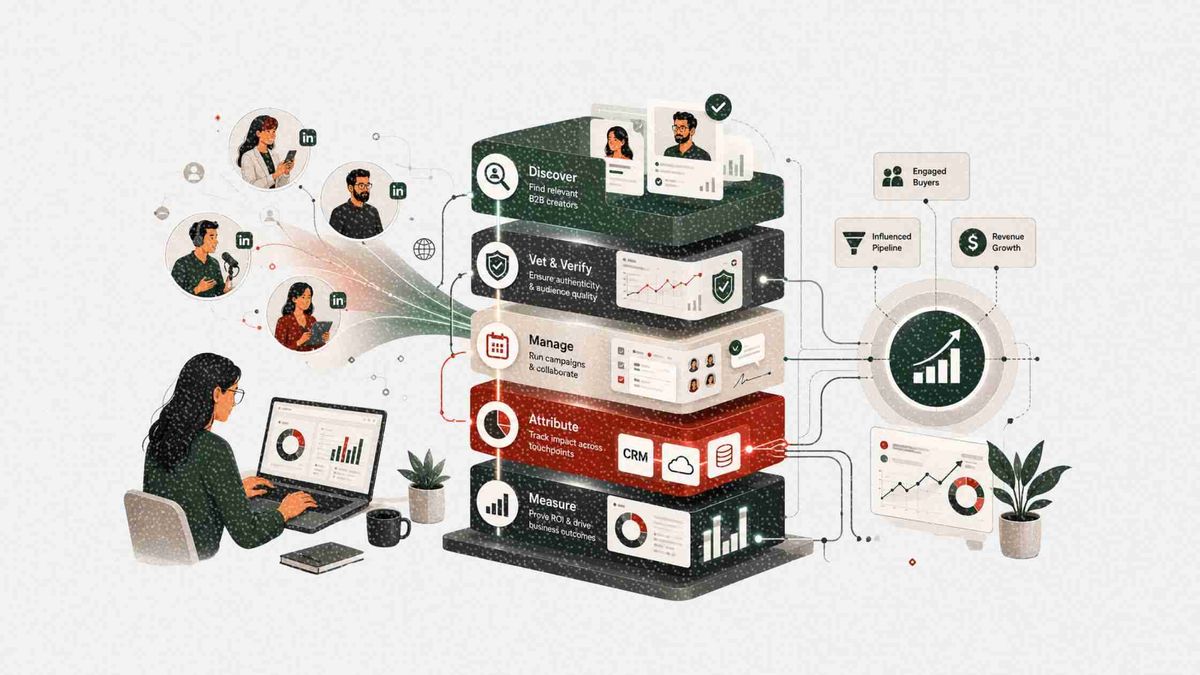
Content production and rights usage account for 5 to 10% of total spend. Mature programs negotiate broad content usage rights in the original creator contract, typically covering 12 to 24 months of repurposing across paid social, sales enablement assets, and landing pages. The investment in rights at the contract stage is always less expensive than renegotiating after the content performs.
Legal and compliance, reporting, and miscellaneous program overhead account for the remaining 5%.
The operational rituals that drive consistency
The most durable finding from TopRank Marketing's multi-year research into B2B influencer programs is that the single most predictive variable for program effectiveness is not budget, platform, or creator quality. It is consistency. According to the 2025 B2B Influencer Marketing Report, 99% of B2B marketers using an always-on approach rate their programs as effective. Marketers who do not use an always-on approach are 17 times more likely to describe their program as ineffective.
Always-on does not mean constant content production. It means consistent creator presence across the buying cycle, maintained through a set of operational rituals that prevent the program from going dark between campaign pushes.
The quarterly narrative planning session is the anchor ritual. Four times per year, the program lead works with product marketing to align creator content with the commercial narrative for the coming quarter. This does not mean scripting creators or building a brief around product talking points. It means identifying the buyer problems and category themes that the product naturally addresses, and sharing those with the creator roster as orientation material rather than instruction.
The monthly creator check-in is a 30-minute call or async message between the creator success manager and each active creator. The purpose is relationship maintenance, not deliverable tracking. Mature programs understand that the quality of creator content correlates with the depth of the creator's genuine understanding of the brand and its buyers. That understanding is built through repeated conversation, not briefing documents.
The weekly amplification review ensures that high-performing organic creator posts are queued for Thought Leader Ad promotion within 48 hours of publication. Mature programs do not wait for a campaign period to amplify creator content. They have a standing Thought Leader Ad budget and a process for moving strong content into paid promotion quickly.
The quarterly pipeline influence review is where the program justifies its budget. The program lead presents creator-influenced pipeline data to the CMO and RevOps lead: number of open opportunities where at least one creator touchpoint was documented, deal velocity comparison between creator-influenced and non-influenced prospects, and cost per influenced opportunity against the equivalent cost from other acquisition channels.
"What B2B teams building to this scale often underestimate is that the program's ability to prove itself comes down to decisions made before the first brief is sent," says Dinda Anandita, Account Director at content-led comms agency Content Collision. "CRM tagging, UTM taxonomy, attribution window settings: these are not measurement afterthoughts. They are the architecture that lets the program survive a budget review in quarter three."
Attribution and reporting: connecting creator activity to pipeline
A 7-figure B2B influencer program cannot be measured with the same KPIs as a consumer campaign. According to the Dreamdata and LinkedIn 2025 B2Believe Benchmarks, the average B2B path to purchase spans 211 days across 76 tracked touchpoints. A 30-day attribution window, the default in most social platforms, captures a fraction of the influence that an always-on creator program generates.
Mature programs use three measurement layers.
The first is UTM-based attribution, which tracks every creator-specific link click back to a contact record in the CRM. This layer captures the measurable fraction of creator influence: clicks to landing pages, gated content downloads, trial signups, and demo requests that arrive via tagged creator links.
The second is CRM-based pipeline influence tracking. Every contact who engages with a creator touchpoint before entering the CRM as a lead is tagged with a creator influence flag. The program then tracks whether creator-influenced contacts convert to qualified opportunities at a higher rate and close faster than non-influenced contacts.
This layer does not require click attribution. It requires consistent CRM tagging from day one and an attribution window that matches the actual sales cycle.
The third is self-reported attribution, capturing the dark funnel: the prospects who saw a creator post in a Slack channel, forwarded it to a colleague, and arrived at a demo request form without a single trackable click in between. This is typically captured through "how did you hear about us?" fields and post-demo sales call notes. It consistently reveals creator influence that UTM attribution misses entirely.
The reporting format that earns executive buy-in combines these three layers into a single slide: creator-influenced pipeline as a percentage of total pipeline, cost per influenced opportunity compared to other acquisition channels, and deal velocity differential.
That comparison, showing creator-influenced opportunities closing days or weeks faster than cold leads, is frequently the argument that secures next year's budget increase.
 Ariana Sorensen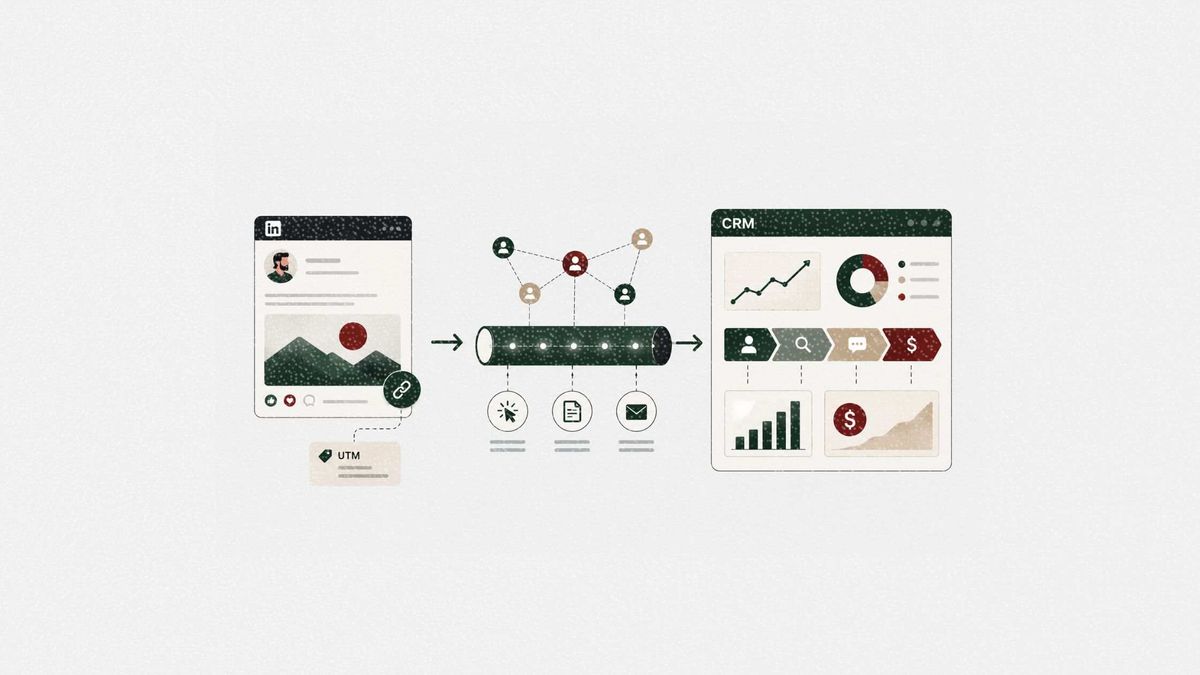
How Salesforce, Adobe, and Nextiva built their programs
These three cases represent different entry points to the 7-figure program structure, but each illustrates a distinct principle.
Salesforce: community as the creator layer
Salesforce built one of the most recognized B2B influencer programs by treating its existing community of expert users as the creator roster. The Trailblazers program organizes certified practitioners, community group leaders, and event speakers into an advocacy network that functions as an always-on influence layer.
The Dreamforce Goes Corporate campaign demonstrated how this approach produces enterprise-scale results, winning Hello Partner's Best B2B Influencer Marketing Campaign award. The program combined employee voices with micro-influencer creator content, generating authentic resonance with professional audiences because it drew from real practitioners rather than constructed partnerships.
The lesson: the highest-credibility creator roster is often already in your customer base. Identifying buyers who have built LinkedIn audiences and activating them through structured community programs is frequently faster than building an external creator network from scratch.
Adobe: influencer content as demand generation
Adobe's B2B influencer program, run in partnership with TopRank Marketing, pursued measurable demand generation from creator-led content. In a documented EMEA campaign targeting over 900 accounts, Adobe co-created an influencer hero asset featuring contributions from named industry experts including tech columnists and analysts.
The result, documented in TopRank's published case study with a named Adobe source: the influencer-led content generated 2 times the engagement of comparable Adobe campaigns and increased LinkedIn form completions by 150%.
The lesson: influencer content built around a specific buyer problem and amplified into a defined target account list produces outcomes the C-suite understands. The brief was built around buyer questions, not brand messages.
Nextiva: LinkedIn Thought Leader Ads as a scale mechanism
Nextiva's approach illustrates how paid amplification transforms creator content from an organic reach event into a sustained pipeline influence engine. The company sponsored video content from internal subject matter experts through LinkedIn Thought Leader Ads and documented 5,600% growth in influenced sales pipeline, according to TopRank Marketing's analysis.
The same content that would reach a fraction of the relevant audience as an organic post reaches its full potential audience when deployed as a Thought Leader Ad with proper ICP targeting.
The lesson: amplification is not optional at seven figures. Programs that generate pipeline results treat paid amplification as a core budget line, not an add-on.
What to build first if you are not there yet
The 7-figure program structure described in this piece did not emerge fully formed. It was built sequentially, and the sequence matters.
The first decision is attribution architecture. Before briefing a single creator, build the UTM taxonomy, map the CRM fields for creator-influenced contact tagging, and set the attribution window to match your actual sales cycle. Skipping this step creates an unfixable measurement gap that surfaces at the worst possible moment.
The second decision is creator selection. Start with three to five operator-creators in your core buyer segment. Prioritize audience composition over follower count in every selection decision. A creator with 8,000 LinkedIn followers where 65% are your ICP is worth more than one with 80,000 mixed followers.
The third decision is always-on architecture. Set a posting cadence that maintains creator presence across the full buying cycle. Even a small program with three creators and eight posts per month is always-on if the cadence is maintained quarterly.
The fourth decision is amplification budget. Allocate a fixed monthly budget for Thought Leader Ads before the first post goes live. Even US$2,000 to US$5,000 per month in amplification extends reach significantly and establishes the discipline that scales into the paid amplification infrastructure of a mature program.
According to the TopRank 2025 B2B Influencer Marketing Report, 72% of B2B marketers with the most advanced influencer programs expect their budgets to grow in the coming year. The brands that reach seven figures do not do so by spending their way there. They do so by measuring their way there, one quarter at a time.